
 en
 русский
 Español
 Deutsch

Heavy-Duty Tool Bag with Rigid Base and Adjustable Shoulder Strap
Content
- 1 Introduction: A Professional Storage Solution for Demanding Work
- 2 Design Priorities for Professional Tool Storage
- 3 High-Grammage Polyester Fabric for Long-Term Use
- 4 The Injection-Molded Rigid Base
- 5 Organization Through 19 Individual Pockets
- 6 Open-Top Access for Faster Job-Site Workflow
- 7 Carrying Comfort: Tubular Handle and Padded Shoulder Straps
- 8 Load Capacity and Practical Capacity Planning
- 9 Advantages Over Conventional Tool Bags
- 10 Suitable Applications
- 11 Manufacturing Expertise and Customization Strengths
- 12 Research and Development Capabilities
- 13 Production Quality and Compliance Infrastructure
- 14 Production Process for a Heavy-Duty Tool Bag
- 15 Customization for Global Buyers
- 16 Care and Use Recommendations
- 17 Product Specification Table
- 18 Why the T004 Is a Strong Choice for Professional Buyers
- 19 Frequently Asked Questions
- 19.1 What type of tool bag is the T004?
- 19.2 What are the dimensions of the bag?
- 19.3 How much weight can the bag carry?
- 19.4 Is the bag waterproof?
- 19.5 How many pockets does the T004 have?
- 19.6 Is the top closed with a zipper?
- 19.7 Who can use this tool bag?
- 19.8 What is the advantage of the rigid base?
- 19.9 Are the shoulder straps adjustable?
- 19.10 Can the color be customized?
- 19.11 Can the bag be customized for a private-label brand?
- 19.12 What manufacturing experience does the supplier have?
- 19.13 Does the company develop new products?
- 19.14 Does the company have third-party audit experience?
- 20 Conclusion
- 21 References
- 22 Product: Heavy-Duty Tool Bag with Rigid Base and Adjustable Shoulder Strap
Introduction: A Professional Storage Solution for Demanding Work
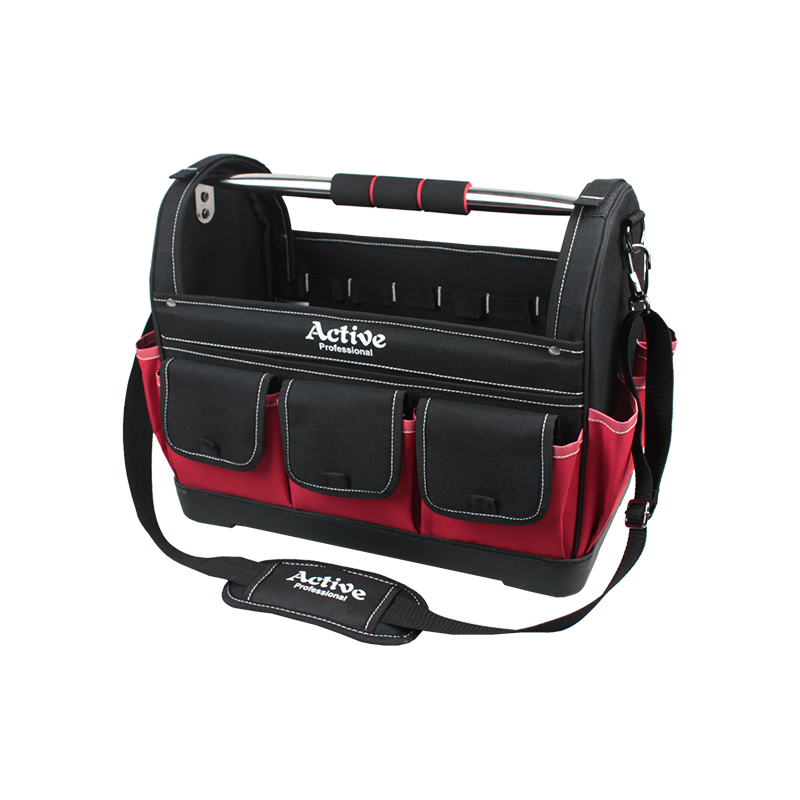
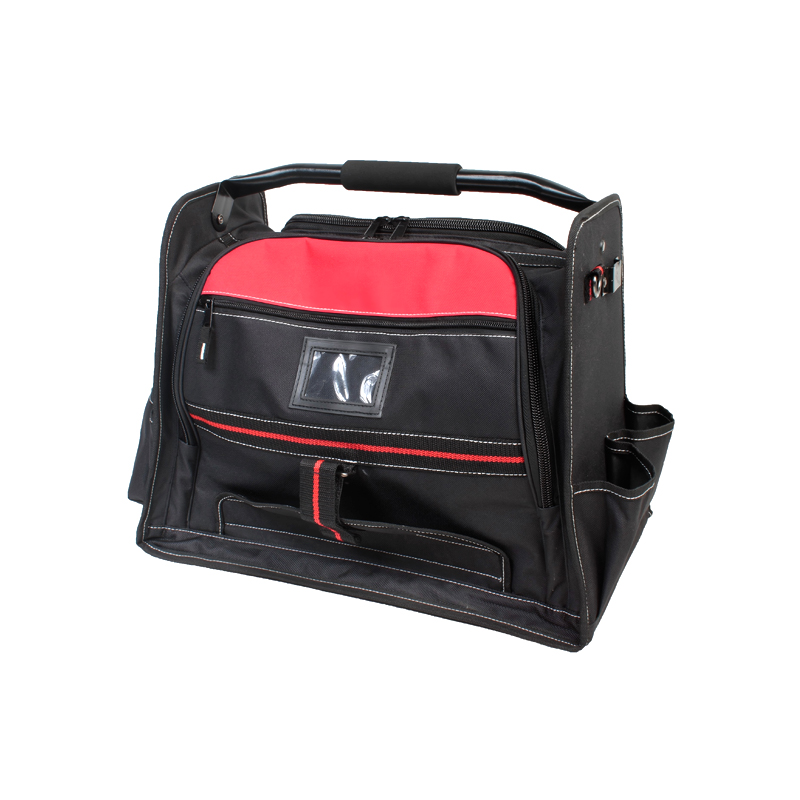
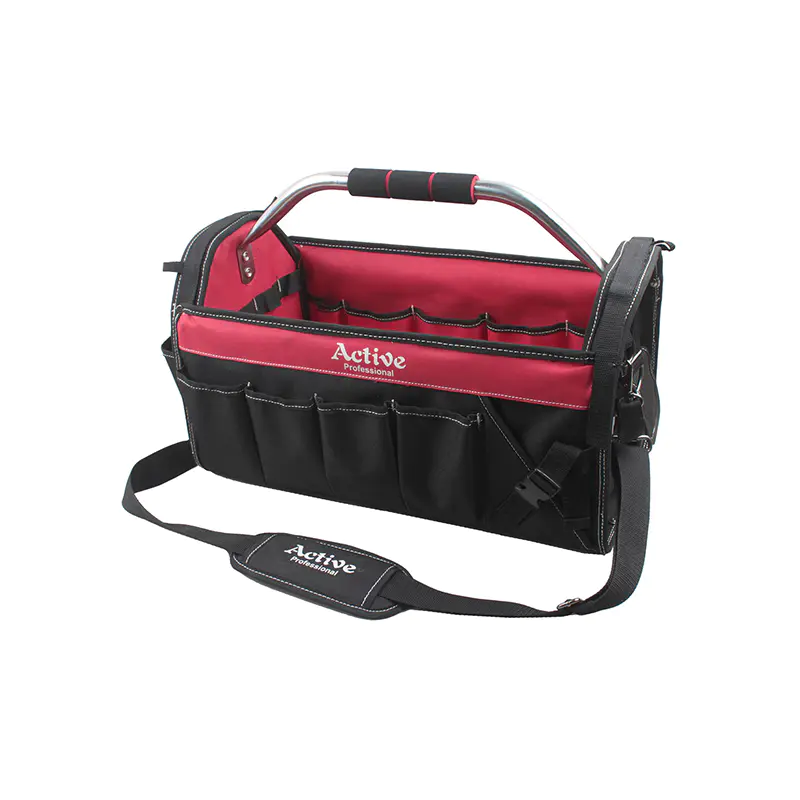
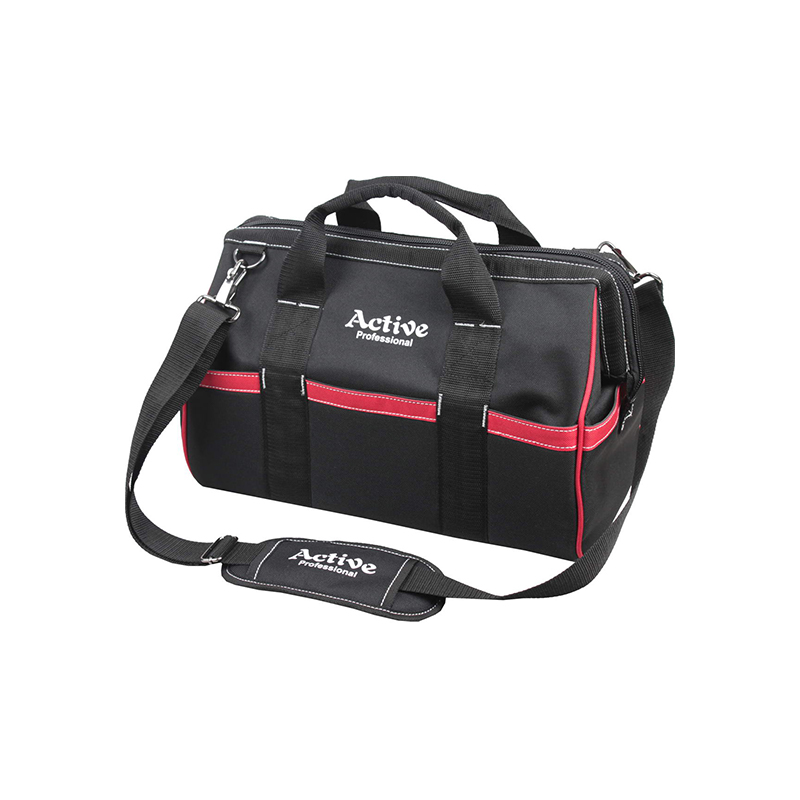
Professional tradespeople depend on their tools every day. Electricians, woodworkers, maintenance technicians, installers, contractors, and service specialists need more than a simple container for carrying equipment from one job site to another. They need a storage solution that protects tools, keeps frequently used items accessible, remains stable on uneven surfaces, and stays comfortable to transport when fully loaded. The T004 heavy-duty tool bag is designed to meet these practical requirements through a combination of high-grammage polyester fabric, an injection-molded rigid base, multiple organized pockets, a padded tubular handle, and adjustable shoulder straps.
With dimensions of 44 x 25 x 34 cm and a stated load capacity of 44.09 lbs, the bag provides a useful balance between storage volume and portability. Its open-top construction supports quick access during active work, while its 19 pockets help separate hand tools, accessories, fasteners, and medium-sized power tools. Instead of forcing users to search through one large compartment, the layout encourages a more organized working method.
The T004 is categorized as a tool bag with a tubular handle, but its design offers more than a reinforced carrying point. The padded handle supports hand transport, while the adjustable and padded shoulder straps provide another carrying option. This dual-carrying design is particularly valuable for professionals who move between vehicles, workshops, construction areas, service rooms, and elevated or restricted work locations.
Its most distinctive feature is the injection-molded hard base. Many conventional soft tool bags use fabric-covered bottoms that can sag under weight, absorb moisture, or become unstable when placed on muddy, wet, or rough surfaces. The rigid base of the T004 helps the bag retain its shape, supports heavier loads, and creates a protective barrier between tools and the ground. This structural improvement makes the bag suitable for demanding environments where ordinary fabric bags may quickly lose their performance.
Heavy-Duty Tool Bag with Rigid Base and Adjustable Shoulder Strap
Design Priorities for Professional Tool Storage
A professional tool bag must solve several problems at the same time. It must be spacious enough for essential equipment without becoming unnecessarily bulky. It must protect tools from the impact of transportation and daily use. It should allow users to identify and retrieve tools efficiently. It also needs to withstand repeated lifting, loading, unloading, and exposure to dust, moisture, abrasion, and changing work conditions.
The T004 addresses these priorities through a practical, work-oriented structure. Its open-top configuration eliminates the delay associated with opening and closing a full-length zipper every time a tool is needed. This is especially useful for electricians and woodworkers who may need to reach for screwdrivers, pliers, measuring tools, cutters, or accessories repeatedly during a task.
Open-top bags also make it easier to see the general contents of the main compartment. A worker can place frequently used tools inside the central storage area while using the outer pockets for small items or tools that need to remain within immediate reach. The result is a flexible arrangement that can be adjusted according to the job rather than being restricted by a fixed internal layout.
The 44 x 25 x 34 cm format gives the bag enough height and depth for medium-sized power tools and a broad selection of hand tools. At the same time, the shape remains practical for transport in a vehicle, workshop, storage room, or job-site staging area. The reinforced form helps prevent the walls from collapsing inward when the bag is partially filled, making it easier to load and unload equipment.
Unlike a basic utility tote, the T004 is designed around the specific carrying behavior of trade professionals. Its structure supports repeated handling, while its organization features help reduce wasted time. The bag is not intended merely to hold tools; it is intended to support a more efficient workflow.
High-Grammage Polyester Fabric for Long-Term Use
The main body of the T004 is made from high-grammage polyester fabric. Material selection is one of the most important factors in tool bag performance because the fabric must tolerate friction, contact with sharp tool edges, repeated folding or loading, and the weight of the contents. Lightweight fabric may be adequate for occasional household use, but professional tool storage requires a stronger construction.
High-grammage polyester offers a useful combination of tear resistance and abrasion resistance. In a work environment, the bag may be placed on concrete, timber, metal platforms, vehicle floors, workshop benches, or unfinished ground. It may rub against walls, shelving, toolboxes, and other equipment. The stronger fabric helps the bag maintain its appearance and functional integrity under these repeated conditions.
Polyester is also suitable for manufacturers seeking a consistent base material for customized products. It can support different colors, branding treatments, pocket arrangements, reinforcement details, and production specifications. Since the T004 is available with a customized color option, the material platform can support the needs of distributors, retailers, and professional brands that require visual consistency across a product range.
The fabric works together with structural reinforcement rather than operating as the only protective element. The rigid base absorbs much of the stress associated with setting the bag down and carrying heavy contents. The padded handle and shoulder straps help distribute handling forces. The pockets divide the load and reduce the need to stack every tool in one congested compartment. This integrated approach is more effective than relying on fabric thickness alone.
For users, fabric durability translates into a longer service life and more dependable performance. For business customers, it can also help reduce product returns associated with premature tearing, deformation, or poor wear resistance. A heavy-duty tool bag must be judged by how it performs after repeated use, not only by how it looks when new.
The Injection-Molded Rigid Base
The rigid base is the defining engineering feature of the T004. It is injection molded to create a firm, stable lower structure that supports the bag and its contents. This design is especially important when the bag is carrying a substantial load or is placed on a wet, muddy, dusty, or uneven surface.
A conventional soft-bottom bag may lose its shape when filled with heavy tools. The center can sag, the sidewalls may lean inward, and the bag may become difficult to load. A rigid base helps counter these problems by creating a stable platform. The bag can stand more securely, and users can place tools inside without constantly holding the sides apart.
The hard bottom also contributes to moisture protection. It helps lift the main fabric body away from direct contact with wet ground, reducing the chance that surface moisture will immediately penetrate the underside. This does not mean the bag should be treated as fully waterproof or submerged. However, the base provides a meaningful advantage in ordinary job-site situations where the bag may be placed on damp concrete, grass, soil, or muddy ground.
Another benefit is improved load distribution. Heavy tools create concentrated pressure, particularly when the bag is carried or set down. The injection-molded base helps spread this pressure across the lower structure, reducing distortion and supporting the bag’s overall form. This contributes to stability during transport and can reduce the mechanical stress placed on the fabric around the bottom panel.
Compared with soft tool bags that depend on a thin fabric base, the T004 offers better resistance to deformation and ground contact. Compared with hard toolboxes, it offers greater flexibility and easier access. This middle position is one of its strongest competitive advantages: users receive a structured lower platform without giving up the portability and accessibility of a fabric bag.
Organization Through 19 Individual Pockets
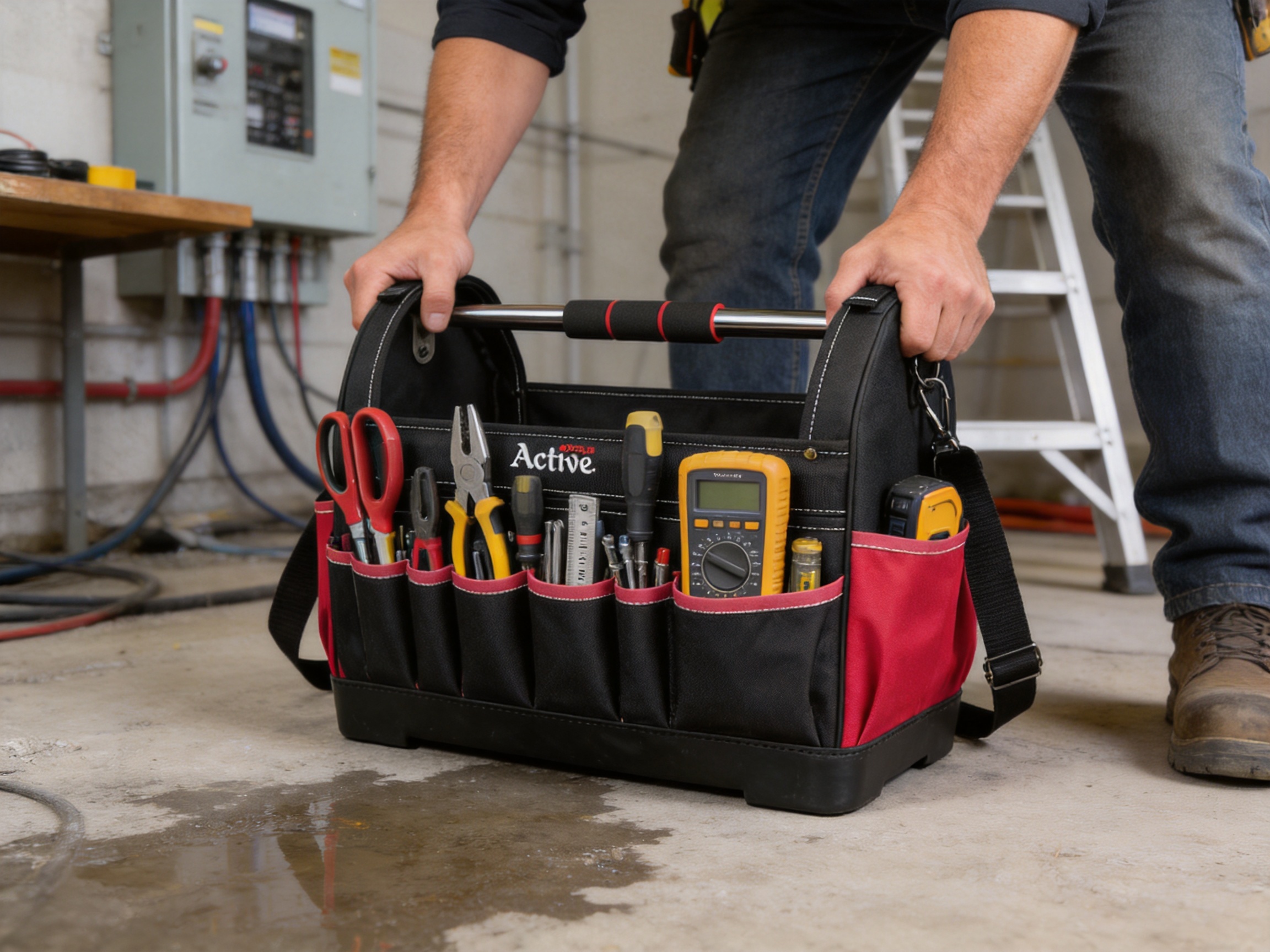
The T004 includes 19 individual pockets, consisting of 11 exterior pockets and 8 interior pockets. This arrangement helps users build a storage system around the tools they use most often. External pockets are suitable for items that need to be reached quickly, while internal pockets can be used for tools and accessories that benefit from additional separation inside the main compartment.
For electricians, the external pockets can accommodate screwdrivers, pliers, wire cutters, measuring instruments, electrical testers, and other frequently used hand tools. The internal pockets can help separate spare components, fasteners, small accessories, or tools that should remain protected within the main body of the bag.
Woodworkers can organize chisels, marking tools, measuring tapes, screwdrivers, clamps, small power-tool accessories, and sanding supplies according to the requirements of a particular project. The open top makes it possible to keep larger tools in the central compartment while using the pockets to prevent smaller tools from disappearing beneath them.
The value of multiple pockets is not only convenience. Organization helps protect tools from unnecessary contact. When every item is placed in one large compartment, metal tools can strike one another during transport. Sharp edges may damage fabric or other equipment, and small items may become difficult to locate. Pocket separation supports a more deliberate arrangement and can reduce time spent searching.
Of course, the best result depends on how the bag is packed. Heavier items should generally be positioned low and near the center, while frequently accessed items should be placed in the external or upper-access areas. The pockets are designed to give users more choices, not to impose a single storage method.
Compared with a basic open tote with no internal organization, the T004 provides a more professional carrying experience. Compared with highly compartmentalized hard cases, it offers greater flexibility for tools with irregular shapes. This makes it appropriate for workers whose equipment changes from one assignment to another.
Open-Top Access for Faster Job-Site Workflow
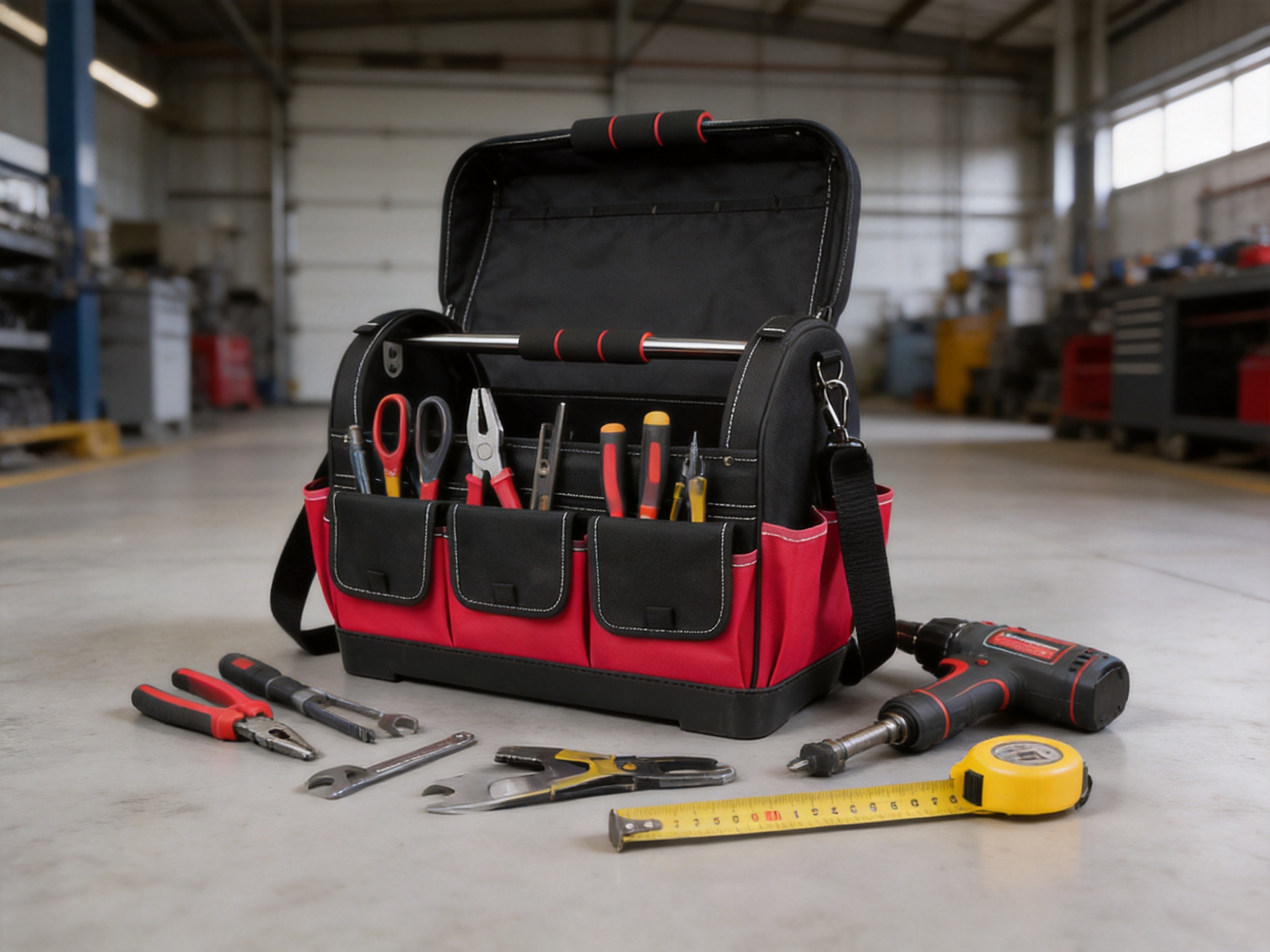
The T004 uses an open-top closure type. This configuration is particularly practical in jobs where tools are used continuously. A technician may need to take out a screwdriver, return it, select pliers, and then reach for a measuring tool within a short period. An open top eliminates repeated zipper operation and allows the user to see and reach into the bag immediately.
Quick access can have a measurable effect on work efficiency. Small delays repeated throughout a day can accumulate, particularly for professionals handling multiple service calls or installation tasks. By keeping tools visible and accessible, the bag helps reduce unnecessary interruption.
The open-top design also accommodates items with different shapes and sizes. A tool with a long handle, a compact drill, or a bundle of accessories can be placed into the central compartment without being restricted by a narrow zipper opening. This flexibility is useful when the contents vary from one project to the next.
There is a trade-off between open access and full enclosure. An open-top bag does not provide the same complete closure as a zippered tool bag. Users should therefore select the T004 when accessibility, visibility, and flexible loading are more important than fully enclosing the contents. For indoor workshops, service vehicles, construction sites, and short-distance transport, this design can be highly effective.
When greater protection is needed during vehicle transport, users can place the T004 in a secure storage area or combine it with a larger covered storage system. Its rigid base makes it easier to position upright, while its fabric body remains convenient for carrying individual tool sets to the immediate work area.
Carrying Comfort: Tubular Handle and Padded Shoulder Straps
A heavy-duty tool bag can become uncomfortable if all of its weight is concentrated in one narrow handle. The T004 addresses this issue with a foam-padded tubular handle and adjustable padded shoulder straps. These features allow users to change carrying methods according to distance, load, and site conditions.
The tubular handle is useful when the bag needs to be lifted into a vehicle, carried across a workshop, or moved a short distance. Foam padding improves the contact surface between the handle and the hand, helping reduce pressure during repeated lifting. It also makes the handle more comfortable when the bag is fully loaded.
The shoulder straps provide an alternative for longer walks or situations where both hands need to remain available. Their adjustable construction allows the fit to be changed for different users or clothing layers. Padding helps distribute pressure across a broader area of the shoulder instead of concentrating it on a thin strap edge.
Carrying comfort is especially important because the bag has a stated load capacity of 44.09 lbs. A bag capable of carrying a substantial quantity of tools must also provide reasonable handling options. The combination of handle and shoulder straps gives users greater flexibility than a single-handle design.
Good carrying practice remains important. Users should avoid overloading the bag beyond its stated capacity, place heavy objects near the bottom and center, and adjust the shoulder straps so that the bag remains close to the body. The straps are designed to improve comfort and distribution, but no carrying system can eliminate the effects of excessive or unbalanced loading.
Load Capacity and Practical Capacity Planning
The T004 has a stated load capacity of 44.09 lbs. This provides useful room for a professional hand-tool kit, selected accessories, and medium-sized power tools. Capacity should be understood as both a weight limit and a volume-management issue. A bag may have unused weight capacity but still become difficult to organize if it is filled with oversized items.
The most efficient approach is to create a tool plan before loading. The main compartment can hold larger equipment, while the 11 external and 8 internal pockets can be assigned to smaller tools. Users should place the tools required most often in positions that can be reached without removing the entire contents.
Distributing weight evenly can improve stability and reduce strain. A heavy drill placed at one end may cause the bag to tilt, while several dense tools stacked in one pocket can stress that pocket and make the bag uncomfortable to carry. Balanced loading allows the rigid base and carrying system to work more effectively.
The stated capacity also makes the bag suitable for shared professional use. A service department may prepare one bag for electrical maintenance, another for woodworking repairs, and another for general installation work. Because the bag can be customized in color, organizations may also use different colors to distinguish teams, trades, or tool categories.
Advantages Over Conventional Tool Bags
The T004 offers several advantages over conventional soft tool bags. The first is its injection-molded rigid base, which supports stability and helps protect the lower part of the bag from wet or dirty surfaces. A soft-bottom bag may be lighter, but it can collapse, absorb moisture more easily, and provide less support for heavy contents.
The second advantage is its combination of open access and organized storage. Some simple totes provide an open top but lack pockets, causing tools to collect in one disordered space. The T004 keeps the convenience of an open top while adding 19 pockets for more systematic arrangement.
The third advantage is its carrying flexibility. A basic handled bag may become uncomfortable over longer distances, while a backpack may not provide the same quick access or open storage area. The T004 combines a padded tubular handle with adjustable padded shoulder straps, allowing users to select the method that matches the task.
The fourth advantage is material durability. High-grammage polyester is selected for tear and abrasion resistance, making it more suitable for professional work than lightweight fabric products designed primarily for occasional household use.
Compared with a hard toolbox, the T004 is generally easier to carry and more adaptable to irregular tool shapes. A hard case may provide strong impact protection, but it can also be heavier, less flexible, and slower to access. The T004 is aimed at users who need a balance of structure, portability, and accessibility.
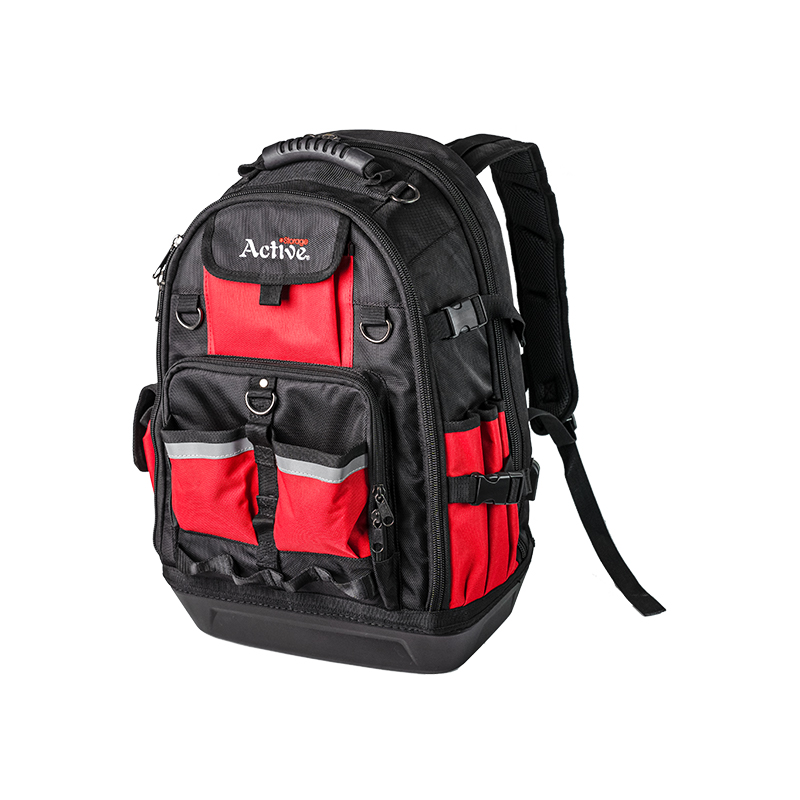
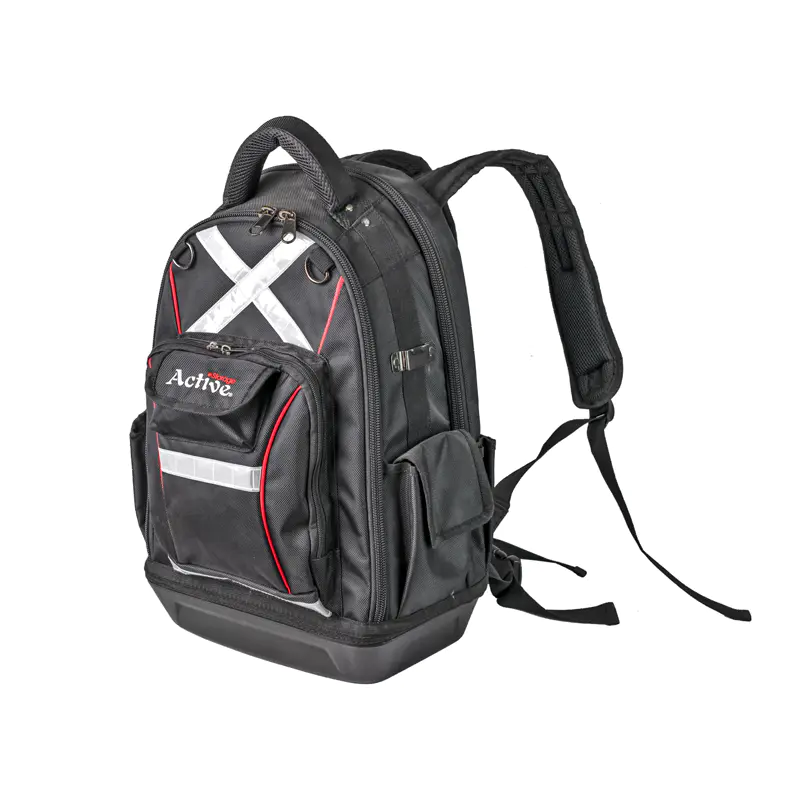
Compared with a tool backpack, the T004 offers a wider open storage area and a rigid base that supports upright placement. A backpack is valuable for hands-free transport, but it may not be ideal for quickly reaching large tools or setting equipment down on a wet work surface. The T004 serves a different but complementary purpose.
Suitable Applications
Electrical Work
Electricians often carry a combination of insulated hand tools, testers, cutters, pliers, screwdrivers, measuring devices, connectors, and small accessories. The T004’s pocket arrangement enables frequently used tools to remain accessible while keeping smaller components separated from the main compartment.
The rigid base is useful on construction sites, utility areas, unfinished floors, and outdoor service locations. The padded shoulder straps can assist when electricians need to move between service points while carrying other equipment in their hands.
Woodworking and Carpentry
Woodworkers can use the bag for measuring and marking tools, screwdrivers, chisels, clamps, drill accessories, sanding materials, and compact power tools. The open top supports rapid access during assembly or installation, while the polyester body provides resistance to ordinary workshop abrasion.
The bag can also serve as a mobile project kit. A worker may prepare it with the tools needed for one installation or repair rather than transporting an entire workshop. This can improve efficiency and reduce the amount of equipment carried between the storage area and the work location.
Maintenance and Installation
Maintenance technicians frequently need a flexible tool selection because each service task can involve different equipment. The T004 allows the central compartment to be adapted for the day’s assignment while the pockets preserve a consistent location for common tools.
For installation work, the bag can hold hand tools, fasteners, accessories, and selected power tools. The upright base helps the bag remain accessible beside a ladder, workbench, service panel, or vehicle.
Workshop and Vehicle Organization
The T004 can be used as a portable secondary kit within a larger workshop or vehicle storage system. Rather than carrying a complete toolbox to every task, users can select the relevant tools and place them in the bag. This modular approach can reduce unnecessary movement and make job preparation faster.
Manufacturing Expertise and Customization Strengths
Zhangjiagang Seaark Tools Industrial Co., Ltd. was founded in 2004 and specializes in professional tool bags and customization solutions. Its experience covers the development and export of tool bags for international customers, providing a foundation for understanding different market requirements, usage conditions, packaging expectations, and product specifications.
In 2012, the company established Zhangjiagang Haiyi Tool Bags Co., Ltd. as a core manufacturing base in China. The company also operates a production facility in Cambodia. This multi-location manufacturing structure supports flexible global supply and can help customers manage sourcing requirements and the effects of additional U.S. tariffs.
With more than 20 years of tool bag manufacturing experience, the company operates multiple production bases, employs more than 200 people, and manages approximately 11,000 square meters of floor space. These resources support the production of different tool bag categories, including trolley tool bags, tool backpacks, zippered tool bags, tool bags with tubular handles, waist tool bags, tool pouches, tool vests, tool bucket bags, folding-seat tool bags, pocket handy tool bags, garden bags, and multifunctional bags.
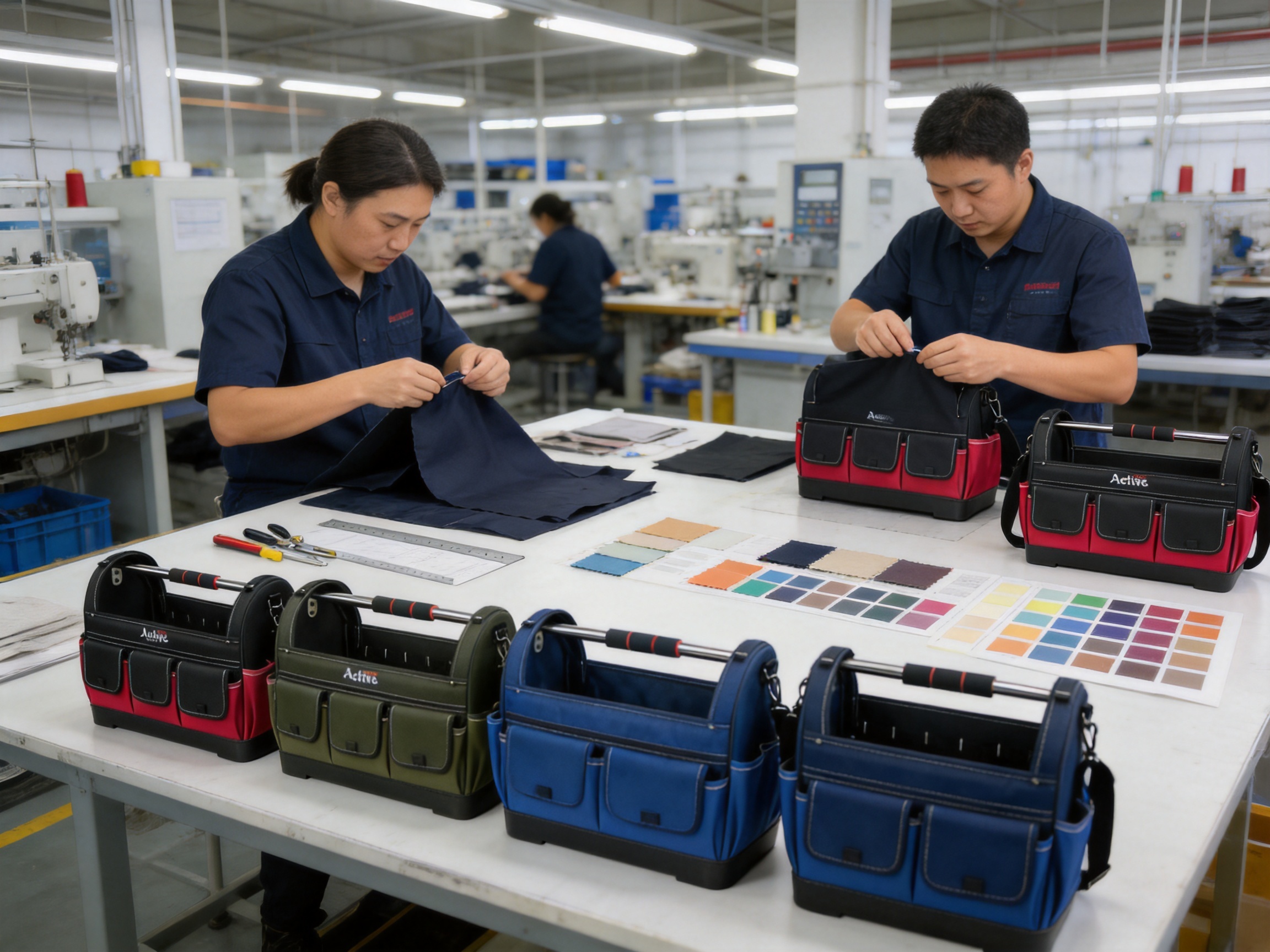
The T004 benefits from the type of manufacturing coordination required to combine fabric construction, molded components, padding, straps, and pocket systems in one product. A heavy-duty bag is not created by selecting strong fabric alone. It requires accurate cutting, consistent stitching, reliable reinforcement, controlled assembly, and inspection of the finished structure.
Research and Development Capabilities
The company maintains an independent research and development team that develops more than 10 new designs each year. This continuous development activity is important in a product category where user needs change according to trade, application, tool size, transportation method, and regional preference.
Research and development can include improvements to pocket layout, carrying comfort, material selection, base construction, reinforcement methods, and product dimensions. For customers seeking customized products, an experienced R&D team can help translate a general requirement into a manufacturable design.
The company’s registered brand is Active Storage, and it holds multiple design patents. These design resources indicate an emphasis on product development rather than simple reproduction of existing market formats. For business customers, this can create opportunities to develop differentiated tool bags with specific colors, configurations, branding treatments, or functional features.
Customization is particularly valuable for distributors, retailers, industrial suppliers, and professional brands. A customer may require a particular external pocket arrangement, a different strap specification, a custom color, modified dimensions, or a private-label presentation. The T004 already offers customized color as a parameter, and its design can serve as a foundation for discussions about additional requirements.
Production Quality and Compliance Infrastructure
Professional buyers often evaluate a tool bag supplier according to more than product appearance. They also consider production consistency, social compliance, factory management, audit readiness, and the ability to maintain quality across repeated orders. Seaark’s facilities undergo annual third-party audits, including BSCI, SEDEX, FCCA, and SCS audits.
Third-party audit systems help provide external review of manufacturing practices and operational standards. While an audit is not a substitute for product inspection, it can support greater transparency in supplier evaluation. For international customers, this infrastructure can simplify the process of assessing a factory’s compliance and production environment.
Consistent manufacturing is especially important for products such as the T004 because several components must work together. The hard base must be properly integrated with the fabric body. The pockets need to be positioned accurately. The tubular handle and straps must be securely attached. Padding should be applied consistently, and the final bag must retain its intended shape.
A structured production process generally includes material receiving, fabric inspection, pattern cutting, printing or branding when required, sewing, reinforcement, component assembly, finishing, and quality control. The exact sequence may vary according to the product specification, but each stage contributes to the final performance of the bag.
Production Process for a Heavy-Duty Tool Bag
Material Selection and Inspection
The process begins with the selection of polyester fabric, reinforcement materials, padding, strap components, hardware, and materials for the injection-molded base. Fabric should be checked for consistency, surface defects, color variation, and suitability for the intended construction.
Pattern Development and Cutting
Accurate pattern development ensures that the bag’s dimensions, pocket positions, side panels, base interface, and handle attachment points are consistent. Precise cutting helps reduce variation between units and supports efficient fabric use.
Component Preparation
Pockets, handles, straps, padding, binding, and reinforcement panels are prepared before final assembly. Preparing components in a controlled sequence allows production teams to confirm that the pieces match the design and are ready for integration.
Sewing and Reinforcement
Sewing joins the main fabric panels and creates the pocket system. High-stress areas, including handle connections, shoulder strap anchors, pocket openings, and base seams, require appropriate reinforcement. The objective is to ensure that the bag can withstand repeated loading and carrying.
Rigid Base Integration
The injection-molded base is integrated with the textile body so that the lower structure remains stable during use. The connection between the fabric and molded component is critical because it affects shape retention, load support, and resistance to separation.
Final Inspection and Packing
Finished bags can be inspected for dimensions, stitching, pocket alignment, handle attachment, strap adjustment, base stability, surface appearance, and general workmanship. Products are then packed according to customer requirements for export, distribution, or retail presentation.
Customization for Global Buyers
Different customers may require different versions of the same basic product. A construction distributor may prefer highly visible colors, while an industrial brand may request a restrained corporate palette. A retailer may need packaging and labeling for a particular market. A professional tool company may want its own logo, pocket layout, or product naming system.
The T004 supports customization through its adaptable polyester construction and customized color option. Depending on the project, customers can discuss details such as dimensions, materials, pocket quantity, handle design, strap configuration, base color, logo application, labels, packaging, and shipment arrangements.
Customization should begin with a clear product brief. Buyers should identify the target users, expected tool load, typical working environment, preferred carrying method, required pocket arrangement, color standards, packaging needs, and market regulations. The more precise the brief, the easier it is for an R&D and production team to develop a reliable result.
Sampling is also an important stage. A sample allows the customer to evaluate proportions, access, comfort, stitching, balance, and visual appearance before larger production begins. For a professional tool bag, it is useful to test the sample with representative tools rather than examining it only when empty.
Care and Use Recommendations
To maintain the T004, users should avoid exceeding the stated 44.09-lb capacity. Tools should be distributed evenly, and sharp objects should be placed so that they do not cut or puncture nearby fabric. Small accessories should be stored in appropriate pockets instead of being left loose beneath heavy tools.
The rigid base helps protect the bag from damp surfaces, but the product should not be submerged or treated as a waterproof container. If the bag becomes wet, it should be emptied and allowed to dry thoroughly in a ventilated area. Dirt can generally be removed with a soft brush or damp cloth, followed by air drying.
Users should periodically inspect stitching, strap anchors, handle attachments, pocket openings, and the connection between the fabric body and rigid base. Early detection of wear can help prevent a minor issue from becoming a larger failure during transport.
When storing the bag for an extended period, it is best to keep it in a dry location away from direct heat and prolonged sunlight. Heavy tools should not be left inside indefinitely if they are not needed, because long-term concentrated loading can place unnecessary stress on the structure.
Product Specification Table
| Parameter | Details |
|---|---|
| Product Model | T004 |
| Product Type | Tool Bag with Tubular Handle |
| Material | High-grammage polyester |
| Dimensions | 44 x 25 x 34 cm |
| Closure Type | Open top |
| Load Capacity | 44.09 lbs |
| Number of Pockets | 19 total: 11 exterior and 8 interior |
| Base Construction | Injection-molded rigid base |
| Carrying Options | Foam-padded tubular handle and adjustable padded shoulder straps |
| Color | Customized |
| Country of Origin | China |
| Recommended Users | Electricians, woodworkers, installers, maintenance technicians, and contractors |
Why the T004 Is a Strong Choice for Professional Buyers
The T004 combines several features that are often separated across different types of tool storage. It has the flexibility of a fabric bag, the stability of a rigid lower platform, the accessibility of an open top, the organization of multiple pockets, and the carrying options of both a handle and shoulder straps.
Its competitive value comes from this combination rather than from one isolated feature. A rigid base alone would not solve tool organization. Pockets alone would not provide ground protection. A shoulder strap alone would not support stable placement. The T004 brings these elements together in a product designed for regular professional use.
For distributors and brands, the company’s manufacturing experience adds another layer of value. The supplier has long-term experience in tool bag production, multiple manufacturing locations, an independent R&D team, design patents, third-party audit experience, and customization capabilities. These strengths can support both standard product purchasing and tailor-made development programs.
For end users, the result is a practical tool organizer designed to remain useful throughout the working day. It can carry a substantial load, provide quick access, protect the lower structure from rough surfaces, and support more orderly tool management. For business customers, it offers a platform that can be adapted to different markets and customer groups.
Frequently Asked Questions
What type of tool bag is the T004?
The T004 is a heavy-duty tool bag with a tubular handle. It also includes adjustable padded shoulder straps, an open top, 19 pockets, and an injection-molded rigid base.
What are the dimensions of the bag?
The dimensions are 44 x 25 x 34 cm. This size is designed to accommodate a practical selection of hand tools and medium-sized power tools.
How much weight can the bag carry?
The stated load capacity is 44.09 lbs. Users should distribute tools evenly and avoid exceeding this capacity.
Is the bag waterproof?
The injection-molded rigid base provides effective protection against ordinary contact with wet or muddy work surfaces. However, the bag should not be submerged or considered fully waterproof unless a specific waterproof specification has been confirmed.
How many pockets does the T004 have?
The bag has 19 individual pockets: 11 exterior pockets and 8 interior pockets.
Is the top closed with a zipper?
No. The T004 uses an open-top design. This allows faster access to tools during active work and makes it easier to load tools with different shapes.
Who can use this tool bag?
The bag is suitable for electricians, woodworkers, contractors, installers, maintenance technicians, service professionals, and other users who need portable and organized tool storage.
What is the advantage of the rigid base?
The rigid base helps the bag retain its shape, improves stability when the bag is placed on the ground, supports heavy contents, and separates the main fabric body from wet or muddy surfaces.
Are the shoulder straps adjustable?
Yes. The shoulder straps are adjustable and padded. This allows users to adapt the carrying position to their body and load conditions.
Can the color be customized?
Yes. The product information lists the color as customized. Buyers can discuss color requirements and other specifications with the manufacturer during the product development or ordering process.
Can the bag be customized for a private-label brand?
The manufacturer provides comprehensive customization solutions for global brands and partners. Customers can discuss branding, colors, dimensions, pocket layouts, materials, packaging, and other requirements.
What manufacturing experience does the supplier have?
The company was founded in 2004 and has more than 20 years of tool bag manufacturing experience. It operates multiple production bases, has more than 200 employees, and manages approximately 11,000 square meters of floor space.
Does the company develop new products?
Yes. The company maintains an independent R&D team that develops more than 10 new designs every year and holds multiple design patents.
Does the company have third-party audit experience?
Yes. Its facilities undergo annual third-party audits, including BSCI, SEDEX, FCCA, and SCS audits.
Conclusion
The T004 heavy-duty tool bag is designed for professionals who need a dependable, organized, and portable solution for carrying tools in demanding environments. Its high-grammage polyester body offers tear and abrasion resistance, while the injection-molded rigid base improves stability, supports heavy loads, and provides a practical barrier against wet or muddy surfaces.
The 19-pocket layout helps users organize hand tools, accessories, and medium-sized power tools. The open top supports quick access, and the combination of a foam-padded tubular handle with adjustable padded shoulder straps makes the bag more adaptable to different carrying situations.
Its advantages over simpler soft bags include stronger structural support, improved ground stability, greater organization, and more carrying flexibility. Its advantages over rigid toolboxes include lighter handling flexibility, easier access, and better accommodation of irregularly shaped equipment.
Behind the product is a manufacturer with more than two decades of industry experience, multiple production bases, an independent R&D team, design patents, third-party audit experience, and extensive customization capabilities. These strengths make the T004 suitable not only for individual professionals but also for distributors, retailers, industrial suppliers, and brands seeking reliable tool bag manufacturing support.
For electricians, woodworkers, maintenance technicians, and contractors, the T004 provides a practical way to keep essential tools close, organized, and protected. For global buyers, it offers a strong foundation for standard purchasing or customized product development.
References
1. Product specification sheet for T004 heavy-duty tool bag, including dimensions, materials, capacity, pocket configuration, and closure type.
2. Manufacturer-provided company profile for Zhangjiagang Seaark Tools Industrial Co., Ltd.
3. Manufacturer-provided information on production bases, research and development, customization services, and third-party audits.
4. General professional tool-storage principles concerning load distribution, abrasion resistance, pocket organization, and carrying ergonomics.
5. General manufacturing references concerning textile bag construction, injection-molded components, reinforcement sewing, and product quality inspection.
Product: Heavy-Duty Tool Bag with Rigid Base and Adjustable Shoulder Strap




We are a professional enterprise engaged in exporting various types of toolkits.
We firmly believe that 'quality is everything, service enhances value'.
-
+86-15298800699

-
+86-512-58670375

-
karen@kun-bag.com

-
Building 11, No. 93 Chengang Road, Zhangjiagang City, Jiangsu Province, China

Copyright © Zhangjiagang Seaark Tools Industrial Co., Ltd. All Rights Reserved.
Custom Electrician Tool Backpack Manufacturers