
 en
 русский
 Español
 Deutsch

A Practical Guide to the Two-Wheel Telescopic Tool Backpack for Professional Worksites
For professionals who carry tools between workshops, construction sites, service calls, and maintenance locations, organization and mobility are just as important as tool capacity. A conventional shoulder bag may be convenient for short trips, but it can become uncomfortable when loaded with heavy hand tools, electrical equipment, measuring instruments, and replacement parts. A standard backpack distributes weight across the shoulders, yet it still requires the user to carry the entire load when walking through buildings, parking areas, warehouses, or outdoor job sites. A wheeled tool bag offers another solution, but many wheeled designs sacrifice portability, pocket access, or durability.
The two-wheel telescopic tool backpack described in this article is designed to combine the useful characteristics of a professional tool bag, a backpack, and compact tool luggage. Measuring 36 x 25 x 54 centimeters, it provides substantial storage while remaining practical for daily transportation. A built-in telescopic handle and two durable casters allow the user to pull the bag instead of carrying its full weight. When the terrain or working conditions require a hands-free option, the backpack format provides another way to transport tools.
With a load capacity of 44.09 pounds, 25 exterior pockets, seven interior pockets, a secure zipper closure, and a strong 1680D polyester construction, this tool backpack is suited to demanding work environments. It is particularly relevant for electricians, plumbers, construction workers, maintenance technicians, installers, repair specialists, and other professionals who need their tools available throughout the working day.
Behind the product is Zhangjiagang Seaark Tools Industrial Co., Ltd., a China-based manufacturer with more than 20 years of experience in professional tool bags. The company develops standard products as well as customized solutions, supported by multiple production bases, an independent research and development team, and manufacturing facilities that undergo annual third-party audits. These capabilities help connect product design with consistent production, material selection, quality management, and global supply requirements.
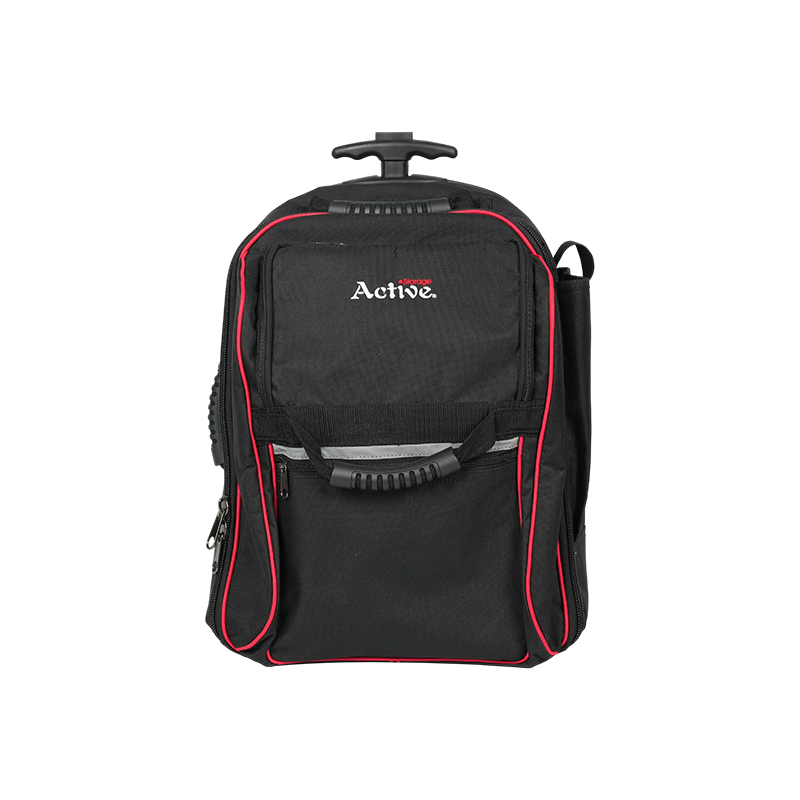
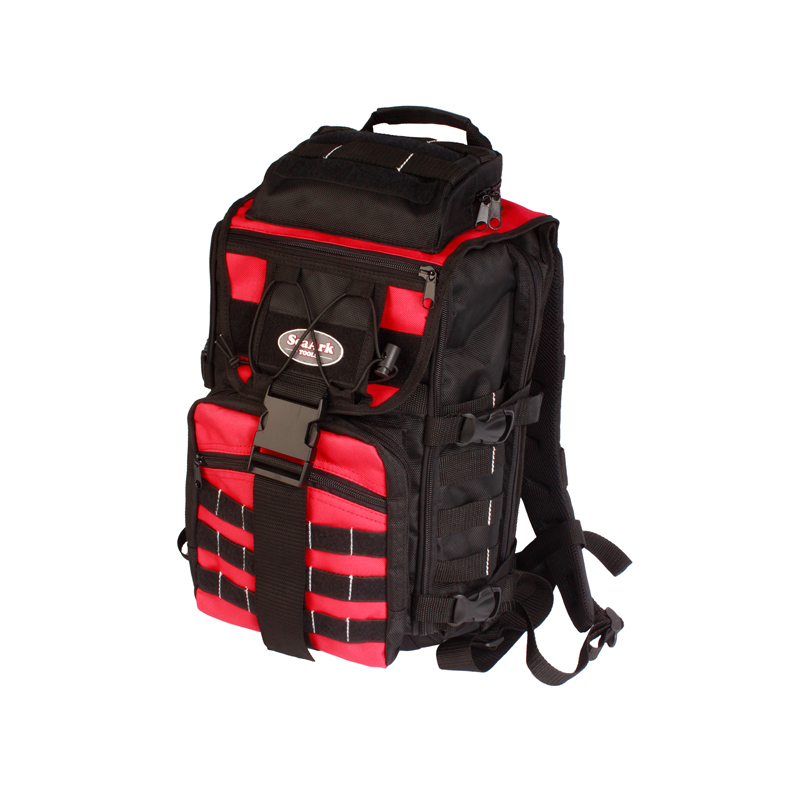
Telescopic Pulling Trolley with 2 Wheels Tool Backpack
Content
- 1 Designed for More Than Simple Tool Storage
- 2 Mobility That Helps Reduce Physical Strain
- 3 Storage Organization for Faster Access
- 4 1680D Polyester for Demanding Work Conditions
- 5 Closure and Protection
- 6 Suitable Applications Across Multiple Trades
- 7 How the Product Compares with Common Alternatives
- 8 Product Specifications at a Glance
- 9 Manufacturing Experience and Product Development
- 10 Customization for Global Buyers
- 11 Quality Considerations for Professional Tool Bags
- 12 Practical Packing Recommendations
- 13 Care and Maintenance
- 14 Why Manufacturing Capability Matters to Buyers
- 15 Frequently Asked Questions
- 15.1 What is the main purpose of this tool backpack?
- 15.2 How much weight can it carry?
- 15.3 How many pockets does the bag have?
- 15.4 Can the bag be used as a regular backpack?
- 15.5 What material is used to make the product?
- 15.6 What type of closure does it use?
- 15.7 What tools can be stored in the bag?
- 15.8 Is the bag suitable for electricians?
- 15.9 Is the product useful for plumbing workers?
- 15.10 What are the product dimensions?
- 15.11 Is the color customizable?
- 15.12 Does the manufacturer offer private-label or customized products?
- 15.13 Where is the product manufactured?
- 15.14 What experience does the manufacturer have?
- 15.15 Does the manufacturer have research and development capabilities?
- 15.16 Are the manufacturing facilities audited?
- 15.17 How should the bag be maintained?
- 16 Conclusion
- 17 References
- 18 Product: Telescopic Pulling Trolley with 2 Wheels Tool Backpack
Designed for More Than Simple Tool Storage
A tool bag must do more than hold equipment. It must protect tools, support quick access, remain stable when placed on the ground, and withstand repeated movement through demanding environments. A professional user may open and close the bag dozens of times in a single day. The bag may be placed on concrete, dragged across floors, loaded into vehicles, carried up stairs, and exposed to dust, moisture, friction, and sharp tool edges. These conditions make the details of construction especially important.
The telescopic pulling trolley tool backpack addresses these demands through a combination of mobility, organized storage, and reinforced textile construction. Its two-wheel format gives it a compact footprint compared with larger rolling cases. The built-in handle can be extended when the bag is pulled and retracted when the bag is carried or stored. This arrangement helps users move heavy equipment without requiring a separate trolley or cart.
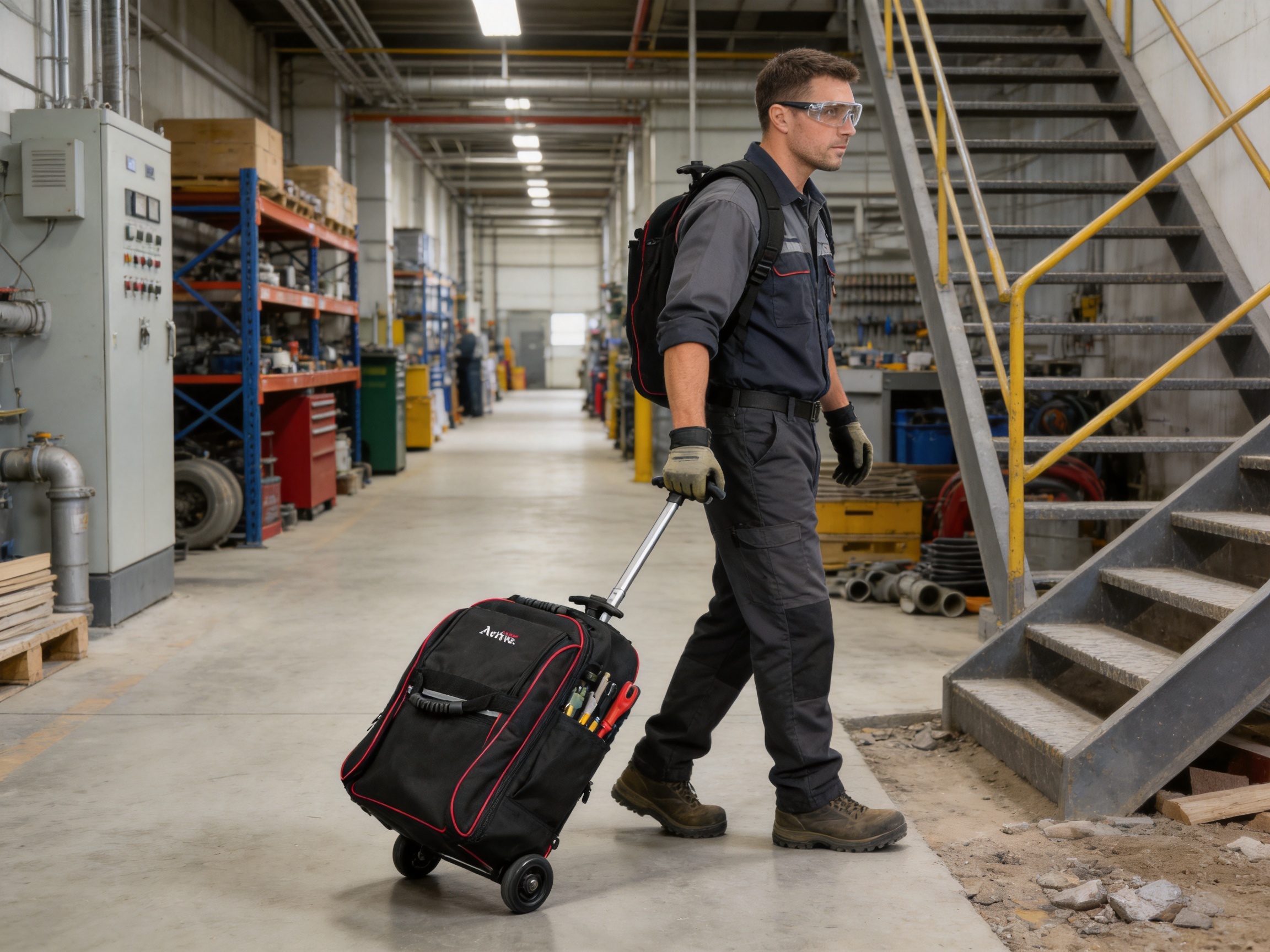
The product also retains the familiar function of a backpack. This is important because not every worksite has smooth, unobstructed surfaces. Stairs, narrow corridors, uneven outdoor ground, crowded workshops, and unfinished construction areas can make wheels inconvenient. In those situations, the user can carry the bag on the back rather than attempting to pull it over unsuitable terrain.
This combination gives the product a practical advantage over single-purpose alternatives. A standard tool backpack may be comfortable on the back but does not reduce the physical burden of a heavy load during long walks. A simple wheeled tool case may roll well but can be awkward to lift or carry. A shoulder tool bag may provide fast access but can place uneven pressure on one side of the body. A two-wheel telescopic tool backpack is intended to provide several transportation options in one product.
Mobility That Helps Reduce Physical Strain
Carrying tools is a normal part of many trades, but repeated lifting and transportation can create unnecessary fatigue. The stated load capacity of 44.09 pounds allows the bag to accommodate a substantial selection of tools and supplies. When the bag is pulled on its two casters, much of that load is transferred away from the user’s shoulders and back.
The built-in telescopic handle is central to this function. Because the handle is integrated into the bag, the user does not need to carry a separate trolley or attach an external frame. The telescopic design also allows the handle to be stored when it is not needed. This helps the product remain more compact during storage, vehicle loading, or backpack use.
Two wheels provide a straightforward and familiar pulling motion. The user can tilt the bag slightly and move it through offices, workshops, warehouses, corridors, and other relatively even areas. The wheel configuration is also easier to manage than a large multi-wheel case in narrow spaces. For professionals who frequently transition between a vehicle and a building, the ability to roll the bag across smooth ground can save time and reduce repeated lifting.
Mobility is not only about comfort. It can also support productivity. A technician who arrives at a service location with the correct tools already organized in one mobile bag may spend less time returning to a vehicle or searching through several containers. A contractor moving between work areas can transport hand tools, measuring devices, fasteners, and accessories in a single unit. A maintenance team can use the bag as a portable tool station that moves with the worker.
Compared with a conventional soft tool bag, this design is especially useful when the tool load becomes too heavy for comfortable shoulder carrying. Compared with a rigid tool chest, it is more adaptable to situations where the user must carry the product, place it in a vehicle, or navigate narrow access points. The mobility system therefore supports both routine transportation and changing site conditions.
Storage Organization for Faster Access
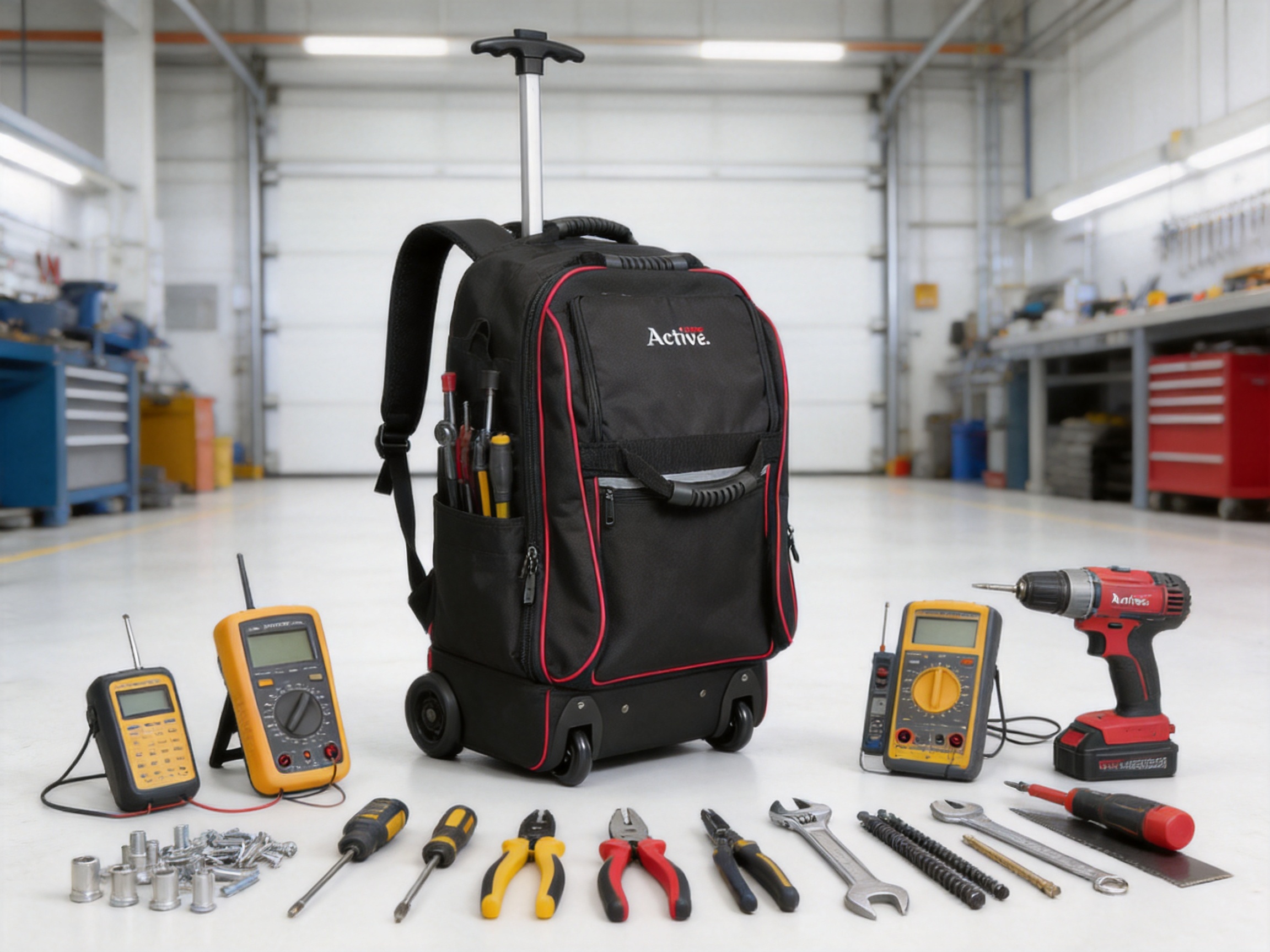
The bag includes 25 exterior pockets and seven interior pockets. This layout is one of its most significant functional features. Exterior pockets provide access to frequently used tools, components, and consumables without requiring the user to open the main compartment. The interior pockets can be used for tools and precision measuring instruments that benefit from additional protection and separation.
In practical use, the exterior storage area may accommodate screwdrivers, pliers, adjustable wrenches, utility knives, tape measures, electrical testers, drill accessories, fasteners, cable ties, small fittings, and other regularly used items. The exact arrangement can be adapted to the profession and personal working habits of the user. The key benefit is that commonly needed equipment remains visible and within reach.
The seven interior pockets offer a separate area for items that should not be mixed loosely with larger tools. Precision measuring instruments, inspection equipment, small electronic devices, connectors, and delicate accessories can be placed in their own compartments. Separation helps reduce contact between fragile instruments and heavier metal tools.
Many conventional bags provide one large cavity with limited internal structure. That configuration can hold a great deal, but it often causes tools to collect at the bottom. The user may then need to remove several items before finding a specific screwdriver, meter, or fitting. By contrast, a multi-pocket design encourages a more systematic arrangement. It can help users establish a consistent location for each tool, making replenishment and inventory checks easier.
Organization also supports job preparation. Before leaving for a service call, a technician can review the exterior pockets for basic hand tools and inspect the interior section for measuring instruments or specialized devices. At the end of the day, missing tools may be easier to identify when each category has a designated location. This is especially valuable for professionals who work across several sites and cannot afford to leave tools behind.
Exterior Access Without Opening the Main Compartment
The exterior pockets are useful when the user needs a tool immediately. Opening the primary zipper may expose the main contents to dust, rain, or accidental spillage, while reaching into an outside pocket can be quicker and less disruptive. This feature is helpful during installation work, equipment inspection, emergency repairs, and other situations in which the user may be wearing gloves or working in a confined position.
Fast access does not mean that every tool should remain outside. Valuable, delicate, or less frequently used items can be placed inside the main compartment or interior pockets. The result is a simple division between daily-use equipment and tools that require more protection or are needed only for specific tasks.
Interior Pockets for Precision Equipment
Measuring instruments often require more careful storage than common hand tools. Electrical meters, levels, gauges, inspection devices, and similar equipment may be affected by impact, abrasion, or contact with sharp edges. The seven interior pockets give users the ability to separate these items from bulkier equipment.
Although the bag is not a specialized hard-shell instrument case, organized textile compartments can still provide an important layer of separation. Users should select the appropriate pocket for each instrument, avoid overloading individual sections, and follow the handling requirements of the equipment manufacturer. Proper packing is essential to obtain the full benefit of the internal layout.
1680D Polyester for Demanding Work Conditions
Material selection is a major factor in the performance of a soft-sided tool bag. Professional tool storage is exposed to repeated abrasion, pulling forces, contact with rough surfaces, and the weight of hard-edged equipment. For this reason, the product uses 1680D polyester, a dense textile commonly selected for applications that require high tear resistance and durable surface performance.
The “D” designation refers to denier, a measurement associated with the linear mass of textile fibers. In general terms, a higher-denier fabric is often chosen when a product requires a stronger and more substantial textile structure. The use of 1680D polyester gives this tool backpack a robust foundation for daily worksite use.
Polyester also offers practical advantages for a professional bag. It is relatively lightweight compared with many rigid materials, can be formed into flexible compartments, and is suitable for sewing into complex pocket layouts. A fabric construction allows the bag to adapt to tools with different shapes while remaining easier to transport than a fully rigid container.
The manufacturer also states that the bag is specially reinforced for the tough working conditions faced by construction and plumbing workers. Reinforcement is important because stress is not distributed evenly throughout a bag. The base, wheel area, handle attachment points, seams, pocket openings, and carrying sections typically experience more strain than the central fabric panels. Strengthening these areas can help the bag maintain its structure during repeated use.
For users, durability is not simply a matter of extending product life. A stronger bag can protect the investment made in tools and reduce disruption caused by damaged storage equipment. When a pocket tears or a handle attachment fails, tools may fall out, become difficult to transport, or require replacement storage. A reinforced construction is therefore relevant to both safety and operating efficiency.
Closure and Protection
The product uses a zipper closure. A zipper allows the main compartment to be opened widely for loading and inspection, then closed securely during movement. It also helps keep tools contained when the bag is tilted onto its wheels or placed into a vehicle.
For professional users, a closure should be easy to operate repeatedly while remaining secure during transport. The zipper can help prevent loose items from falling out of the main compartment when the bag is carried or pulled. It also provides a clear distinction between the main storage area and the outer pockets, allowing users to control which contents are exposed.
As with any textile tool bag, users should avoid forcing the zipper over an overloaded compartment. Correct packing helps prevent excessive pressure on the teeth, slider, and surrounding fabric. Keeping sharp objects away from the zipper track can also help maintain smooth operation. Basic care and sensible loading are important parts of achieving long-term performance.
Suitable Applications Across Multiple Trades
The product is designed for broad professional use rather than a single specialized occupation. Its combination of wheeled transport, backpack mobility, and compartmentalized storage is relevant to workers who regularly carry a mixed collection of tools.
Electrical Work
Electricians often carry hand tools, cable preparation tools, testers, meters, connectors, fasteners, insulation materials, and personal protective accessories. The exterior pockets can hold frequently used screwdrivers, pliers, cutters, and tape measures. Interior pockets may be used for meters and other precision devices. The rolling function can be useful when moving through commercial buildings or industrial facilities, while the backpack format can help when stairs or restricted access are involved.
Plumbing and Pipe Installation
Plumbing work may require wrenches, cutters, measuring tools, sealants, fittings, repair components, and small installation accessories. These items vary in shape and weight, making organized storage important. A durable textile bag with reinforced construction can support the repeated loading associated with service work. The 44.09-pound capacity offers room for a practical selection of equipment, although users should distribute heavy contents carefully.
Construction and General Maintenance
Construction and maintenance workers may move between several parts of a building or site. A mobile bag can carry basic hand tools, inspection devices, replacement components, and consumables. The ability to roll the bag across smooth surfaces and carry it over uneven sections gives workers more flexibility than a fixed tool chest.
Installation and Repair Services
Technicians who visit customers may need a professional, organized way to transport tools from a service vehicle to an indoor work area. The bag’s structured pocket layout can make it easier to prepare for different service calls. Its compact rectangular footprint can also be more convenient than transporting multiple loose bags.
Industrial Inspection and Facility Services
Facility technicians and inspection personnel often carry measuring instruments along with general tools. The seven internal pockets provide a way to separate these devices from heavier equipment. The rolling function can reduce fatigue when a facility is large, while the backpack format remains available for stairs and areas where wheels cannot be used.
How the Product Compares with Common Alternatives
Every type of tool storage has strengths and limitations. The advantages of this two-wheel telescopic tool backpack become clearer when it is compared with the alternatives commonly used by professionals.
| Storage Type | Typical Strength | Potential Limitation | Relevant Advantage of This Product |
|---|---|---|---|
| Shoulder Tool Bag | Quick access and simple design | Can place concentrated weight on one side of the body | Provides wheels and backpack carrying options |
| Basic Tool Backpack | Hands-free transportation | Requires the user to carry the full load | Allows the load to be pulled on two casters when conditions permit |
| Rigid Tool Chest | Strong shell and fixed organization | Can be bulky and difficult to carry over stairs | Uses a flexible, lighter textile format with backpack functionality |
| Small Rolling Case | Easy movement on smooth floors | May lack flexible carrying options or sufficient pockets | Combines rolling mobility with 25 exterior and seven interior pockets |
| Open Tool Tote | Fast top access | Contents may be exposed and less protected during transport | Offers a zipped main compartment and organized external storage |
This comparison does not mean that one storage format is ideal for every worker. A rigid case may be preferred for delicate equipment, while an open tote may be convenient for a short indoor task. The key benefit of this product is versatility. It is intended for users who need more than one transportation method and who value organized access without giving up portability.
Product Specifications at a Glance
| Parameter | Details |
|---|---|
| Product Type | Two-wheel telescopic tool backpack |
| Dimensions | 36 x 25 x 54 centimeters |
| Load Capacity | 44.09 pounds |
| Material | Polyester, including 1680D construction |
| Closure Type | Zipper |
| Exterior Pockets | 25 |
| Interior Pockets | 7 |
| Wheels | 2 durable casters |
| Handle | Built-in telescopic pulling handle |
| Color | Customized |
| Country of Origin | China |
The dimensions provide a balance between storage volume and transportability. At 54 centimeters in height, the bag can accommodate a meaningful tool selection without becoming the size of a large job-site chest. The 36-centimeter width and 25-centimeter depth support a relatively narrow profile for movement through doors, corridors, and vehicle storage areas.
Actual performance depends on how tools are packed and how the product is used. The load capacity should be treated as a maximum guideline rather than a reason to fill every pocket indiscriminately. Heavy tools should be positioned to maintain balance, and users should inspect the wheels, handle, seams, and closures regularly when the bag is used under demanding conditions.
Manufacturing Experience and Product Development
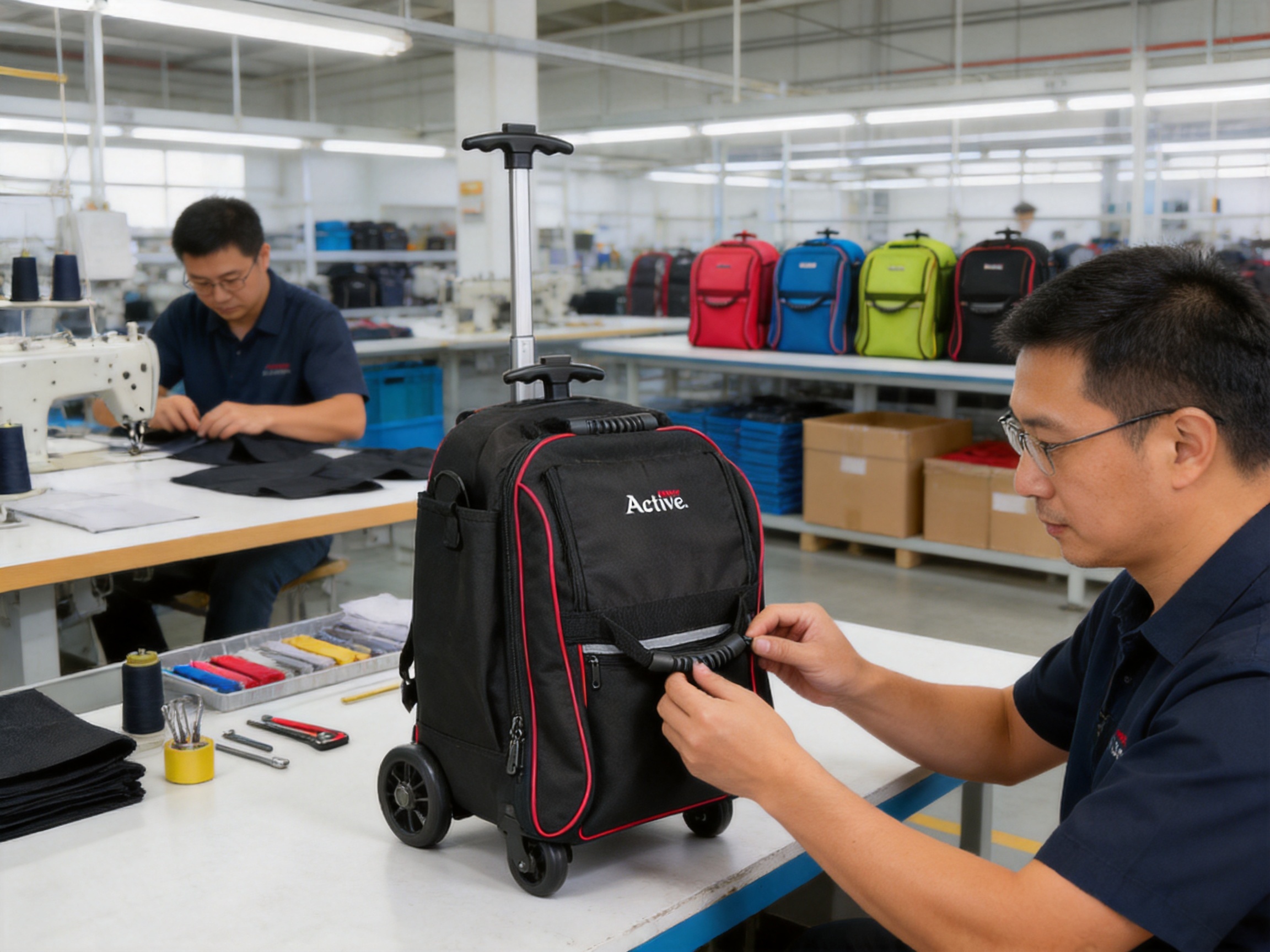
Product performance begins with design, but consistent manufacturing determines whether that design can be repeated at scale. Zhangjiagang Seaark Tools Industrial Co., Ltd. was founded in 2004 and specializes in exporting professional tool bags and providing customization solutions. With more than two decades of experience, the company has developed knowledge across materials, pattern making, sewing, reinforcement, pocket construction, hardware integration, and quality control.
In 2012, the company established Zhangjiagang Haiyi Tool Bags Co., Ltd. as a core manufacturing base in China. It also operates a production facility in Cambodia. Multiple production locations can provide manufacturing flexibility and help support different customer requirements. The Cambodia facility is also positioned as a way to help customers reduce the impact of additional United States tariffs, depending on applicable trade conditions and sourcing arrangements.
The company’s manufacturing organization includes more than 200 employees and approximately 11,000 square meters of floor space. These resources support production planning, material handling, assembly, inspection, packaging, and order fulfillment. For buyers seeking a stable supplier, manufacturing scale can be important because it helps a factory manage repeat orders, product variations, and larger production programs.
Independent Research and Development
Seaark maintains an independent research and development team that develops more than 10 new designs each year. Ongoing design work is valuable in a category where professional users expect improvements in comfort, access, capacity, durability, and specialized functionality.
Research and development for tool bags involves more than changing the appearance of a product. Designers must consider how tools are placed, how weight is distributed, how the bag opens, where stress is concentrated, and how the product interacts with vehicles and worksite conditions. For a trolley tool backpack, the design team must also integrate the telescopic handle, wheels, textile body, pocket system, and carrying structure without making the bag unnecessarily difficult to use.
The company holds multiple design patents and operates the registered Active Storage brand. Patented designs can reflect original approaches to construction, organization, or product structure. For business customers, an established development team can also support private-label projects, modifications to existing products, and new product concepts based on specific market requirements.
Audited Production Facilities
The company’s facilities undergo annual third-party audits, including BSCI, SEDEX, FCCA, and SCS audits. These programs are associated with areas such as social responsibility, ethical sourcing, workplace standards, and supply chain review. Audit results and requirements vary according to the specific program and customer expectations, but regular third-party assessment demonstrates an effort to maintain documented and standardized production practices.
For international buyers, audited facilities can provide additional confidence during supplier evaluation. Compliance management is especially relevant when products are sold through global retail channels or supplied to established brands with requirements relating to labor practices, factory procedures, documentation, and responsible sourcing.
Customization for Global Buyers
The product is available with customized color options, and the manufacturer provides broader customization solutions for global brands and partners. Tool bags can often be adapted in several ways, including fabric color, logo application, labels, pocket arrangements, handle details, packaging, and product dimensions. The appropriate level of customization depends on the buyer’s market, order quantity, target price, and technical requirements.
Customization can help distributors and brands create a product range that corresponds to their identity. A professional tool brand may request a specific color system and logo treatment. A hardware distributor may require packaging suited to retail display. An industrial customer may want a pocket layout designed around a particular set of instruments. A contractor or service company may seek branded bags for employees and field teams.
Effective customization requires coordination between design, materials, sampling, engineering, production, and quality inspection. A change that appears small, such as moving an exterior pocket or adding a heavier tool loop, can affect balance, stitching, production time, and overall cost. An experienced manufacturer can evaluate these effects during the development stage rather than discovering them after mass production begins.
Buyers should provide clear specifications before sampling. Useful information may include target dimensions, expected tool types, maximum load, fabric preferences, color references, logo artwork, packaging needs, performance expectations, and delivery schedule. Detailed requirements help the factory develop a product that is functional as well as visually consistent.
Quality Considerations for Professional Tool Bags
Quality evaluation should cover the complete product rather than a single material or feature. For a wheeled tool backpack, important inspection points include fabric strength, seam quality, pocket attachment, zipper performance, handle movement, wheel installation, base stability, load distribution, and overall appearance.
Fabric inspection helps identify weaving defects, color inconsistency, contamination, or damage before cutting. During production, workers and inspectors can check whether panels are aligned correctly and whether reinforcement pieces have been applied in the intended locations. Stitching should be examined at stress points such as handles, shoulder straps, wheel supports, pocket corners, and the base.
The telescopic handle should extend and retract smoothly and remain stable during pulling. The wheels should rotate without excessive looseness, and their attachment points should be checked for secure assembly. The base should be able to support the bag when it is placed on a flat surface. The zipper should open and close consistently without catching on nearby fabric.
Load testing and simulated handling can provide information about how the product responds to realistic use. Such tests may include repeated pulling, lifting, packing, unpacking, and placement on the ground. The exact testing program should be established according to customer specifications and applicable product requirements.
Quality control also includes packaging and shipment preparation. A well-manufactured bag can still arrive damaged if it is compressed incorrectly, exposed to moisture, or packed without sufficient protection. Careful folding, carton selection, labeling, and loading procedures help preserve product condition through international transportation.
Practical Packing Recommendations
The best organization system is one that matches the user’s working routine. Frequently used tools should be placed in easily visible exterior pockets. Heavier equipment should be positioned low and close to the central body of the bag to help maintain balance when the product is pulled. Delicate instruments should be separated from metal tools and secured in the interior pockets.
Sharp items should be stored so that their edges do not press against the fabric, zipper, or neighboring equipment. Small parts can be grouped in suitable pouches or containers before being placed into larger pockets. This prevents screws, fittings, connectors, and other loose items from spreading throughout the bag.
Users should avoid placing excessive weight in one exterior pocket. Uneven loading can affect balance and increase strain on pocket seams. It is also wise to leave enough room for the bag to close without compressing the contents against the zipper track.
Before pulling the bag, the user should ensure that the telescopic handle is fully extended and that loose straps or accessories do not interfere with the wheels. When carrying the product as a backpack, the load should be adjusted so that the bag sits securely and does not shift excessively during movement.
Care and Maintenance
Regular care can help preserve both the appearance and function of the tool backpack. Surface dirt should be removed with a soft brush or cloth. If deeper cleaning is necessary, users should follow the care instructions provided with the product and avoid chemicals that could weaken the polyester, coatings, labels, or hardware.
The zipper track should be kept free of dust, metal fragments, and fabric debris. Wheels should be checked for thread, wire, or other materials that may become wrapped around the axle. The telescopic handle should be inspected for smooth movement, visible damage, or loose components.
Users should not drag the bag over surfaces that could unnecessarily damage the wheels or base. When the bag is stored for a long period, it should be kept in a dry area away from prolonged direct sunlight and extreme heat. Tools should be removed before storage if their weight could place continuous strain on the bag’s structure.
Professional teams may benefit from a simple inspection routine. At the end of a workday or service cycle, workers can check the zipper, wheels, handle, straps, pocket seams, and base. Early identification of wear makes it easier to repair or replace a component before the issue affects a job.
Why Manufacturing Capability Matters to Buyers
For individual users, the product’s mobility and organization are the most visible benefits. For distributors, importers, and brands, manufacturing capability is equally important. A supplier must be able to produce the approved design consistently, maintain material quality, communicate clearly, and manage orders over time.
Seaark’s experience in professional tool bags provides a foundation for understanding the technical requirements of this product category. Its manufacturing bases in China and Cambodia provide sourcing flexibility, while its workforce and production area support different order programs. The company’s design development activities allow it to offer both existing models and customized solutions.
Long-term supplier relationships depend on more than a single successful shipment. Buyers may need updated samples, revised packaging, new colorways, additional sizes, or modifications for different markets. A manufacturer with an established research and development team, documented production systems, and audit experience is better positioned to support these continuing needs.
The company’s stated philosophy that quality is essential and service adds value reflects the two sides of professional manufacturing. Product quality influences user satisfaction and return rates, while service affects communication, development speed, documentation, and problem resolution. Both are important when supplying tool bags to international customers.
Frequently Asked Questions
What is the main purpose of this tool backpack?
The product is designed to transport professional tools in an organized bag that can be carried as a backpack or pulled on two wheels. It combines a telescopic handle, durable casters, multiple pockets, and a zipped main compartment.
How much weight can it carry?
The stated load capacity is 44.09 pounds. Users should distribute tools evenly, avoid overloading individual pockets, and consider the product’s operating conditions when packing heavy equipment.
How many pockets does the bag have?
It has 25 exterior pockets and seven interior pockets. The exterior pockets are intended for quick access to frequently used tools and parts, while the interior pockets can help separate precision instruments and other equipment.
Can the bag be used as a regular backpack?
Yes. It is designed as a tool backpack and includes a backpack carrying format in addition to the two-wheel trolley function. The backpack option is useful on stairs, uneven terrain, or in areas where pulling a wheeled bag is impractical.
What material is used to make the product?
The product uses polyester, with 1680D polyester identified for high tear resistance. The manufacturer also states that the bag is specially reinforced for demanding construction and plumbing work conditions.
What type of closure does it use?
The main compartment uses a zipper closure. The zipper helps keep stored tools contained during carrying, pulling, and vehicle transportation.
What tools can be stored in the bag?
The bag can be used for a wide variety of professional equipment, including hand tools, electrical tools, plumbing tools, fasteners, accessories, measuring instruments, repair components, and maintenance supplies. The specific tool selection depends on the user’s occupation and packing method.
Is the bag suitable for electricians?
Yes. The exterior pockets can hold frequently used electrical hand tools, while the interior pockets provide separate storage for testers, meters, and other precision equipment. The rolling function can also reduce carrying strain when electricians move through large facilities.
Is the product useful for plumbing workers?
Yes. Plumbing professionals often carry a combination of wrenches, cutters, fittings, sealants, measuring devices, and repair parts. The reinforced construction and organized pocket layout are suitable for this type of mixed tool load.
What are the product dimensions?
The dimensions are 36 x 25 x 54 centimeters. These dimensions provide a relatively compact vertical format while allowing the bag to hold a substantial selection of tools.
Is the color customizable?
Yes. The listed color is customized. Buyers should confirm available color references, minimum order quantities, logo requirements, and sampling procedures with the manufacturer.
Does the manufacturer offer private-label or customized products?
Yes. The company provides comprehensive customization solutions for global brands and partners. Customization may include colors, logos, pocket configurations, materials, packaging, and other product details, subject to technical and commercial evaluation.
Where is the product manufactured?
The product is associated with manufacturing operations in China, and the company also operates a production facility in Cambodia. The country of origin listed for this product is China.
What experience does the manufacturer have?
Zhangjiagang Seaark Tools Industrial Co., Ltd. was founded in 2004 and has more than 20 years of tool bag manufacturing experience. The company operates multiple production bases, employs more than 200 people, and manages approximately 11,000 square meters of floor space.
Does the manufacturer have research and development capabilities?
Yes. The company maintains an independent research and development team that develops more than 10 new designs each year. It also holds multiple design patents and operates the registered Active Storage brand.
Are the manufacturing facilities audited?
The company states that its facilities undergo annual third-party audits, including BSCI, SEDEX, FCCA, and SCS audits. These audits support standardized and compliant production practices for international business.
How should the bag be maintained?
Users should remove dirt regularly, keep the zipper and wheels free from debris, inspect the handle and seams, avoid excessive overloading, and store the bag in a dry location away from prolonged direct sunlight and extreme heat.
Conclusion
The two-wheel telescopic tool backpack provides a versatile answer to the everyday challenge of transporting heavy and varied tool loads. Its 44.09-pound capacity, 25 exterior pockets, seven interior pockets, zipper closure, 1680D polyester construction, telescopic handle, and two durable casters combine to support mobility and organization in one product.
Its main advantage over a conventional tool backpack is the ability to roll the load when suitable surfaces are available. Its advantage over a basic rolling case is the backpack format and flexible textile construction. Its advantage over a simple shoulder bag is the distribution of transportation options and the reduction of concentrated shoulder strain. These features make it suitable for electricians, plumbers, construction workers, maintenance technicians, installers, and service professionals.
The product is also supported by a manufacturer with long-term experience in professional tool bags, multiple production bases, independent research and development, design patents, customization capabilities, and third-party factory audits. This combination of product functionality and manufacturing depth makes the tool backpack relevant not only to individual tradespeople but also to distributors, importers, private-label brands, and industrial buyers.
For the best results, users should select tools carefully, distribute weight evenly, use the exterior and interior pockets according to access needs, and inspect the bag regularly. When properly packed and maintained, the product can serve as a mobile, organized, and adaptable tool storage solution for demanding professional environments.
References
1. Product specification sheet for the two-wheel telescopic tool backpack, including dimensions, material, capacity, closure type, and pocket count.
2. Manufacturer-provided company profile for Zhangjiagang Seaark Tools Industrial Co., Ltd., including company history, production bases, employee count, facility area, and customization services.
3. Manufacturer-provided information concerning product research and development, design patents, registered brand activities, and annual third-party factory audits.
4. General textile product knowledge concerning polyester denier classifications, abrasion resistance, tear resistance, sewing construction, and reinforcement practices.
5. General professional tool-storage principles concerning load distribution, compartment organization, equipment protection, mobility, and routine product maintenance.
Product: Telescopic Pulling Trolley with 2 Wheels Tool Backpack




We are a professional enterprise engaged in exporting various types of toolkits.
We firmly believe that 'quality is everything, service enhances value'.
-
+86-15298800699

-
+86-512-58670375

-
karen@kun-bag.com

-
Building 11, No. 93 Chengang Road, Zhangjiagang City, Jiangsu Province, China

Copyright © Zhangjiagang Seaark Tools Industrial Co., Ltd. All Rights Reserved.
Custom Electrician Tool Backpack Manufacturers