
 en
 русский
 Español
 Deutsch

Professional Woodworking Tool Bag with Adjustable Shoulder Strap: A Rugged, Modular Carrying Solution
For carpenters, joiners, contractors, maintenance technicians, and serious do-it-yourself users, a tool bag is more than a container. It is a mobile workstation that must protect equipment, organize essential tools, withstand demanding jobsite conditions, and remain comfortable during transport. A poorly designed bag can waste time, expose tools to damage, and increase physical strain. A well-designed bag, by contrast, improves workflow from the moment the tools are packed until the final task is completed.
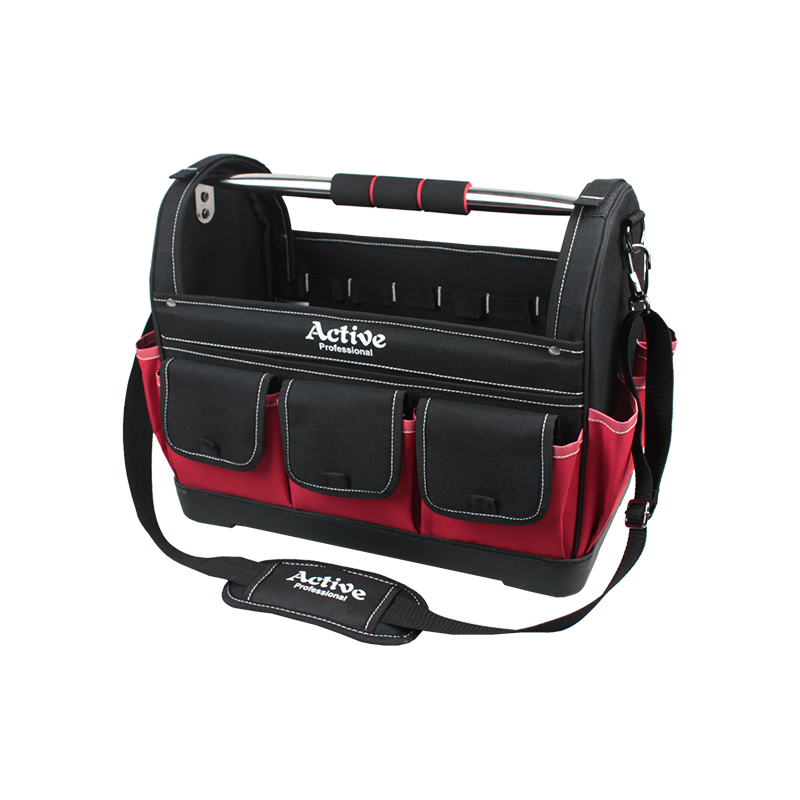
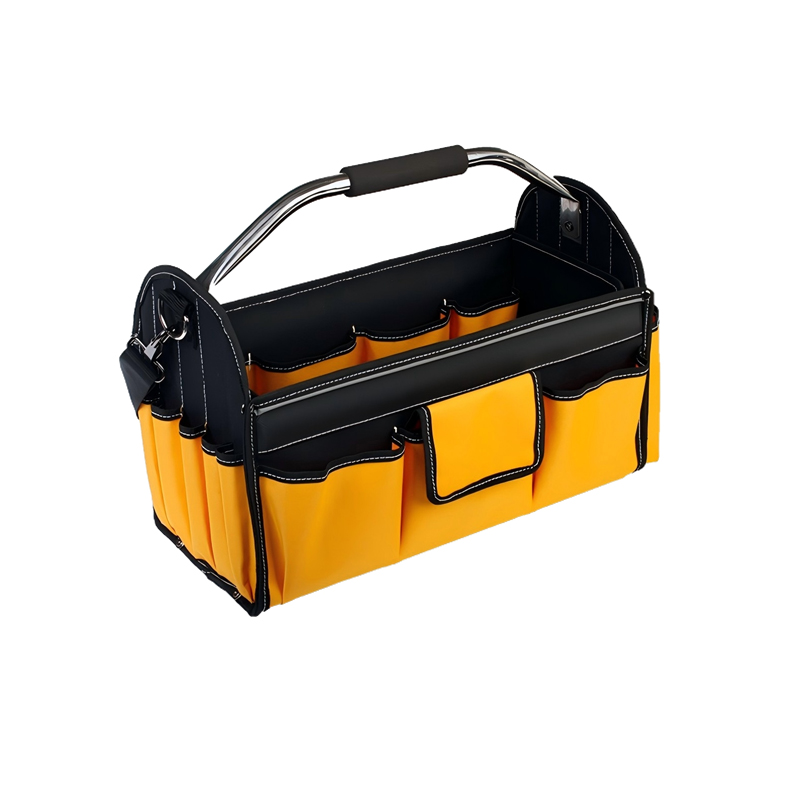
The S003 woodworking tool bag is designed around these practical requirements. It combines high-density polyester fabric, reinforced construction, a wide-mouth opening, a wide-angle zipper system, multiple storage areas, and an adjustable padded shoulder strap. Its 41 × 21 × 28.5 cm format creates a useful balance between carrying capacity and portability, while its stated static load capacity of 44.09 pounds allows users to transport a substantial selection of hand tools and power tools.
Unlike a basic open tote or a lightweight fabric pouch, this zippered tool bag is intended for structured organization and secure transport. It is suitable for woodworking tools such as chisels, planes, measuring equipment, screwdrivers, clamps, and accessories, while its reinforced opening and broad access area make it practical for larger equipment as well. The design is particularly relevant to professionals who need a dependable tool luggage solution that can move between workshops, vehicles, construction sites, and customer locations.
Content
- 1 Why Tool Organization Matters in Professional Work
- 2 High-Density Polyester for Demanding Environments
- 3 Wide-Mouth Access for Faster Tool Retrieval
- 4 Wide-Angle Zipper Closure and Secure Storage
- 5 Storage Capacity and Pocket Configuration
- 6 Designed for Woodworkers and Broader Trade Applications
- 7 Adjustable Padded Shoulder Strap for Long-Distance Carrying
- 8 Comparison with Common Tool-Carrying Alternatives
- 9 Dimensions and Practical Load Planning
- 10 Manufacturing Experience and Production Capability
- 11 Research, Development, and Product Improvement
- 12 Quality Management and Third-Party Audits
- 13 Customization for Global Buyers
- 14 Global Supply and Commercial Advantages
- 15 How the S003 Supports Daily Workflow
- 16 Care and Maintenance Recommendations
- 17 Recommended Use Cases
- 18 Frequently Asked Questions
- 18.1 What type of product is the S003?
- 18.2 What are the dimensions of the tool bag?
- 18.3 What material is used?
- 18.4 How many pockets does the bag have?
- 18.5 Does the bag have a zipper closure?
- 18.6 Can the bag hold power tools?
- 18.7 What is the stated load capacity?
- 18.8 Is the shoulder strap adjustable?
- 18.9 Is the color customizable?
- 18.10 Where is the product manufactured?
- 18.11 Who is the manufacturer?
- 18.12 Can the manufacturer develop customized tool bags?
- 19 Conclusion
- 20 References
- 21 Product: Woodworking Tool Bag with Adjustable Shoulder Strap
Why Tool Organization Matters in Professional Work
Professional tradespeople lose valuable time when tools are mixed together in a single compartment. A chisel may be hidden beneath a tape measure, a small accessory may fall beneath a power tool, and delicate measuring equipment may be exposed to impact from heavier items. These problems appear minor, but they accumulate throughout a working day. Repeated searching interrupts concentration, slows project progress, and creates unnecessary frustration.
The S003 addresses this challenge through a modular spatial layout. Its design incorporates storage areas on both the exterior and interior of the bag, allowing users to separate frequently accessed tools from equipment that should remain protected inside the main compartment. Smaller items can be placed in dedicated areas, while larger tools can be stored in the central cavity. This arrangement helps users establish a consistent packing system according to the requirements of each project.
Organization also has a safety function. Sharp tools such as chisels, blades, and awls should not move freely through a bag where they may contact hands or damage other equipment. Measuring instruments need protection from unnecessary impacts, and electrical tools should be packed in a way that reduces abrasion against cables, housings, and switches. By dividing the interior and exterior storage zones, the bag helps minimize uncontrolled tool movement.
A modular layout is also adaptable. A carpenter working on fine joinery may carry hand planes, chisels, marking gauges, and precision measuring tools. A contractor performing installation work may need drills, drivers, fasteners, and accessories. A maintenance technician may require a different combination of screwdrivers, pliers, testers, and replacement parts. The same bag can be configured for these different tasks without requiring a separate carrying system for every application.
High-Density Polyester for Demanding Environments
Material selection is one of the most important differences between a professional tool bag and a general-purpose carry bag. The S003 uses high-density polyester fabric, selected for its resistance to tearing and abrasion. Tool bags are frequently placed on concrete, timber, metal platforms, vehicle floors, workshop benches, and unfinished surfaces. They may be dragged short distances, pressed against walls, or exposed to repeated friction during loading and unloading. A fabric that performs well in a showroom may fail quickly under these conditions.
High-density polyester provides a practical combination of durability, weight efficiency, and manufacturing flexibility. It can be formed into panels, pockets, handles, protective sections, and reinforced seams while remaining lighter than many rigid alternatives. This makes it appropriate for a bag that must carry heavy tools without becoming unnecessarily difficult to transport when empty or partially loaded.
Abrasion resistance is especially important around the base, corners, pocket openings, and areas that come into contact with vehicle interiors. These are high-wear locations because the bag is repeatedly placed down, lifted, and repositioned. Tear resistance is equally important when a pocket is loaded with a bulky object or when tools press outward against the fabric. The high-density construction helps the bag retain its shape and functional integrity during routine professional use.
Polyester also supports customization. Professional buyers, distributors, and private-label customers often require particular colors, labels, trims, pocket arrangements, or packaging specifications. The product information identifies color as customizable, which allows the same underlying design to be adapted for different markets, corporate identities, and product programs. This flexibility is valuable for wholesalers and brands looking for a consistent tool storage platform rather than a one-time generic purchase.
Wide-Mouth Access for Faster Tool Retrieval
One of the S003’s most useful structural features is its wide-mouth opening reinforced with wire. The opening is designed to remain accessible instead of collapsing inward whenever the zipper is opened. This is a significant advantage over soft bags with narrow, unstructured openings, where users must often hold the bag open with one hand while searching through the contents with the other.
For carpenters and installers, access speed has a direct effect on productivity. A wide opening provides a clearer view of the main compartment and allows tools to be inserted or removed with less resistance. Large hand tools and compact power tools can be placed inside without forcing them through a restricted opening. When a user is working from a ladder, kneeling beside a workpiece, or operating in a confined room, easier access can reduce unnecessary movement.
The wire reinforcement also helps preserve the intended shape of the upper rim. This is useful when the bag is not completely full, because the opening remains more stable and easier to use. It also helps prevent the top from folding inward and obstructing the zipper path. The result is a more controlled opening and closing experience over repeated cycles.
The wide-mouth format does not eliminate the need for careful packing. Heavy items should still be positioned low and centrally, while delicate tools should be separated from hard edges. However, the opening provides the physical space needed to organize the load effectively. Users can see more of the bag’s contents and can pack equipment in a deliberate sequence rather than forcing tools into a narrow cavity.
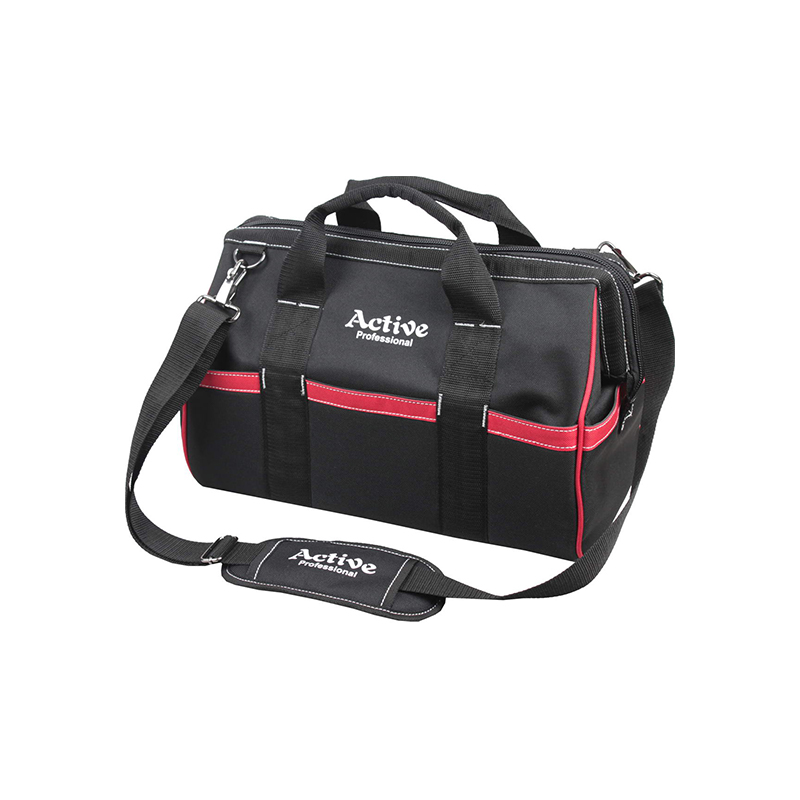
Woodworking Tool Bag with Adjustable Shoulder Strap
Wide-Angle Zipper Closure and Secure Storage
The S003 uses a zipper closure system that works together with the reinforced wide-mouth opening. The zipper helps secure the contents during transport, reducing the chance that tools will fall out when the bag is moved or tilted. It also creates a barrier against the accidental loss of small accessories, such as driver bits, blades, fasteners, and measuring components.
A wide-angle zipper configuration is particularly helpful for a professional tool bag because it permits the top to open farther than a simple straight zipper. This improves visibility and reduces the effort required to reach into the main compartment. It also allows larger items to pass through the opening more easily. In practical use, the combination of a broad opening and a smooth closure system supports both rapid access and reliable containment.
The zipper should be treated as a working component rather than a decorative detail. On a jobsite, it may be opened and closed dozens of times in a single day. Users may operate it while wearing gloves, while carrying another item, or while standing in an awkward position. A well-planned zipper path reduces snagging and makes the bag more convenient for repeated use.
Secure closure is also valuable during vehicle transport. Tools can shift as a vehicle accelerates, stops, or turns. An open tote may allow loose items to bounce out or become scattered across the cargo area. Closing the S003 keeps the principal load contained and helps maintain the user’s organization between locations.
Storage Capacity and Pocket Configuration
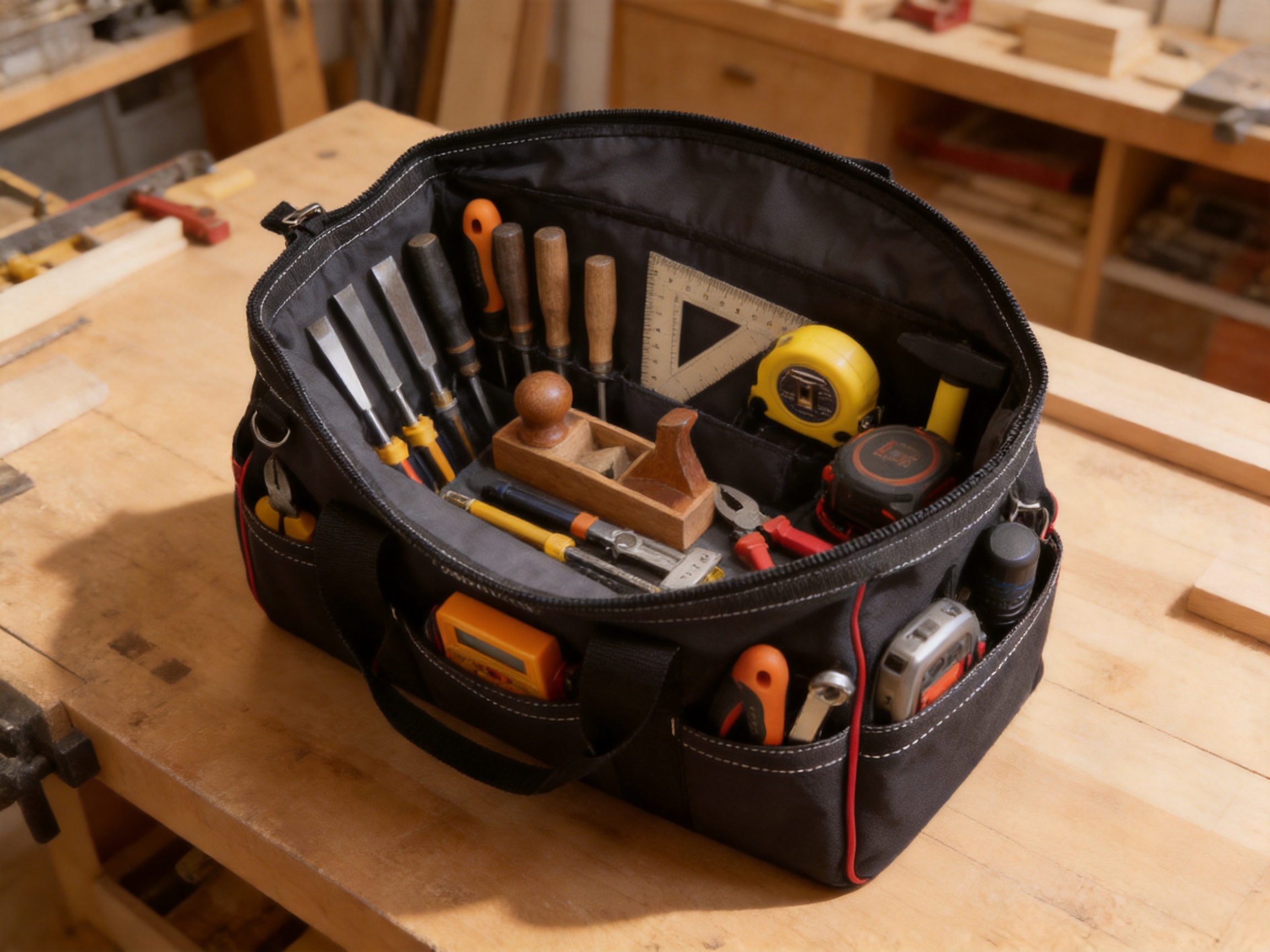
The product information identifies eight functional pockets and specifies eight exterior and eight interior pocket positions in the parameter table. Together, these storage zones give users a structured system for separating tools by frequency of use, size, and sensitivity. Exterior pockets can be used for items that need to be reached quickly, while interior pockets can hold tools that should remain within the protected body of the bag.
Exterior organization is especially useful for common hand tools. A user may place a tape measure, pencil, utility knife, small screwdriver, or pair of pliers in an outside section for immediate access. This prevents the main compartment from becoming a single crowded mass and reduces the number of times the zipper needs to be opened during routine tasks.
Interior storage provides additional control for tools that are less frequently accessed or more vulnerable to contact with the surroundings. Precision measuring equipment, woodworking accessories, spare components, and smaller instruments can be separated from larger power tools. The internal arrangement also gives users more flexibility when dividing tools according to a project’s workflow.
Different users will interpret the pocket system according to their own working habits. A finish carpenter may reserve individual spaces for marking and layout tools. A rough carpenter may use the pockets for drivers, pliers, bits, and fasteners. An electrician or maintenance professional may assign areas to testers, cutters, connectors, and insulated tools. The value of the system is not limited to one trade; it is the ability to create a repeatable arrangement.
Good packing practices can maximize the available capacity. Heavy items should be placed near the bottom of the central compartment, with frequently used tools positioned in accessible outer locations. Sharp tools should be covered or placed so their edges do not press against fabric or other instruments. Small components should be grouped rather than scattered. When the bag is packed consistently, users can identify missing tools more easily before leaving a workshop or jobsite.
Designed for Woodworkers and Broader Trade Applications
The product title identifies the S003 as a woodworking tool bag, and its design is well suited to carpentry-related work. Woodworkers often carry a mixture of hand tools and measuring instruments, including chisels, hand planes, marking tools, squares, rulers, screwdrivers, clamps, and compact power equipment. These tools vary considerably in shape and size, making a combination of pockets and a spacious main compartment more practical than a narrow specialist case.
Chisels and planes require careful placement because their cutting edges and metal bodies can damage softer tools. The bag’s separated storage areas provide a way to position such equipment more responsibly. Measuring tools can be kept in a dedicated zone where they are less likely to be struck by heavier objects. The wide opening also makes it easier to inspect the arrangement before transport.
The same characteristics make the bag useful beyond woodworking. Building contractors can use it for installation equipment and site tools. Maintenance personnel can organize repair instruments and replacement parts. Technicians can carry diagnostic devices, hand tools, and accessories between service locations. Garden and property maintenance workers can use it for compact equipment, pruning accessories, and repair supplies, provided the load is packed within the bag’s intended capacity.
Its adaptability gives the S003 an advantage over highly specialized cases that are designed for only one tool category. A rigid drill case may protect one device effectively but provide little room for supporting hand tools. A simple tote may hold many objects but offer inadequate organization or closure. The S003 occupies a useful middle position: it provides broad access and flexible storage while retaining the security of a zippered enclosure.
Adjustable Padded Shoulder Strap for Long-Distance Carrying
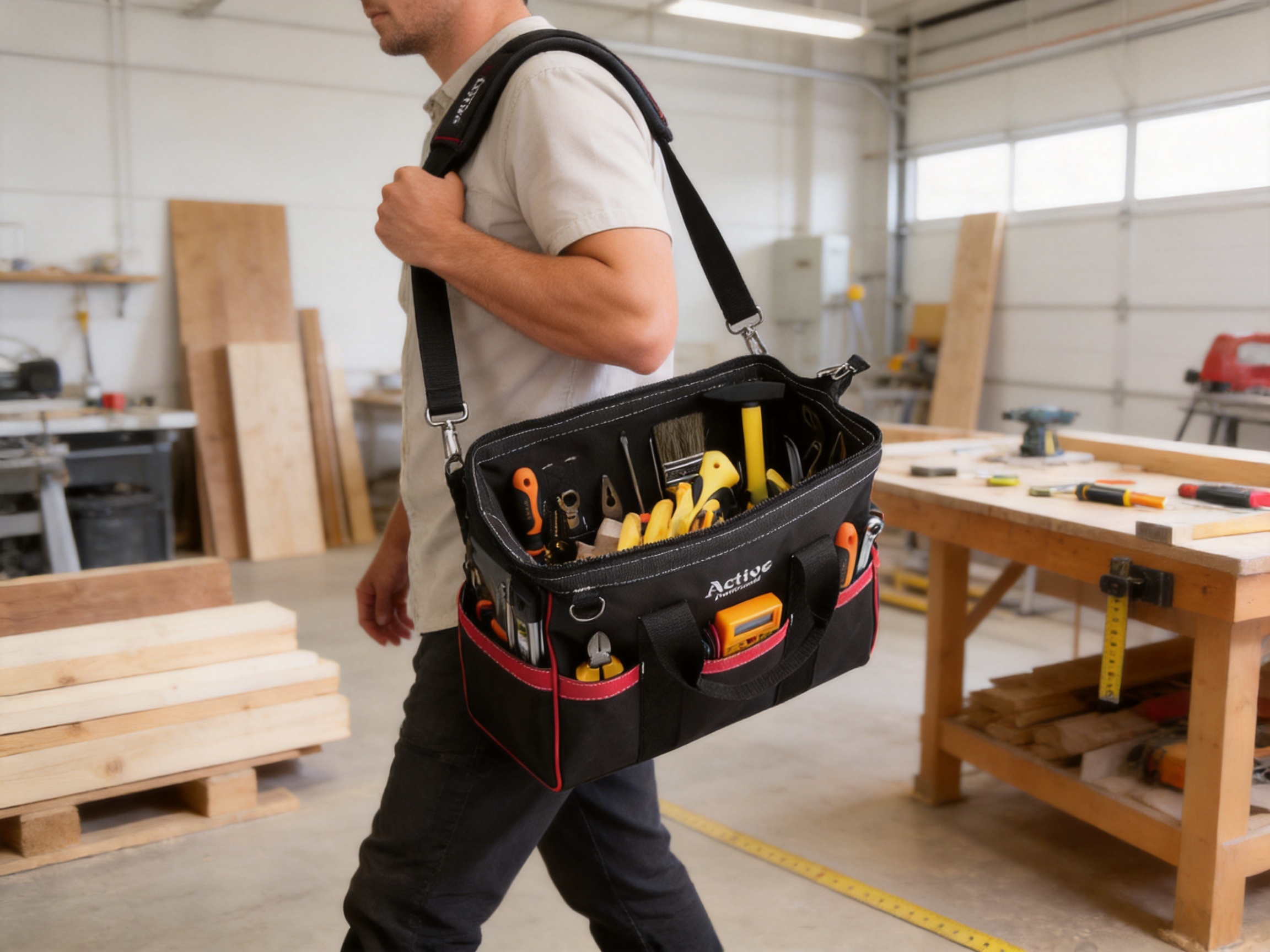
Carrying comfort becomes increasingly important when a tool bag contains metal tools, power equipment, and accessories. Even a short distance can feel demanding when weight is concentrated in one hand or supported by a narrow strap. For users who travel between vehicles, buildings, floors, or work areas, a shoulder strap can be more practical than a hand-only design.
The S003 is equipped with an ergonomically designed adjustable padded shoulder strap. The adjustable feature allows users to change the length according to body size, carrying preference, and the type of clothing being worn. A carpenter may prefer the bag to rest higher while moving through a crowded workshop, while another user may want it lower for easier access or improved balance.
Padding helps distribute pressure over a broader contact area. This can reduce the discomfort associated with a narrow strap pressing into the shoulder, especially when the bag is heavily loaded. The shoulder strap is not intended to eliminate the effects of weight, but it can make the load feel more manageable by improving contact and reducing concentrated pressure.
Ergonomic carrying is also related to movement efficiency. A properly adjusted strap helps keep the bag closer to the user’s body, limiting excessive swinging while walking. Better control can be particularly helpful when navigating stairs, uneven ground, workshop obstacles, and active construction areas. Users should always adjust the strap before loading the bag fully and should avoid carrying more weight than is appropriate for their physical condition.
The stated static load capacity is 44.09 pounds. This figure indicates the product’s specified ability to support a substantial load under static conditions. Actual field performance depends on how the load is distributed, how the bag is lifted, the condition of the strap and seams, and the duration and frequency of use. Responsible loading remains essential, but the rating demonstrates that the bag is intended for professional-level carrying rather than light personal storage.
Comparison with Common Tool-Carrying Alternatives
Tool storage products differ significantly in their balance between capacity, access, organization, protection, and portability. Comparing the S003 with common alternatives helps clarify its competitive advantages.
| Tool-Carrying Option | Typical Strength | Common Limitation | Relevant S003 Advantage |
|---|---|---|---|
| Open fabric tote | Fast top access and simple construction | Limited security and weak organization | Combines broad access with a zipper closure and multiple pockets |
| Rigid plastic case | Strong protection for a specific tool | Limited flexibility and inefficient use of space for mixed tools | Flexible polyester body accommodates varied hand and power tools |
| Small tool pouch | Lightweight and easy to wear | Insufficient capacity for a complete tool selection | Provides a larger main compartment and structured storage zones |
| Tool backpack | Hands-free carrying and vertical organization | Can be slower to access when placed on the ground | Wide-mouth opening supports fast access from above |
| Rolling tool luggage | Convenient for very heavy loads on smooth surfaces | Less convenient on stairs, rough ground, and confined spaces | Shoulder carrying is practical for varied jobsite conditions |
| Basic duffel bag | Large, inexpensive central space | Tools become mixed and may damage one another | Interior and exterior pocket organization improves separation |
The comparison does not suggest that one type of storage is ideal for every task. A rolling bag may be preferable when transporting a very large load across a warehouse, and a rigid case may be best for a fragile specialized instrument. The S003’s advantage is its versatility. It provides a professional balance for users who need a portable, organized, and closable bag capable of handling a varied tool selection.
Compared with an open tote, the S003 offers better containment during transport. Compared with a small pouch, it provides substantially more capacity. Compared with a rigid case, it is more adaptable to irregularly shaped equipment. Compared with a backpack, it offers a wide top opening that can be easier to inspect and load. These distinctions make it a strong candidate for mobile work where conditions change throughout the day.
Dimensions and Practical Load Planning
The stated dimensions are 41 × 21 × 28.5 cm. This size is large enough to hold a meaningful selection of tools while remaining compact enough for vehicle storage, workshop shelving, and movement through ordinary work areas. Dimensions also affect how the bag fits beside other equipment. A moderately proportioned rectangular format can be placed in a van compartment, under a workbench, or next to a toolbox without requiring excessive space.
Users should plan the load according to both volume and weight. A bag may have enough physical space for a large number of tools but become uncomfortable if every available area is filled with dense metal equipment. Conversely, a lightweight collection of bulky accessories may occupy significant volume without approaching the load limit. Understanding this difference helps prevent overloading and improves carrying comfort.
The central space should be reserved for the largest or least frequently accessed equipment. Pockets should hold slim tools and small accessories, with each zone assigned a logical purpose. If the bag is used for a specific trade, users can create a standard load list. For example, a woodworking load may include layout tools, chisels, planes, fastening tools, abrasives, and a compact power tool. A maintenance load may instead prioritize drivers, pliers, testers, replacement parts, and cable accessories.
Balanced packing reduces strain on the shoulder strap and helps the bag sit more naturally against the body. Heavy tools should not all be placed on one side. Sharp edges should be oriented away from the fabric and strap attachments. Tools that may leak oil, moisture, or other substances should be cleaned and isolated before being stored. These simple practices can extend product life and protect the rest of the contents.
Manufacturing Experience and Production Capability
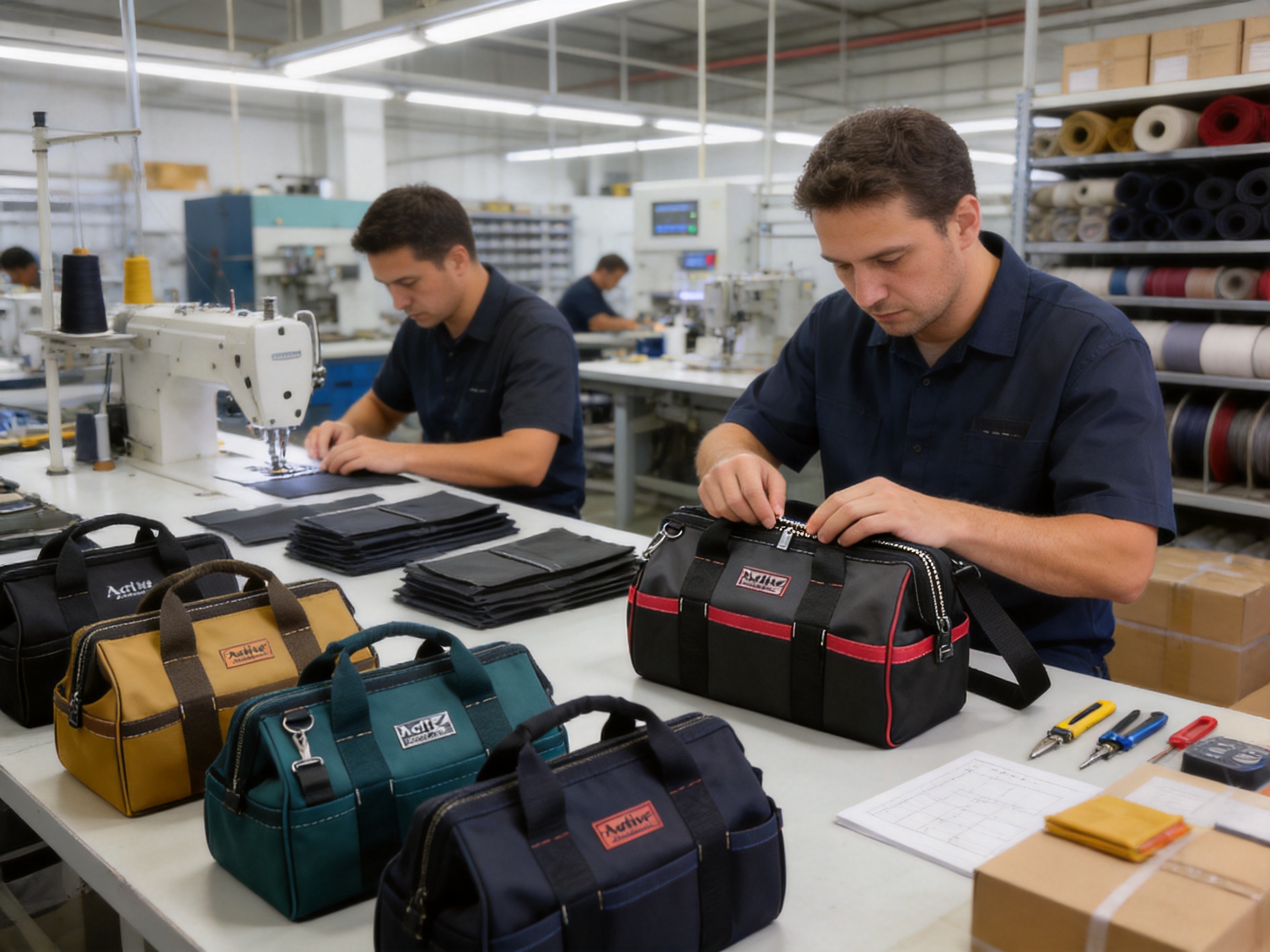
The performance of a professional tool bag depends not only on its visible design but also on the manufacturing system behind it. Zhangjiagang Seaark Tools Industrial Co., Ltd. was founded in 2004 and specializes in exporting professional tool bags and delivering customization solutions. More than two decades of experience provide an important foundation for understanding fabric selection, pocket construction, reinforcement, closures, load-bearing components, and the practical requirements of international customers.
In 2012, the company established Zhangjiagang Haiyi Tool Bags Co., Ltd. as a core manufacturing base in China. The company also operates a production facility in Cambodia. This multi-location structure supports flexible global supply and can help customers manage sourcing requirements and the effects of additional United States tariffs. For importers and brands, production flexibility can be as important as product design because it supports continuity when market conditions, order volumes, or regional requirements change.
The organization operates multiple production bases, employs more than 200 people, and manages approximately 11,000 square meters of floor space. These resources are relevant to both standard product supply and customized programs. A larger manufacturing structure can support material purchasing, sample development, cutting, sewing, inspection, packing, and shipment coordination with greater consistency than a small workshop focused only on occasional orders.
Manufacturing scale must be supported by process discipline. Tool bags contain many interacting components: outer fabric panels, lining sections, pocket walls, webbing, zipper tapes, reinforcement materials, thread, labels, and attachment points. If any component is poorly aligned or inadequately secured, the finished product may be difficult to use or less durable. Experienced production teams are better positioned to control these details through established work instructions and inspection procedures.
Research, Development, and Product Improvement
The company maintains an independent research and development team and develops more than ten new designs each year. This ongoing development activity is significant in a product category where small improvements can create meaningful practical benefits. Changes to pocket depth, zipper direction, opening width, strap position, reinforcement placement, or internal layout can influence how efficiently a professional works.
Independent research and development also allows the manufacturer to respond to customer feedback rather than simply reproducing a fixed design. A distributor may request a different color or logo arrangement. A private-label brand may need a revised pocket system. An industrial customer may require a stronger base, a different closure, or a special compartment for a particular instrument. A manufacturer with internal development capability can evaluate these requirements more efficiently.
The S003 demonstrates a design approach based on real use conditions. Its features address several common complaints about tool bags: inadequate access, weak organization, uncomfortable carrying, insufficient closure, and poor resistance to jobsite wear. The wide-mouth opening supports visibility, the pocket system supports separation, the padded strap supports carrying comfort, and the high-density polyester supports durability.
The company’s registered brand is Active Storage, and it holds multiple design patents. Intellectual property protection indicates that the organization invests in original product development rather than relying exclusively on generic market designs. For professional buyers, this can provide confidence that the product platform is supported by purposeful engineering and an established development process.
Quality Management and Third-Party Audits
Quality in soft goods manufacturing is built through repeatable processes. Visual inspection alone is not enough if cutting dimensions vary, seams are inconsistent, zipper alignment is poor, or webbing attachments are not properly secured. A professional supplier must control materials, production operations, finishing, inspection, and packing as part of a connected system.
The company’s facilities undergo annual third-party audits, including BSCI, SEDEX, FCCA, and SCS audits. These programs are associated with social responsibility, ethical sourcing, factory compliance, and supply-chain expectations. Audits do not replace product testing or customer inspection, but they provide an additional level of external review of manufacturing practices and operational standards.
For international buyers, third-party audits can be important during supplier qualification. Retailers, importers, and brands often need evidence that manufacturing partners operate within recognized compliance frameworks. Audited facilities may also be better prepared to provide documentation and maintain the process consistency required by larger customers.
Quality assurance for a product such as the S003 may include checking fabric condition, dimensions, pocket placement, zipper operation, strap attachment, stitching, appearance, and packing. Load-related evaluation should consider the connection between the bag body, handles, strap points, and seams. Although the supplied product information identifies a 44.09-pound static load capacity, users should follow the manufacturer’s handling guidance and avoid treating a static rating as a guarantee for every dynamic lifting situation.
Consistent quality is particularly important when the product is sold under a distributor’s or private-label customer’s identity. End users judge the brand by the performance of the finished bag, so the manufacturer must protect both product function and visual presentation. Reliable color matching, labeling, packaging, and final inspection all contribute to customer satisfaction.
Customization for Global Buyers
Color is identified as customizable, and the company provides comprehensive customization solutions. Customization may allow business customers to align the tool bag with an existing product range, corporate identity, safety color system, or retail strategy. A contractor may request a recognizable team color, while a distributor may require a coordinated appearance across several tool storage products.
Customization can extend beyond color when project requirements justify additional development. Potential areas may include logo application, label placement, pocket configuration, trim details, packaging, instruction materials, and regional product presentation. Any modification should be evaluated for its effect on production complexity, durability, lead time, minimum order quantity, and cost.
Experienced customization requires clear communication. Buyers should provide technical drawings, reference samples, target dimensions, material preferences, branding files, packaging requirements, and inspection standards. The manufacturer can then create samples for evaluation before mass production. Sample approval is especially important for tool bags because the visual appearance may not reveal how easily tools fit into pockets or how the bag behaves when fully loaded.
A structured development process can reduce the risk of late-stage changes. The buyer and manufacturer should confirm the intended users, primary tools, expected load, carrying method, market regulations, and shipping requirements at the beginning of the project. When these details are defined early, the resulting product is more likely to meet functional expectations as well as appearance requirements.
Global Supply and Commercial Advantages
For wholesalers, importers, and established brands, a supplier’s commercial capabilities matter alongside the physical quality of the product. Zhangjiagang Seaark Tools Industrial Co., Ltd. specializes in exporting professional tool bags and has experience serving global clients. Its production resources in China and Cambodia create options for supply planning and may help customers respond to changing tariff or sourcing conditions.
Multiple production bases can support capacity management. If demand rises, production planning may be distributed across suitable facilities. If a customer has specific regional sourcing requirements, the supplier can evaluate available options. This does not remove the need for careful qualification, because quality and specifications must remain consistent across production locations. However, the presence of an international manufacturing structure can provide greater flexibility than a single-site supplier.
The company’s more than 20 years of manufacturing experience also supports communication with overseas buyers. Export-oriented production typically requires attention to carton dimensions, shipping marks, documentation, product labeling, packing methods, and delivery schedules. These details are essential to a smooth supply chain and can affect the total cost of ownership even when the unit price of the bag is competitive.
For customers building a range of professional storage products, the company’s broader portfolio is another advantage. Its product categories include trolley tool bags, tool backpacks, zippered tool bags, tool bags with tubular handles, waist tool bags, tool pouches, tool vests, tool bucket bags, folding-seat tool bags, pocket handy tool bags, garden bags, and other multifunctional bags. A buyer can therefore evaluate related products through a supplier with experience across multiple carrying formats.
How the S003 Supports Daily Workflow
A professional tool bag should save time repeatedly, not merely look durable when new. The S003 supports daily workflow through a sequence of practical actions. Before leaving the workshop, the user can check the exterior pockets and main compartment against a standard tool list. During transport, the zipper keeps the load enclosed. At the work location, the wide-mouth opening allows a quick visual check. During the task, frequently used tools can remain in accessible pockets while larger equipment stays in the central area.
At the end of the project, the same organization supports faster cleanup. Missing tools are easier to identify when each category has a defined location. Loose accessories can be returned to the interior pockets, and the main compartment can be checked before the zipper is closed. This reduces the possibility of leaving a tool behind in a customer’s home, a construction area, or a vehicle.
The bag can also support team standardization. A company with several technicians may establish a common arrangement for each bag. Standard packing helps employees find tools even when they use equipment belonging to another team member. It also makes replenishment easier because missing or damaged items can be identified from a consistent checklist.
For training environments, organized tool storage teaches good working habits. Apprentices and new employees can learn to protect sharp tools, separate delicate instruments, close bags during movement, and return equipment to designated locations. These habits support both efficiency and safety across the working life of the tool set.
Care and Maintenance Recommendations
Regular care can extend the service life of any textile tool bag. Users should remove sawdust, dirt, metal fragments, and other debris from the interior and pocket areas. Fine particles can accumulate near zipper tracks and seams, where they may interfere with operation or cause unnecessary abrasion. The bag should be emptied periodically rather than allowing debris to remain beneath the tools.
The polyester fabric can be cleaned according to the manufacturer’s care instructions. Harsh chemicals, excessive heat, and abrasive scrubbing should be avoided unless specifically approved. After exposure to moisture, the bag should be allowed to dry fully before it is packed and stored. Prolonged dampness can affect tools as well as the fabric and hardware.
The zipper should be operated without forcing it around overloaded sections. If the main compartment is packed beyond its practical capacity, tension may increase along the zipper path and at the seams. Users should inspect the strap, attachment points, stitching, pocket edges, and base periodically. Early identification of loose threads or damage allows repair or replacement before a failure occurs.
When storing the bag for an extended period, it is best to keep it in a dry, ventilated location away from direct heat and sharp objects. Tools should not be left inside if they are oily, wet, or unusually heavy. Proper storage protects the bag and prevents the equipment from creating unnecessary deformation.
Recommended Use Cases
The S003 is a strong fit for mobile carpenters who need to transport a mixed set of hand tools and compact power equipment. It is also suitable for workshop-to-site work, where tools must move between a fixed storage area and an active project. The adjustable shoulder strap is particularly useful when the user must walk across a property or carry the bag up stairs.
Contractors may use the bag as a secondary equipment carrier alongside larger tool luggage or a rolling toolbox. Its role can be to hold the tools needed for a particular stage of a project, reducing the need to move an entire collection at once. Maintenance technicians can use it as a portable service kit, while installers can organize the instruments and accessories required for a scheduled task.
It may be less suitable for extremely oversized equipment, very fragile laboratory instruments, or loads that require waterproof hard-shell protection. Users working in exceptionally wet conditions should confirm whether additional weather protection is required. The product is designed as a professional polyester tool bag with a zipper closure, not as a fully sealed waterproof container.
Within its intended application, however, the S003 offers an effective combination of capacity, organization, access, and carrying comfort. Its competitive value comes from integrating these features into one portable format rather than optimizing only one characteristic at the expense of the others.
Frequently Asked Questions
What type of product is the S003?
The S003 is a professional zippered tool bag designed for woodworking, carpentry, maintenance, installation, and related trade applications. It includes a wide-mouth main opening, multiple storage areas, and an adjustable padded shoulder strap.
What are the dimensions of the tool bag?
The stated dimensions are 41 × 21 × 28.5 cm. This format provides space for a mixed selection of hand tools, accessories, and compact power tools while remaining practical for transport and vehicle storage.
What material is used?
The bag is made from high-density polyester fabric. The material is selected for tear resistance and abrasion resistance, which are important characteristics for repeated use in workshops, vehicles, and construction environments.
How many pockets does the bag have?
The product description refers to eight functional pockets, while the parameter information specifies eight exterior and eight interior pocket positions. These interior and exterior storage zones are intended to support structured organization and separation of tools.
Does the bag have a zipper closure?
Yes. The closure type is zipper. The wide-angle zipper works with the reinforced wide-mouth opening to provide broad access while helping keep tools contained during transport.
Can the bag hold power tools?
The wide-mouth design is intended to provide access for large hand tools and power tools. Users should confirm that the dimensions of a particular tool are compatible with the bag and should pack heavy equipment securely.
What is the stated load capacity?
The stated static load capacity is 44.09 pounds. Actual safe use depends on load distribution, handling conditions, component condition, and the manufacturer’s guidance. The bag should not be overloaded or subjected to inappropriate dynamic lifting.
Is the shoulder strap adjustable?
Yes. The S003 includes an adjustable padded shoulder strap. Its length can be adapted to the user’s body size and carrying preference, while the padding helps distribute pressure over the shoulder.
Is the color customizable?
Yes. The product information identifies color as customizable. Customers should discuss available color standards, minimum order quantities, branding requirements, and sampling procedures with the manufacturer.
Where is the product manufactured?
The company is based in Zhangjiagang, Jiangsu Province, China, and maintains manufacturing resources in China and Cambodia. The product information identifies China as the country of origin for this item.
Who is the manufacturer?
The product is manufactured and supplied by Zhangjiagang Seaark Tools Industrial Co., Ltd., a company specializing in professional tool bags, export supply, and customization solutions.
Can the manufacturer develop customized tool bags?
Yes. The company provides standard products and tailor-made solutions. Customization may involve color, branding, pocket arrangements, packaging, and other specifications, subject to technical review and commercial requirements.
Conclusion
The S003 woodworking tool bag is designed to solve several everyday challenges faced by professional tool users. Its high-density polyester construction supports resistance to tearing and abrasion. Its 41 × 21 × 28.5 cm dimensions provide a practical balance between capacity and portability. Its interior and exterior storage areas support organized packing, while the reinforced wide-mouth opening and wide-angle zipper make tool retrieval more convenient.
The adjustable padded shoulder strap adds carrying flexibility for users who travel between work areas, and the stated 44.09-pound static load capacity demonstrates a professional-oriented design target. Compared with open totes, small pouches, rigid cases, and unstructured duffel bags, the S003 offers a well-rounded combination of access, containment, organization, and mobility.
Its commercial value is strengthened by the manufacturer’s long experience, independent research and development capability, multiple production bases, international export background, and annual third-party factory audits. These capabilities support both standard supply and customized programs for global brands, distributors, contractors, and industrial customers.
For buyers seeking a rugged tool bag that can accommodate varied equipment without becoming unnecessarily complicated, the S003 represents a practical and adaptable solution. It is built around the realities of professional work: tools must be protected, available, organized, and transportable. By combining durable fabric, flexible storage, secure closure, wide access, and ergonomic carrying, the bag provides a dependable foundation for efficient tool management.
References
1. Product specification sheet for the S003 woodworking tool bag, including dimensions, material, closure type, pocket configuration, load capacity, and country of origin.
2. Product description for the professional woodworking tool bag with adjustable padded shoulder strap.
3. Company information supplied by Zhangjiagang Seaark Tools Industrial Co., Ltd., including manufacturing history, production locations, employee scale, facility area, product categories, and customization services.
4. Manufacturing and quality information supplied by Zhangjiagang Seaark Tools Industrial Co., Ltd., including independent research and development, design patents, and third-party audit programs.
5. General principles of professional tool storage, load distribution, textile product care, and workplace organization.
Product: Woodworking Tool Bag with Adjustable Shoulder Strap


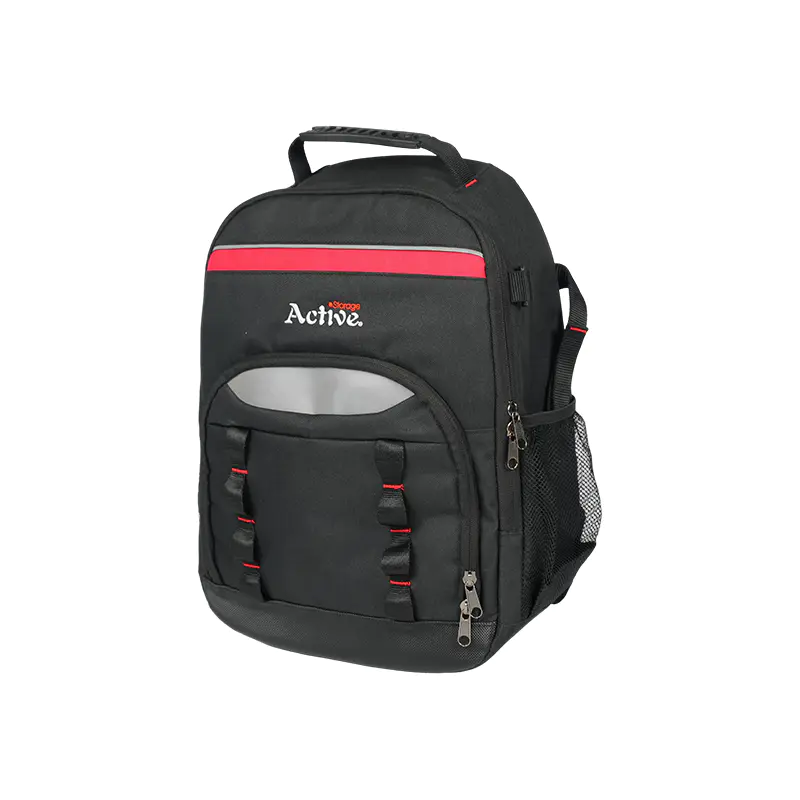


We are a professional enterprise engaged in exporting various types of toolkits.
We firmly believe that 'quality is everything, service enhances value'.
-
+86-15298800699

-
+86-512-58670375

-
karen@kun-bag.com

-
Building 11, No. 93 Chengang Road, Zhangjiagang City, Jiangsu Province, China

Copyright © Zhangjiagang Seaark Tools Industrial Co., Ltd. All Rights Reserved.
Custom Electrician Tool Backpack Manufacturers