
 en
 русский
 Español
 Deutsch

Dual-Wheel Off-Road Heavy-Duty Traction Tool Bag: A Complete Guide to Capacity, Mobility, and Professional Performance
Professionals who work outdoors need more than a simple container for carrying hand tools. Gardeners, landscapers, construction crews, maintenance technicians, utility workers, and mobile repair specialists often move across surfaces that are difficult for ordinary tool bags to handle. Gravel paths, muddy ground, uneven soil, construction debris, grass, and outdoor work sites place considerable demands on both the worker and the equipment carrier. A tool bag designed for smooth indoor floors may become unstable, difficult to pull, or vulnerable to abrasion as soon as it is used in a demanding outdoor environment.
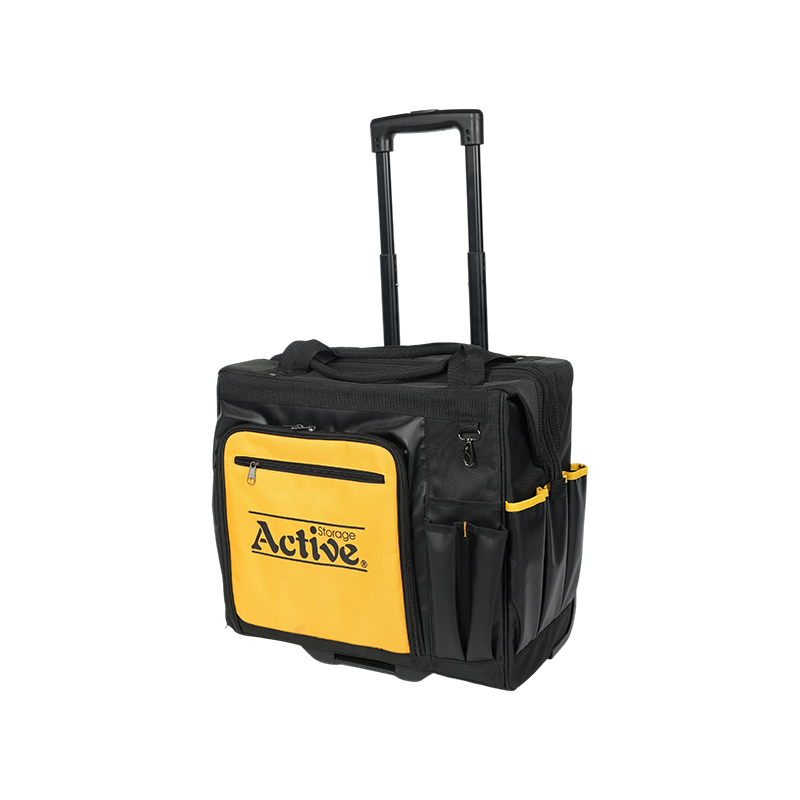
The Dual-Wheel Off-Road Heavy-Duty Traction Tool Bag is designed to address these practical challenges. As a trolley tool bag, it combines a large internal storage area, 26 organized pockets, a zipper closure, durable hardware, a high-strength polyester body, and two heavy-duty wheels. Its construction is intended to provide improved mobility over irregular terrain while keeping a professional collection of tools organized and accessible.
With dimensions of 48 by 25.5 by 44 centimeters and a stated load capacity of 55.12 pounds, the bag offers a substantial carrying solution without requiring the user to carry the full load by hand. The dual-wheel configuration supports controlled movement, while the reinforced exterior and waterproof polyester help the bag withstand outdoor exposure. These characteristics make the model particularly suitable for users who need a dependable mobile tool carrier rather than a lightweight pouch or conventional shoulder bag.
This article examines the product’s design, storage system, mobility, materials, manufacturing support, customization potential, and advantages compared with common tool-carrying alternatives. It also explains how its design may benefit professional users who require capacity, organization, and durability in a single product.
Content
- 1 Designed for Difficult Outdoor Work Environments
- 2 High-Capacity Storage in a Compact Professional Format
- 3 Dimensions and Load Capacity
- 4 High-Strength Waterproof Polyester Construction
- 5 Advantages Over Common Tool-Carrying Alternatives
- 6 Practical Applications Across Multiple Industries
- 7 Manufacturing Expertise and Customization Capability
- 8 Customization for Brands and Professional Programs
- 9 Using the Bag Efficiently
- 10 Purchasing Considerations for Professional Buyers
- 11 Why the Product Is a Strong Competitive Choice
- 12 Quality, Durability, and Long-Term Value
- 13 Frequently Asked Questions
- 13.1 What type of product is the Dual-Wheel Off-Road Heavy-Duty Traction Tool Bag?
- 13.2 What makes the bag suitable for off-road use?
- 13.3 How many pockets does the bag have?
- 13.4 What are the product dimensions?
- 13.5 What is the load capacity?
- 13.6 Is the bag waterproof?
- 13.7 Is the main compartment secured with a zipper?
- 13.8 Who can use this trolley tool bag?
- 13.9 How does it compare with a tool backpack?
- 13.10 How does it compare with a standard hand-carry tool bag?
- 13.11 Can the color be customized?
- 13.12 Can the product be customized for a private-label program?
- 13.13 Where is the product manufactured?
- 13.14 What manufacturing experience does the supplier have?
- 13.15 Does the supplier develop new tool bag designs?
- 13.16 What audits are associated with the manufacturing facilities?
- 13.17 How should the bag be loaded?
- 13.18 Can the wheels handle every type of terrain?
- 14 Conclusion
- 15 References
- 16 Product: Dual-Wheel Off-Road Heavy-Duty Traction Tool Bag
Designed for Difficult Outdoor Work Environments
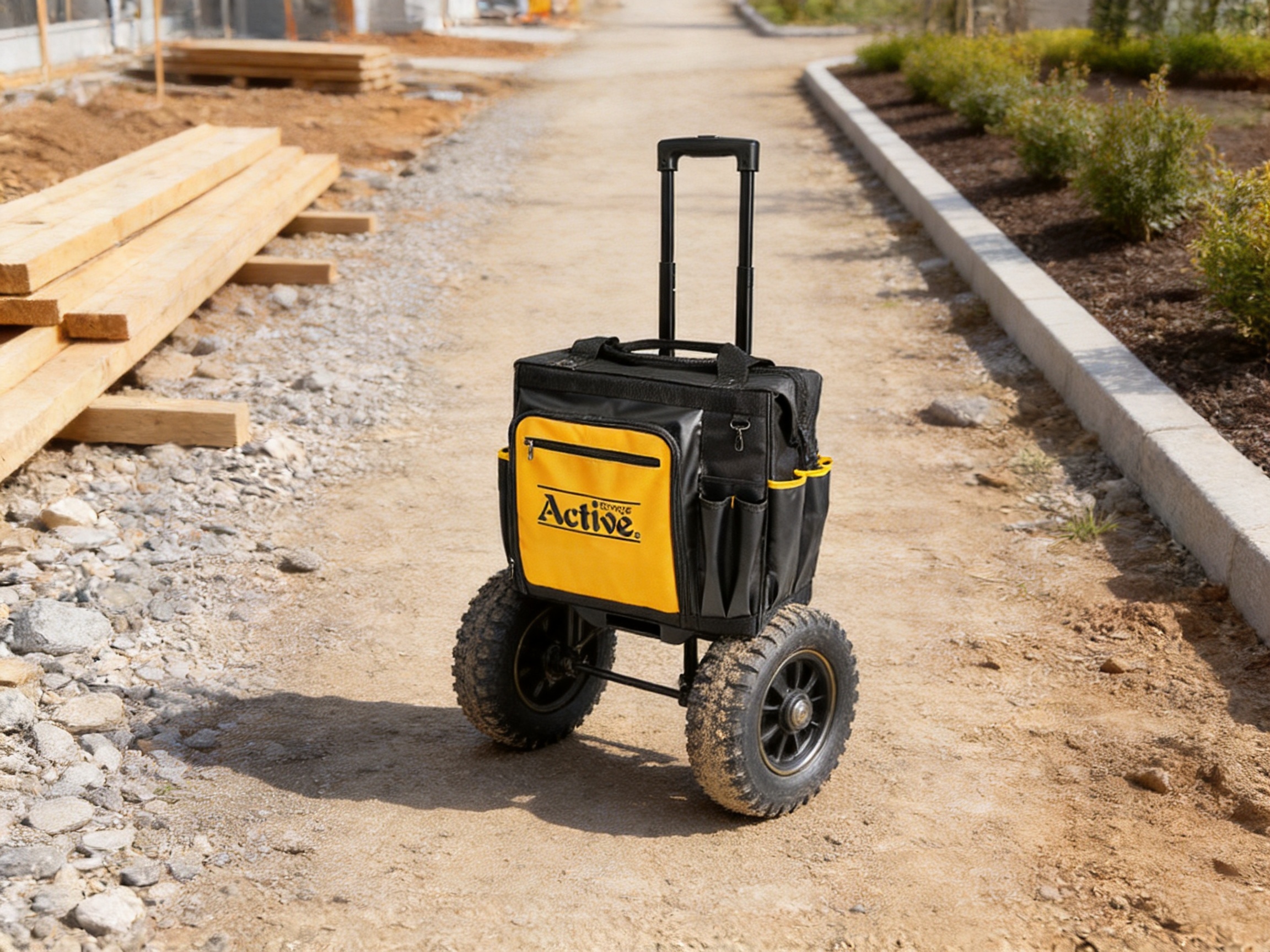
The defining feature of this trolley tool bag is its focus on off-road movement. Many wheeled bags are created primarily for indoor use, where the floor is flat, clean, and relatively predictable. Small casters can work effectively on workshop floors, warehouse surfaces, and office corridors, but they may struggle when exposed to loose gravel, uneven soil, grass, roots, stones, or outdoor debris. A wheel that performs well on polished concrete is not necessarily suitable for a garden, construction site, or rural maintenance area.
This model uses two heavy-duty large wheels to support movement across challenging ground. The larger wheel format helps the bag roll over small obstacles more effectively than many compact-wheel designs. Instead of lifting the bag repeatedly or dragging its lower section across the ground, the user can pull the trolley along a suitable path and let the wheel system absorb much of the movement.
Two wheels also provide a practical balance between stability and maneuverability. A single-wheel bag may tilt heavily when loaded, especially if tools are distributed unevenly. A multi-caster design may offer smooth turning indoors but can become less reliable outdoors when one caster enters a depression or catches on loose material. The dual-wheel structure of this model is intended to keep the bag aligned during forward movement while supporting the substantial load associated with professional tools.
For gardeners and outdoor constructors, this distinction can have a direct effect on productivity. A worker may need to move from a storage area to a garden bed, from a vehicle to a construction location, or between several outdoor workstations. A trolley bag that is easier to pull over rough surfaces reduces unnecessary lifting and allows more tools to be transported in one trip.
The off-road concept does not mean that the bag should be treated as industrial transport equipment or exposed to extreme conditions without care. However, its design clearly prioritizes terrain tolerance over the limited mobility of a conventional soft tool bag. This makes it a more suitable choice for outdoor work than many compact trolley products designed only for level indoor surfaces.
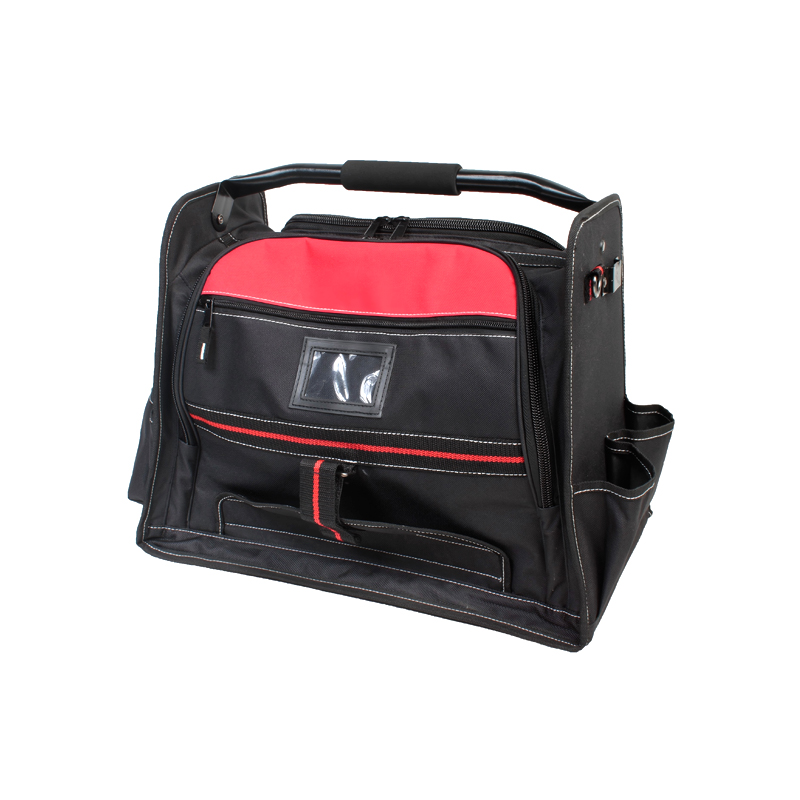
Dual-Wheel Off-Road Heavy-Duty Traction Tool Bag
High-Capacity Storage in a Compact Professional Format
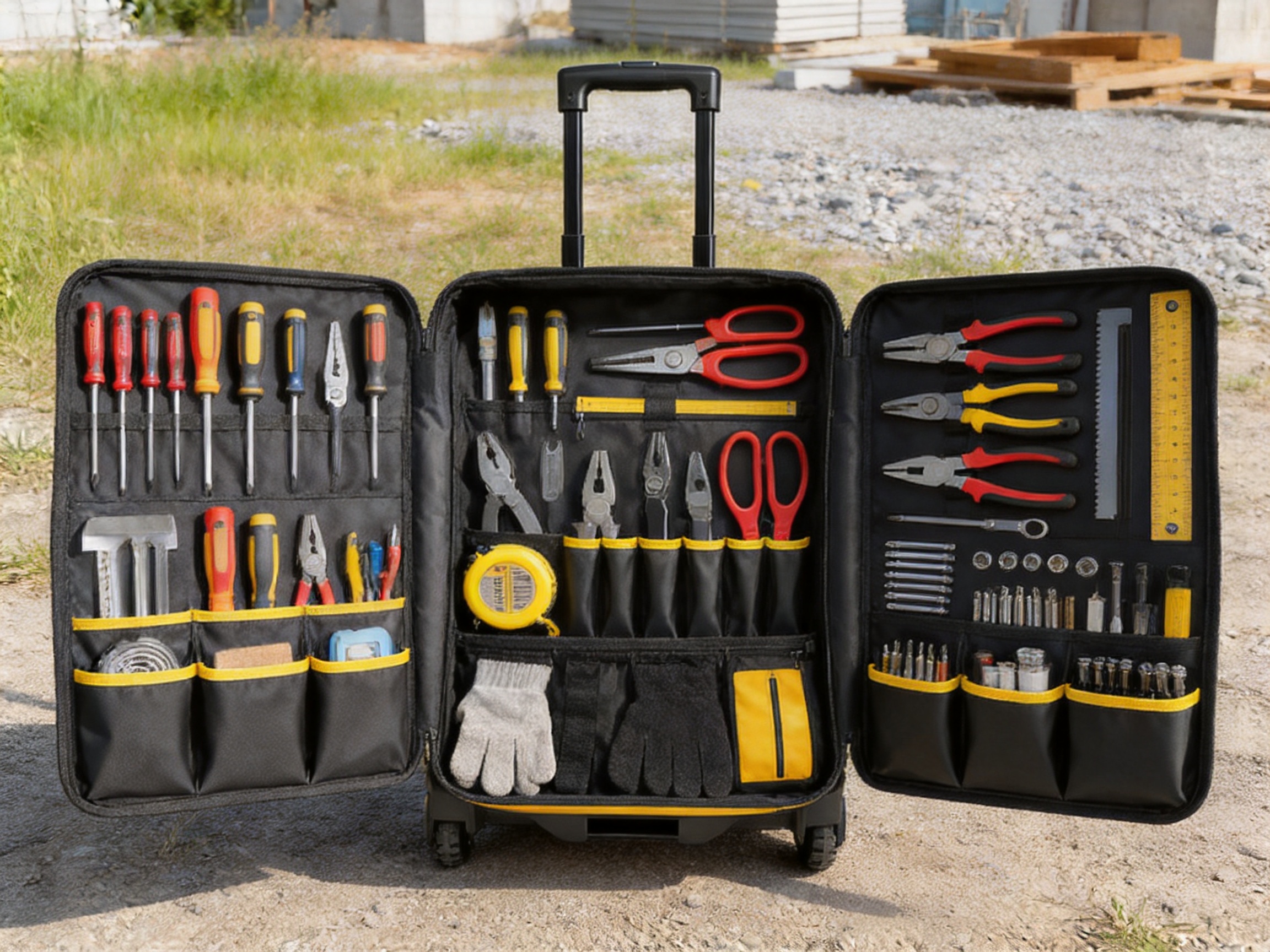
A tool carrier must do more than hold a large number of items. It should help users identify, separate, and retrieve those items efficiently. Unorganized storage can create delays, increase the risk of losing small components, and force workers to unpack the entire bag to find one screwdriver, wrench, cutter, or measuring device. The Dual-Wheel Off-Road Heavy-Duty Traction Tool Bag addresses this issue through a total of 26 pockets, divided into 11 exterior pockets and 15 interior pockets.
The 11 exterior pockets are useful for equipment that needs to remain immediately accessible. Frequently used hand tools, gloves, tape measures, fasteners, markers, small accessories, and maintenance items can be placed around the outside of the bag. This arrangement allows a user to reach essential tools without opening the main compartment every time.
The 15 interior pockets provide a more protected organization system for tools that should remain inside the main body. Users can divide their equipment according to task, size, material, or frequency of use. For example, a technician may keep electrical testing accessories in one area, hand tools in another, and replacement parts in a separate internal section. A gardener may organize pruning tools, plant ties, gloves, measuring accessories, and small repair equipment according to the work planned for the day.
The combination of external and internal compartments is more flexible than a single large cavity. A large open compartment can provide volume, but it often allows tools to collect at the bottom in an inaccessible pile. The 26-pocket configuration creates a more deliberate storage system. It supports a professional workflow in which every item has a designated location.
This organization is also valuable when the bag is transported on its wheels. Tools that are loosely placed inside may shift during movement, especially when the trolley crosses gravel or uneven ground. Internal pockets help separate equipment and reduce uncontrolled movement. Exterior pockets provide additional access points without requiring the main compartment to be opened repeatedly.
The pocket count is one of the product’s significant competitive advantages. Many basic tool bags are built around one main compartment with a small number of external sleeves. Such products may be adequate for a limited tool set, but they offer less flexibility for users carrying equipment for full-day professional work. Conversely, some highly compartmentalized bags provide organization but lack the volume or mobility required for heavy tool loads. This model brings capacity, compartmentalization, and wheeled transport together in one design.
Storage Benefits for Different Professional Users
Electricians can use the interior and exterior organization to separate insulated hand tools, testers, wire accessories, fasteners, and protective equipment. A designated location for each category can make it easier to conduct a quick tool check before leaving a work site.
Gardeners and landscapers may use the external pockets for pruning shears, gloves, plant labels, small hand trowels, tape, and other items that need frequent access. Larger tools can remain in the main storage area, while small accessories can be protected in the internal pockets.
Construction and maintenance workers may benefit from using the bag as a mobile support station. Different pockets can hold measuring tools, fixings, repair components, personal protective accessories, and commonly used hand tools. The wheeled format makes it possible to move this collection without carrying all the weight on one shoulder or in one hand.
Facilities technicians and mobile repair teams can assign pockets to specific service functions. This allows the same bag format to support electrical repair, plumbing maintenance, assembly, inspection, and general facility work.
Dimensions and Load Capacity
The product measures 48 by 25.5 by 44 centimeters. These dimensions create a relatively tall and substantial tool carrier that can accommodate a broad range of professional equipment. The vertical format can be helpful for storing longer hand tools while retaining a footprint that remains manageable in vehicles, workshops, and storage areas.
The stated load capacity is 55.12 pounds. This rating indicates that the product is intended for a serious tool load rather than a small collection of lightweight accessories. Users should distribute weight carefully and avoid placing the heaviest items in a single pocket or at one extreme side of the bag. Balanced loading can improve stability, reduce stress on the wheels and hardware, and make the trolley easier to pull.
A high load rating is particularly useful for teams that want to reduce repeated trips between a vehicle and the work area. Instead of carrying several small bags, a worker may consolidate tools into one larger mobile carrier. This can improve efficiency where work sites are spread out or where the surface makes repeated walking inconvenient.
At the same time, a load capacity should be understood as a design guideline rather than an invitation to overload the product. The actual performance of the bag will depend on the weight distribution, the condition of the terrain, the method of handling, and the frequency of use. Proper use includes securing the zipper, avoiding sharp objects that could damage the fabric, and pulling the bag at a controlled speed over rough surfaces.
| Product Feature | Specification or Function | Practical Benefit |
|---|---|---|
| Product type | Trolley tool bag | Allows tools to be transported with reduced lifting effort |
| Wheel configuration | Two heavy-duty large wheels | Supports movement across gravel, soil, and outdoor debris |
| Dimensions | 48 × 25.5 × 44 cm | Provides substantial storage in a mobile vertical format |
| Load capacity | 55.12 pounds | Suitable for a broad professional tool load |
| Total pockets | 26 | Promotes organized storage for tools and accessories |
| Exterior pockets | 11 | Keeps frequently used items accessible |
| Interior pockets | 15 | Separates and protects tools within the main compartment |
| Closure | Zipper | Helps secure the main storage area during transport |
| Main material | High-strength polyester | Supports durability and resistance to outdoor exposure |
| Color | Customized | Allows alignment with brand or product requirements |
High-Strength Waterproof Polyester Construction
Material selection is a central factor in the service life of a tool bag. A product used outdoors must contend with friction, dust, moisture, contact with rough surfaces, repeated loading, and the sharp edges of tools. Ordinary lightweight fabric may be unsuitable for these conditions because it can lose its shape, tear at stress points, or absorb moisture quickly.
The Dual-Wheel Off-Road Heavy-Duty Traction Tool Bag is made with high-strength waterproof polyester. Polyester is widely used in professional bags because it offers a useful balance of durability, weight, flexibility, and manufacturability. When constructed with suitable density and reinforcement, polyester can resist everyday abrasion and maintain its form during repeated handling.
The waterproof characteristic adds practical value for outdoor users. A water-resistant or waterproof textile surface can help protect the contents from light rain, damp grass, splashes, and brief exposure to wet conditions. This is important for gardeners, construction workers, and maintenance teams who cannot always postpone work because of changing weather.
Water resistance does not make the product a fully sealed dry case. Users should still avoid submerging the bag, leaving it exposed to prolonged heavy rain, or storing wet tools inside for extended periods. After use in damp conditions, opening the compartments and allowing the bag to dry can help preserve the fabric, hardware, and tools.
The fabric body also supports customization. Polyester can be produced in different colors, weights, surface finishes, and constructions. Customized color options allow distributors, importers, professional brands, and corporate users to align the bag with an existing identity or product range. A customized exterior may be useful for fleet recognition, uniform branding, retail presentation, or color coding by trade.
Hardware and Stress Management
A durable fabric body is only one part of a professional tool bag. The wheels, seams, zipper, handles, attachment points, and reinforcing panels must work together as a complete load-bearing system. When a bag is pulled over uneven ground, force is transferred through the wheel mounts and the lower structure. When the bag is lifted into a vehicle, additional stress reaches the handles and upper seams.
The product is described as using sturdy hardware and a heavy-duty construction approach. This supports its positioning as a rugged trolley tool bag rather than a casual storage product. In practical use, users should lift the bag from appropriate reinforced areas, keep the wheel path clear of large obstacles, and avoid using the zipper or thin pocket edges as lifting points.
Regular inspection is also beneficial. Users can check the wheel attachment points, zipper track, seams, handles, and pocket openings for signs of wear. Early maintenance can help prevent minor issues from becoming major failures, particularly for teams using the same bag every day.
Advantages Over Common Tool-Carrying Alternatives
The product’s competitive advantages become clearer when it is compared with several common categories of tool carriers. Each type has its own role, but the Dual-Wheel Off-Road Heavy-Duty Traction Tool Bag combines features that are not always available in a single alternative.
Compared with Standard Hand-Carry Tool Bags
Traditional hand-carry tool bags are often compact and easy to place on a shelf or vehicle seat. They may be suitable for light loads and short-distance transport. However, as the number and weight of tools increase, the user must carry the entire load by hand. This can create fatigue, especially when the work site is far from the vehicle or when the bag must be moved repeatedly.
The trolley design transfers much of the transport effort to the wheels. A user can pull the bag rather than hold it continuously. This does not eliminate all physical effort, but it can reduce strain on the hands, arms, shoulders, and back during movement between locations.
Compared with Tool Backpacks
A tool backpack distributes weight across the shoulders and may be convenient when both hands must remain free. It can also be useful on stairs or narrow paths where a trolley cannot be pulled easily. However, a backpack’s carrying comfort decreases as the load becomes heavier. Long-term use with dense tools can place pressure on the back and shoulders.
The trolley tool bag is better suited to situations where a large tool load must move across a relatively open route. Its 55.12-pound load rating and wheel system allow the user to transport more equipment without carrying the entire weight on the body. For teams that already use a backpack for climbing or stair access, this trolley bag can serve as a complementary high-capacity carrier for ground-level work.
Compared with Small-Caster Trolley Bags
Small-caster bags may maneuver easily on flat indoor floors. They can turn sharply and may fit well in offices, workshops, or service corridors. However, small wheels can be vulnerable to cracks, stones, grass, loose soil, and other outdoor obstacles.
The large dual-wheel design of this product is oriented toward rougher terrain. It may not turn as tightly as a compact four-caster case, but it offers a more appropriate balance for outdoor pulling. Its advantage lies in forward stability and obstacle tolerance rather than indoor spinning maneuverability.
Compared with Open Tool Buckets
Tool buckets allow quick access to frequently used items and often remain upright during short-distance movement. However, they may expose tools to rain and dust, provide limited protection during transport, and lack a secure closure. Their storage organization is also usually less comprehensive than a 26-pocket trolley bag.
The zippered structure of this model provides a more enclosed storage environment. Internal and exterior pockets offer greater organization, while the wheeled base supports movement over a longer distance. This makes it more suitable for a complete professional tool set.
Compared with Hard Tool Cases
Hard cases can provide excellent protection against impact and compression. They may be appropriate for delicate instruments or specialized equipment. However, hard cases can be heavy before tools are added, and their rigid shape may provide less flexibility for irregularly shaped items. Some cases also have limited external access.
The polyester trolley bag offers a lighter and more adaptable alternative for general hand tools and outdoor equipment. Its soft-sided construction can accommodate different shapes, while the pockets provide rapid access. Users requiring impact protection for delicate instruments may still choose a hard case for those items and use this bag for general tools and accessories.
Practical Applications Across Multiple Industries
The product is suitable for a wide range of work scenarios because its value is based on mobility, capacity, and organization rather than a single trade-specific feature. This broad application potential makes it attractive to distributors and professional buyers who need a versatile product category.
Gardening and Landscaping
Gardeners frequently move between planting areas, lawns, greenhouses, storage sheds, and maintenance zones. The ground may be uneven, wet, or covered with leaves and debris. A wheeled tool bag with large wheels can make this movement more manageable than a shoulder bag or hand basket.
The exterior pockets can hold gloves, pruning shears, markers, tape, plant ties, and small hand tools. Internal pockets can store replacement parts, fasteners, measuring items, and personal protective accessories. Larger tools may be placed in the main compartment, allowing one carrier to support a broad range of routine gardening tasks.
Outdoor Construction
Construction workers and outdoor contractors often work in changing locations. A tool carrier may need to travel across soil, gravel, unfinished flooring, and temporary access routes. The large dual wheels are well matched to these environments, provided that the route is suitable for a pull-style bag.
The high load capacity can help crews consolidate tools and reduce unnecessary trips. Organization is especially important on construction sites, where misplaced tools can slow work and create avoidable replacement costs. A designated pocket system allows workers to perform faster inventory checks at the beginning and end of a shift.
Electrical and Maintenance Service
Electricians, installers, and maintenance technicians often carry many small tools and accessories. Screwdrivers, pliers, testers, cutters, wire tools, fasteners, labels, and protective equipment can become difficult to manage in an undivided bag.
The product’s interior and exterior pocket structure allows the tool set to be arranged according to frequency of use and work function. Although the bag is not presented as a specialized electrical safety container, its organization can support more efficient transport for general service tools.
Facility Management
Facility management teams may need to move equipment through large buildings, campuses, warehouses, or outdoor grounds. A trolley bag can serve as a mobile maintenance station for common repair items. The zipper closure helps keep the contents together while the bag is moved between areas.
For facilities with multiple teams, customized colors can provide a visual distinction between electrical, plumbing, groundskeeping, and general maintenance bags. This can improve equipment identification and simplify distribution.
Manufacturing Expertise and Customization Capability
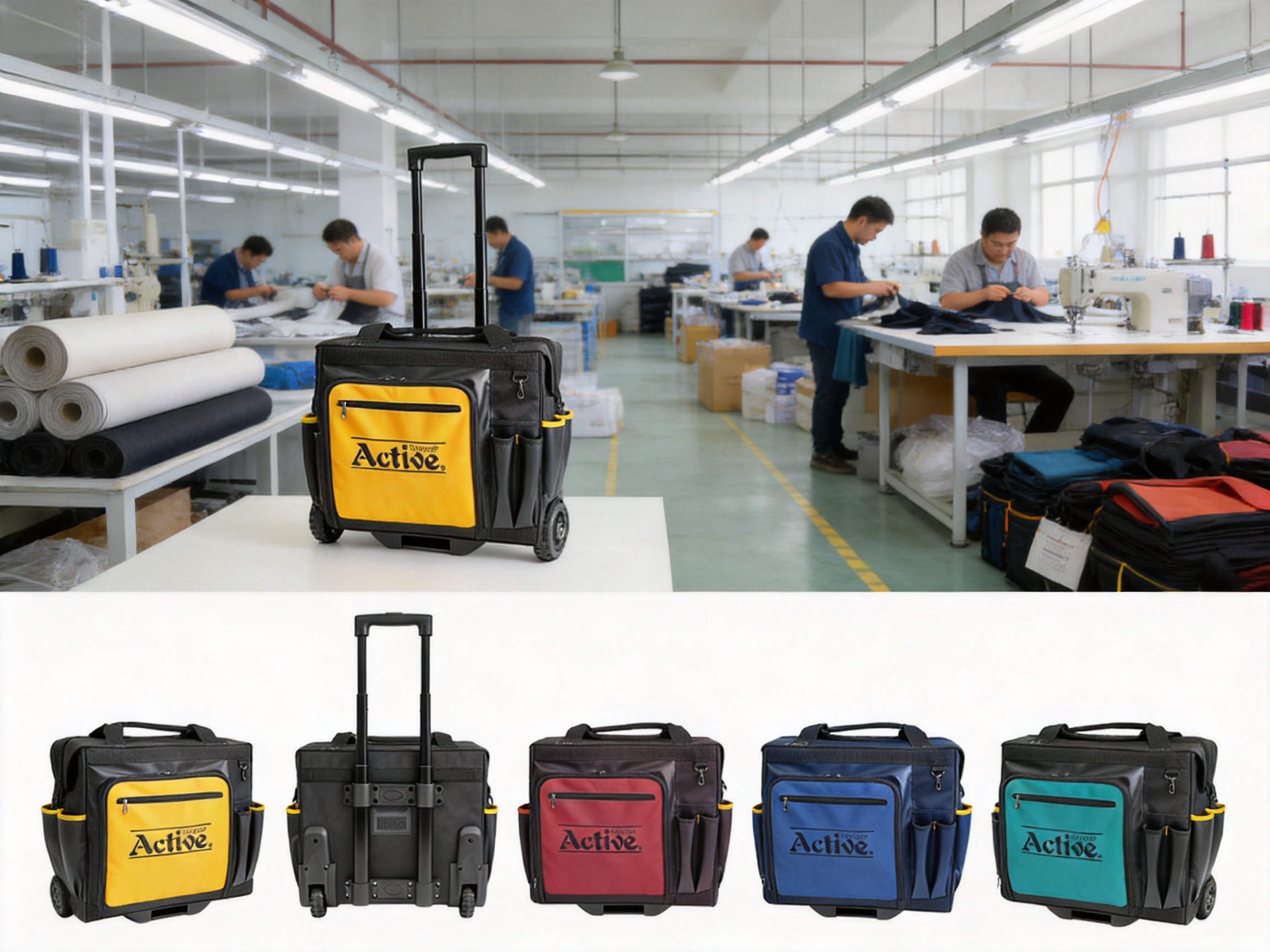
The product is supplied by Zhangjiagang Seaark Tools Industrial Co., Ltd., a company founded in 2004 and focused on the export of professional tool bags and related customization solutions. Its long operating history provides a manufacturing background relevant to buyers who need repeatable production, product development, and support for international orders.
Seaark established Zhangjiagang Haiyi Tool Bags Co., Ltd. in 2012 as a core manufacturing base in China. The company also operates a production facility in Cambodia. A multi-location production structure can give customers greater supply flexibility and may help address sourcing requirements, production scheduling, and tariff considerations for different markets.
The company reports more than 20 years of tool bag manufacturing experience, a workforce of more than 200 employees, and approximately 11,000 square meters of factory space. These resources are relevant to the production of structured tool bags because a professional trolley bag requires coordination between material preparation, cutting, sewing, reinforcement, hardware installation, wheel assembly, inspection, and packing.
Manufacturing scale can also support more consistent quality control. A repeatable process is important for pockets because small variations in placement, opening size, or stitching can affect usability. It is equally important for trolley products because the wheels, bottom structure, zipper, and load-bearing seams must be assembled accurately.
Product Development and Research
Seaark maintains an independent research and development team and reports developing more than 10 new designs each year. This development capability is important in a competitive tool bag market where buyers increasingly seek products that solve specific problems rather than generic storage products.
The Dual-Wheel Off-Road Heavy-Duty Traction Tool Bag reflects a product development approach centered on outdoor mobility and high capacity. Its large wheels, 26-pocket system, waterproof polyester, and 55.12-pound load rating respond to practical requirements that may not be fully addressed by standard tool backpacks or indoor trolley cases.
The company’s registered Active Storage brand and design patents indicate an emphasis on product design and intellectual property. For business customers, this may support the development of differentiated product ranges instead of relying only on widely available generic formats.
Production Compliance and Third-Party Audits
The company reports that its facilities undergo annual third-party audits, including BSCI, SEDEX, FCCA, and SCS. Such audits are intended to assess aspects of standardized and compliant production. Specific audit scope and current status should be confirmed directly for a particular order, but the reported audit framework demonstrates an awareness of social, ethical, and operational requirements in international supply chains.
For importers and global brands, supplier assessment is an important part of product selection. A tool bag is not evaluated only by its appearance. Buyers may also consider factory capacity, labor practices, production controls, material traceability, inspection procedures, packaging, lead times, and communication support. A manufacturer with established export experience can help address these requirements more effectively than an unverified trading source.
Quality control for this type of bag may include fabric inspection, color confirmation, dimensional checks, pocket placement checks, seam inspection, zipper testing, handle and attachment testing, wheel installation checks, and finished-product inspection. Buyers should define their own acceptance standards and testing requirements before mass production, particularly when a customized version is requested.
Customization for Brands and Professional Programs
The product is offered with customized color options, making it suitable for private-label programs, distributor catalogs, company fleets, promotional tool systems, and professional retail ranges. Color is one of the simplest ways to distinguish a product, but customization can also extend to other elements depending on project requirements.
Potential customization discussions may include fabric color, logo application, label design, zipper color, pocket arrangement, packaging, hangtags, carton markings, and quantity requirements. Any modifications should be reviewed with the manufacturer because changes to dimensions, pocket construction, hardware, or wheel placement may affect cost, tooling, production time, and testing requirements.
For a brand selling to electricians, gardeners, contractors, or maintenance professionals, a customized trolley bag can become part of a broader equipment system. Matching colors and labels can connect the bag with workwear, hand tools, storage boxes, or company vehicles. For service companies, custom identification can reduce the risk of bags being mixed up among teams.
Customization also allows buyers to adapt the product to regional preferences. Some markets may favor high-visibility colors for outdoor work, while others may prefer understated professional colors. A distributor may require a specific combination of exterior color and interior lining, subject to material availability and minimum order requirements.
Using the Bag Efficiently
Good organization begins with a loading plan. Heavy tools should generally be placed low and near the center of the bag to support stability. Frequently used items can be placed in exterior pockets, while delicate or less frequently used tools can be stored in the interior compartments. Sharp tools should be positioned so that their edges do not press directly against the fabric or zipper.
Users should avoid filling every pocket to the point where the zipper is under constant tension. A zipper works most reliably when the bag is not overpacked and the contents do not obstruct the track. Before pulling the bag, the main closure should be fully closed and loose straps or accessories should be secured away from the wheels.
When moving across gravel or uneven soil, the bag should be pulled at a moderate speed. Large wheels can handle challenging surfaces, but abrupt direction changes, deep holes, and large obstacles may still damage the wheel assembly or cause the bag to tip. If an obstacle is too high for the wheels to cross safely, the bag should be lifted using a suitable reinforced handle rather than forced over it.
After outdoor use, users should remove dirt and debris from the wheel area. Mud and stones can affect rolling performance if allowed to accumulate. The fabric may be cleaned according to the manufacturer’s care instructions, and the bag should be dried before long-term storage.
Purchasing Considerations for Professional Buyers
Professional buyers should evaluate the product according to the intended working environment rather than relying only on pocket count or appearance. The first consideration is terrain. The dual-wheel design is particularly relevant where the bag will travel over gravel, soil, grass, or construction debris. If the product will be used almost entirely indoors, a compact multi-caster trolley may offer different maneuverability benefits.
The second consideration is the expected tool load. The stated 55.12-pound capacity makes the model appropriate for substantial equipment, but users should determine whether their typical load can be distributed safely within the available compartments. The dimensions should also be compared with vehicle storage space, workshop shelving, and delivery packaging requirements.
The third consideration is organizational need. Twenty-six pockets provide considerable flexibility, but a user who carries only a few large tools may prefer a simpler bag. Conversely, technicians with numerous small accessories may find the pocket system especially valuable.
The fourth consideration is weather exposure. Waterproof polyester can provide useful protection against ordinary outdoor moisture, but buyers working in extreme weather or transporting sensitive electronic equipment may require an additional waterproof case or liner.
For business customers, supply factors are equally important. Buyers may ask about sample approval, material specifications, production lead times, minimum order quantities, packaging, inspection standards, logo requirements, shipping arrangements, and after-sales support. These details should be settled before confirming a large customized order.
Why the Product Is a Strong Competitive Choice
The product’s main advantage is not one isolated specification but the way several practical features work together. Large dual wheels support off-road movement. The 26-pocket system improves organization. The high-strength waterproof polyester provides a durable and weather-conscious exterior. The 55.12-pound load rating supports professional equipment. The zipper closure keeps the main compartment contained. Customized color options support brand and fleet requirements.
Many competing products may provide one or two of these characteristics. A backpack may offer organization but require the user to carry the full weight. A hand bag may be portable but less suitable for heavy loads. An indoor trolley may have wheels but perform poorly on uneven terrain. An open bucket may provide access but offer limited weather protection and organization. A hard case may protect tools but be heavier and less adaptable.
This product is positioned between these categories. It offers the mobility of luggage, the organization of a professional tool bag, and the terrain tolerance expected from a rugged outdoor carrier. That combination makes it especially relevant for users whose work cannot be confined to smooth indoor surfaces.
Its value is also strengthened by the manufacturer’s ability to support development and customization. Buyers are not limited to selecting an anonymous stock bag. They can work with an experienced tool bag producer to discuss colors, branding, product adjustments, and supply arrangements for professional or retail programs.
Quality, Durability, and Long-Term Value
A durable tool bag can create value beyond its initial purchase price. When a carrier remains functional through repeated transport, it reduces the need for frequent replacement. When tools are organized and easy to access, workers may spend less time searching for equipment. When the bag can move a large tool set in one trip, it may reduce unnecessary walking and improve daily productivity.
Long-term value depends on both product construction and user care. The polyester body, sturdy hardware, zipper, wheels, and reinforced construction are intended to support demanding use, but no soft-sided bag is immune to misuse. Proper loading, routine cleaning, controlled pulling, and storage in a dry location can all contribute to a longer service life.
For companies purchasing multiple units, standardizing the tool carrier can also simplify training and equipment management. Workers can learn a common pocket layout, supervisors can perform faster inventory checks, and replacement purchases can follow an established product specification. Customized colors or identification labels may further support organization across departments.
Frequently Asked Questions
What type of product is the Dual-Wheel Off-Road Heavy-Duty Traction Tool Bag?
It is a wheeled trolley tool bag designed for carrying professional tools across indoor and outdoor work environments. Its primary features include two heavy-duty large wheels, 26 pockets, a zippered closure, high-strength waterproof polyester, and a stated load capacity of 55.12 pounds.
What makes the bag suitable for off-road use?
The bag uses two large heavy-duty wheels intended to roll over gravel, uneven soil, and outdoor debris with less effort than many small-wheel or hand-carry designs. Its construction also includes durable hardware and a strong polyester exterior for demanding work conditions.
How many pockets does the bag have?
The bag has 26 pockets in total. There are 11 exterior pockets for quick access and 15 interior pockets for more organized and protected storage.
What are the product dimensions?
The stated dimensions are 48 by 25.5 by 44 centimeters. Buyers should compare these measurements with their vehicle, warehouse, shelving, and workplace requirements before ordering.
What is the load capacity?
The stated load capacity is 55.12 pounds. For safe and comfortable operation, the load should be distributed evenly and the bag should not be overloaded beyond its intended rating.
Is the bag waterproof?
The bag is made from high-strength waterproof polyester, which helps resist ordinary outdoor moisture and light exposure to wet conditions. It should not be treated as a fully sealed waterproof case or submerged in water. Wet tools and the bag interior should be dried after use.
Is the main compartment secured with a zipper?
Yes. The listed closure type is a zipper. The zipper helps keep the main compartment closed during transport and supports a more contained storage arrangement than an open tool bucket.
Who can use this trolley tool bag?
It is suitable for gardeners, landscapers, outdoor construction workers, electricians, maintenance technicians, facilities teams, installers, repair professionals, and other users who need to transport a substantial set of tools across variable surfaces.
How does it compare with a tool backpack?
A tool backpack places the load on the user’s shoulders and back, while this trolley bag allows much of the load to be moved on wheels. The trolley is generally more suitable for heavier loads and open ground, while a backpack may be more convenient on stairs, narrow routes, or situations where both hands must remain free.
How does it compare with a standard hand-carry tool bag?
A standard hand-carry bag may be lighter and more compact, but the user must carry its entire weight. The trolley format reduces the physical effort required to move a larger tool collection over suitable surfaces.
Can the color be customized?
Yes. The product information lists the color as customized. Specific color choices, available materials, minimum quantities, and production requirements should be confirmed with the manufacturer.
Can the product be customized for a private-label program?
The manufacturer provides comprehensive customization solutions and works with global brands and partners. Buyers can discuss color, labeling, packaging, logo application, pocket configurations, and other possible modifications during the project development process.
Where is the product manufactured?
The company operates manufacturing facilities in China and Cambodia. The listed company address is in Zhangjiagang City, Jiangsu Province, China. Production location and order allocation should be confirmed for a specific project.
What manufacturing experience does the supplier have?
The supplier was founded in 2004 and has more than 20 years of tool bag manufacturing experience. It reports more than 200 employees, approximately 11,000 square meters of floor space, multiple production bases, and an independent research and development team.
Does the supplier develop new tool bag designs?
The company reports developing more than 10 new designs each year. Its product range includes trolley tool bags, tool backpacks, zippered tool bags, tubular-handle tool bags, waist tool bags, tool pouches, tool vests, tool bucket bags, garden bags, and other multifunctional bags.
What audits are associated with the manufacturing facilities?
The company reports annual third-party audits, including BSCI, SEDEX, FCCA, and SCS. Buyers should request current documentation and confirm the exact scope and validity of any audit relevant to their order.
How should the bag be loaded?
Heavy items should be positioned low and near the center, while frequently used accessories can be placed in the exterior pockets. Sharp objects should be protected from direct contact with the fabric and zipper. The main compartment should not be overfilled, and the load should remain balanced for stable pulling.
Can the wheels handle every type of terrain?
The wheels are designed for gravel, uneven soil, and outdoor debris, but they are not intended to overcome every obstacle. Deep holes, large stones, stairs, mud, and steep slopes may require the user to lift or guide the bag carefully. Controlled handling will help protect the wheels and hardware.
Conclusion
The Dual-Wheel Off-Road Heavy-Duty Traction Tool Bag is designed for professionals who need more than basic tool storage. Its large dual-wheel structure provides a practical mobility advantage on gravel, uneven soil, and outdoor debris. Its 26 pockets support organized storage, while the 48 by 25.5 by 44 centimeter format and 55.12-pound load capacity make it suitable for substantial professional tool collections.
The high-strength waterproof polyester exterior, zipper closure, and sturdy hardware contribute to its rugged outdoor positioning. Compared with standard hand-carry bags, it reduces the need to carry heavy loads. Compared with tool backpacks, it shifts much of the transport effort to the wheels. Compared with small-caster indoor trolleys, it is better suited to outdoor ground conditions. Compared with open buckets, it offers more organization and a more enclosed storage structure.
Its value is further supported by the supplier’s manufacturing experience, product development capabilities, multiple production bases, customization services, and reported third-party audit program. These strengths make the product relevant not only to individual professionals but also to distributors, private-label brands, service companies, contractors, and organizations seeking a repeatable tool-carrying solution.
For buyers evaluating a rugged trolley tool bag, the most important considerations are terrain, load requirements, organization, weather exposure, customization needs, and supply capability. When these factors align with the product’s design, this dual-wheel model can provide a practical and durable mobile platform for transporting tools across demanding work environments.
References
1. Product specification sheet for the Dual-Wheel Off-Road Heavy-Duty Traction Tool Bag, model L013.
2. Product information covering dimensions, load capacity, pocket configuration, materials, closure type, and color customization.
3. Company profile of Zhangjiagang Seaark Tools Industrial Co., Ltd., including manufacturing history, production bases, workforce, factory area, and export experience.
4. Company-provided information concerning research and development activities, product categories, design patents, and the Active Storage registered brand.
5. Company-provided information concerning reported BSCI, SEDEX, FCCA, and SCS third-party audit programs.
6. General professional tool storage and material-handling principles concerning load distribution, textile care, zipper use, wheel maintenance, and outdoor equipment handling.
Product: Dual-Wheel Off-Road Heavy-Duty Traction Tool Bag




We are a professional enterprise engaged in exporting various types of toolkits.
We firmly believe that 'quality is everything, service enhances value'.
-
+86-15298800699

-
+86-512-58670375

-
karen@kun-bag.com

-
Building 11, No. 93 Chengang Road, Zhangjiagang City, Jiangsu Province, China

Copyright © Zhangjiagang Seaark Tools Industrial Co., Ltd. All Rights Reserved.
Custom Electrician Tool Backpack Manufacturers