
 en
 русский
 Español
 Deutsch

Foldable Tool Bag with Seat: A Mobile Storage and Workstation Solution for Outdoor Professionals
Outdoor maintenance work often requires more than a simple container for carrying tools. Gardeners, farmers, landscapers, repair workers, and woodworking professionals must transport equipment, organize accessories, move between work areas, and sometimes take a short rest during long working sessions. Carrying several separate products for these tasks can add unnecessary weight, occupy valuable storage space, and make work less efficient.
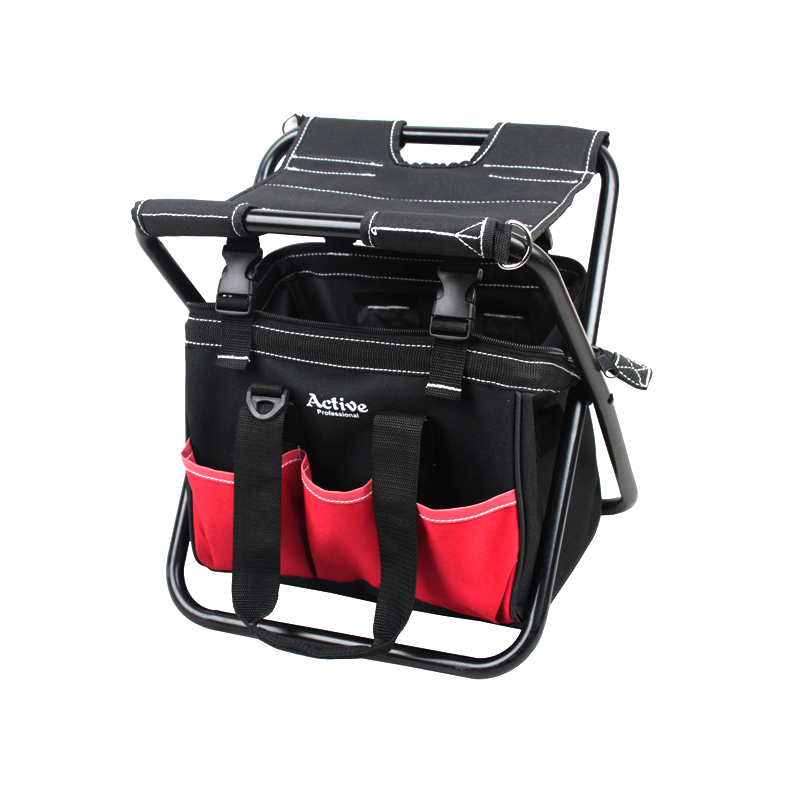
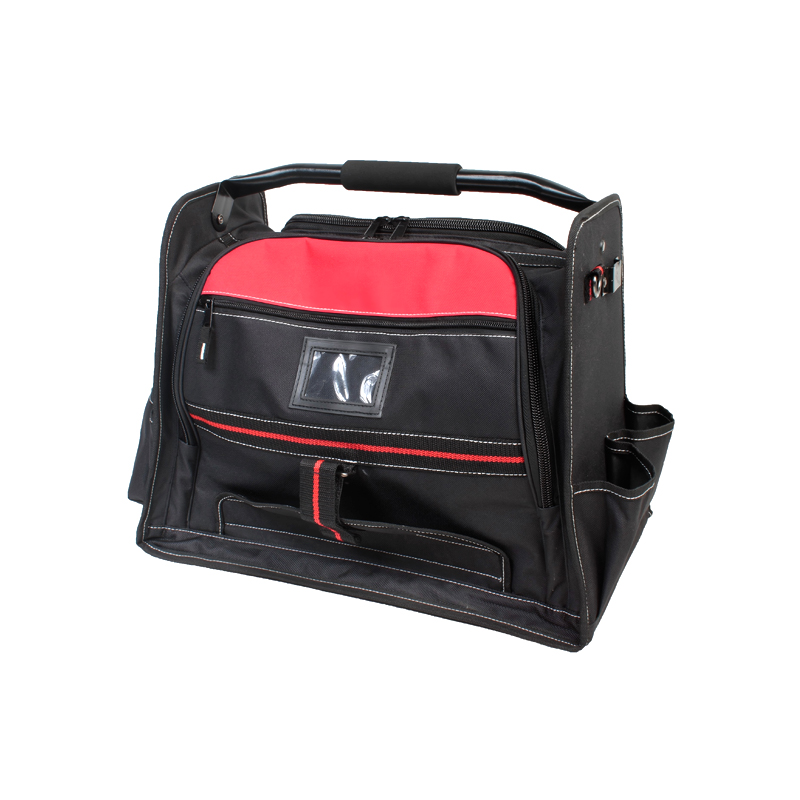
The Foldable Tool Bag with Seat Detachable Storage Tote Bag addresses these challenges with a practical two-in-one design. It combines a reinforced folding seat frame with a detachable polyester tool bag, creating a mobile workstation that supports tools, supplies, and short periods of seated work. Instead of functioning only as a tool container, the product is designed to support the complete workflow of outdoor maintenance: transport, organization, access, support, and storage.
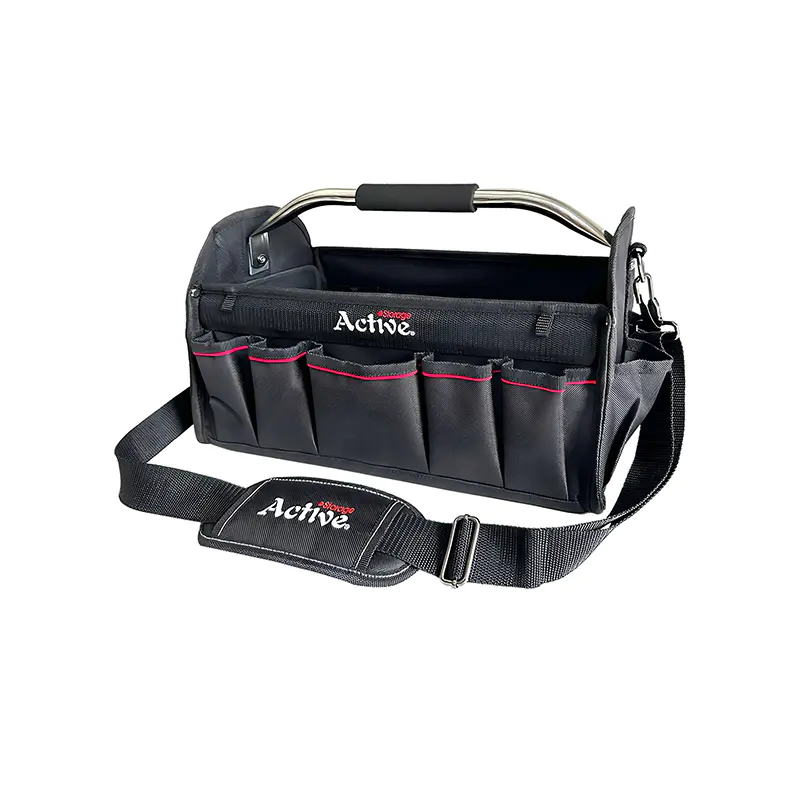
With a seven-pocket organization system, zipper closure, steel support frame, high-density polyester construction, and a load capacity of 33.07 pounds, this foldable tool bag offers a balance of portability and working strength. Its 42 × 29 × 31 centimeter dimensions provide useful storage volume while remaining compact enough for transportation and folding storage.
For distributors, importers, landscaping suppliers, hardware retailers, and professional brands seeking a versatile tool storage product, this design offers several advantages over traditional open totes, basic tool bags, and separate folding stools. It also demonstrates how a professional tool bag manufacturer can combine functional product engineering with flexible manufacturing and customization capabilities.
Foldable Tool Bag with Seat Detachable Storage Tote Bag
Content
- 1 What Is a Foldable Tool Bag with Seat?
- 2 Core Product Specifications
- 3 A Two-in-One Design That Improves Work Efficiency
- 4 Seven-Pocket Storage for Better Organization
- 5 Materials and Structural Engineering
- 6 Advantages Compared with Conventional Tool Bags
- 7 Why the Product Is Suitable for Custom Programs
- 8 Manufacturing Expertise and Production Capabilities
- 9 Production Process for a Professional Tool Bag with Folding Seat
- 10 Practical Use and Maintenance Guidance
- 11 Commercial Value for Distributors and Retailers
- 12 How It Supports Different Workflows
- 13 Q&A: Foldable Tool Bag with Seat
- 13.1 What is the main purpose of this product?
- 13.2 How many pockets does the tool bag have?
- 13.3 What is the product made from?
- 13.4 Can the bag be removed from the frame?
- 13.5 What is the load capacity?
- 13.6 What are the product dimensions?
- 13.7 Is this product only for gardening?
- 13.8 How is this different from a regular tool tote?
- 13.9 How is this different from a folding stool?
- 13.10 Can the color be customized?
- 13.11 Can the pocket layout be customized?
- 13.12 Who manufactures this product?
- 13.13 Does the manufacturer support private-label projects?
- 13.14 What quality information is available about the manufacturer?
- 13.15 How should the product be stored?
- 14 Why Choose an Experienced Tool Bag Manufacturer?
- 15 Conclusion
- 16 References
- 17 Product: Foldable Tool Bag with Seat Detachable Storage Tote Bag
What Is a Foldable Tool Bag with Seat?
A foldable tool bag with seat is a portable storage product built around a supporting frame that can be folded when not in use. The frame creates a stable seating and support structure, while the attached or detachable bag provides organized storage for tools and materials. In this design, the user can carry tools to a working location, arrange them in dedicated pockets, and use the reinforced frame as a convenient seat or support point.
The product is especially suitable for tasks performed close to the ground or in outdoor environments. Gardening, pruning, planting, farming maintenance, equipment inspection, small woodworking jobs, and household repair work may require workers to kneel, bend, squat, or frequently change positions. Having a mobile seat and tool organizer in one product can reduce the need to repeatedly return to a toolbox or carry separate equipment.
The detachable construction is another important feature. The external tool bag uses a zipper system that allows it to be quickly removed from the frame. This makes it easier to clean, replace, transport, or use the storage section independently. The frame can also be folded for more compact storage, making the product suitable for workshops, vehicle compartments, garden sheds, retail packaging, and warehouse distribution.
Rather than being limited to one type of user, the product can serve a broad range of applications. A gardener may use it for hand tools and pruning equipment. A farmer may use it for routine maintenance around a field or greenhouse. A woodworking user may store measuring tools, hand saws, clamps, and accessories. A home repair user may carry screwdrivers, pliers, fasteners, and small power-tool accessories.
Core Product Specifications
The product is designed around a clear set of functional specifications. These specifications help buyers evaluate the product for private-label programs, wholesale distribution, and professional use.
| Specification | Details |
| Product Type | Foldable tool bag with seat and detachable storage tote |
| Product Category | Tool bag with folding seat |
| Dimensions | 42 × 29 × 31 centimeters |
| Material | Polyester bag with reinforced steel frame |
| Closure Type | Zipper |
| Number of Pockets | Seven |
| Load Capacity | 33.07 pounds |
| Color | Customizable |
| Country of Origin | China |
| Primary Applications | Gardening, farming, maintenance, woodworking, and household repair |
The dimensions provide a practical balance between capacity and portability. A bag that is too small cannot carry the tools required for a complete task, while an oversized bag can become difficult to transport. The 42 × 29 × 31 centimeter format creates room for commonly used hand tools while maintaining a manageable footprint.
The 33.07-pound load capacity is also important for professional users. Gardening and maintenance tools can be heavy when combined, especially when the bag includes shears, hand saws, shovels, fasteners, gloves, measuring equipment, and replacement components. A stated load-bearing rating helps users understand the intended performance range and encourages proper use of the product.
A Two-in-One Design That Improves Work Efficiency
The primary advantage of this product is its combination of tool storage and seating support. Traditional tool bags focus on carrying and organization, but they do not provide a place to sit. A separate folding stool may solve the seating problem, but it creates another item to transport and manage. The foldable tool bag with seat integrates both functions into one mobile product.
This combination is particularly useful for work that involves repeated low-level tasks. Planting flowers, removing weeds, inspecting irrigation systems, repairing garden borders, assembling small wooden components, and performing outdoor maintenance can all require prolonged bending or crouching. The integrated seat allows the user to pause or work from a more supported position without setting up a separate chair.
The frame also functions as a structural support for the storage bag. This helps the bag maintain its form when loaded and makes it easier to access tools. In a soft-sided tote without a supporting structure, the sides may collapse inward, making small tools difficult to locate. The reinforced frame helps create a more stable working station.
The two-in-one format can also improve transport efficiency. Instead of carrying a tool bag in one hand and a stool in the other, the user can move one coordinated product. This is valuable for mobile workers who travel across gardens, farms, construction areas, workshops, and service locations. It can also reduce the amount of space required in a vehicle or storage room.
Benefits for Gardeners and Landscapers
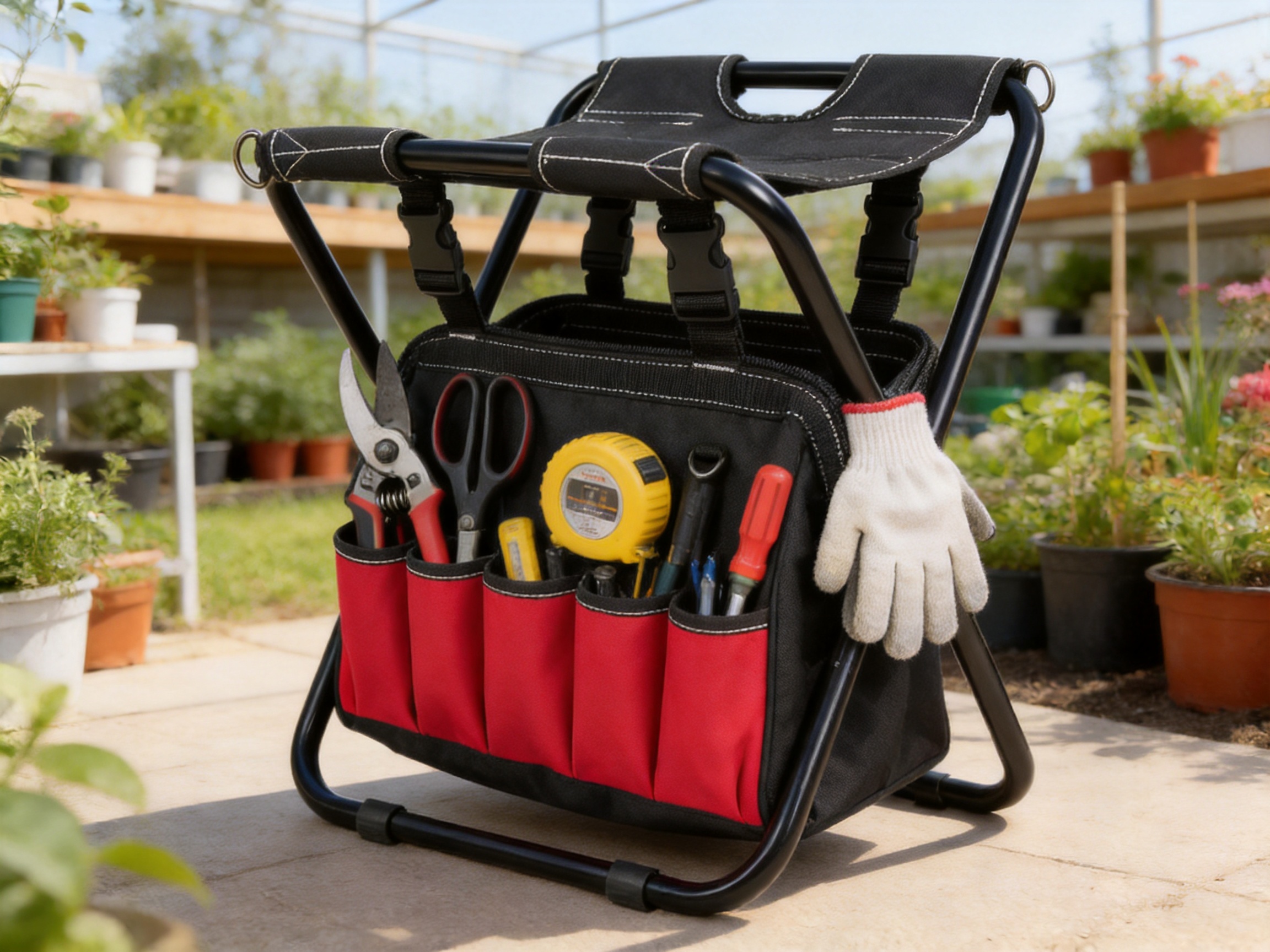
Gardeners frequently carry tools such as hand trowels, pruning shears, cultivators, gloves, plant ties, small saws, measuring tools, and soil accessories. These items vary in size and shape, and they can easily become scattered when placed in a single open compartment. The seven-pocket layout allows frequently used tools to remain visible and separated.
The seat function is useful for planting, weeding, trimming low shrubs, checking soil, and maintaining flower beds. Instead of repeatedly kneeling on wet or uneven ground, a gardener can use the frame as a raised support. The folding structure also allows the product to be stored in a garden shed or transported in a car after the work is complete.
Benefits for Farmers and Outdoor Maintenance Workers
Farm and property maintenance work often takes place far from a permanent workshop. Workers may need to carry equipment across fields, around greenhouses, beside irrigation systems, or between multiple buildings. A portable storage solution with a usable load capacity can reduce trips back to a central toolbox.
The polyester bag is suitable for carrying a range of routine maintenance items, while the zipper closure helps keep the main compartment secure during movement. The detachable bag can be removed from the frame for cleaning or separate transportation when soil, leaves, or other outdoor debris accumulate.
Benefits for Woodworkers and Repair Users
Fine woodworking and household repair tasks often involve frequent tool changes. A user may need a tape measure, pencils, screwdrivers, pliers, a small saw, clamps, fasteners, sanding accessories, and protective equipment within easy reach. The seven-pocket arrangement can support a practical division between large tools, small accessories, and frequently used items.
The seat can be used during detail work, inspection, assembly, or finishing. For mobile woodworking services, the product offers a way to bring essential tools to a customer location without transporting a full-size toolbox. It is not intended to replace heavy-duty tool chests for large workshops, but it can serve as a flexible secondary organizer or jobsite companion.
Seven-Pocket Storage for Better Organization
Tool organization is one of the most important factors in workplace efficiency. When equipment is placed together in one deep compartment, users may spend unnecessary time searching for small items. Tools may also become damaged when sharp edges, metal components, and delicate accessories are allowed to move freely against one another.
The seven-pocket system provides a straightforward way to separate tools by size, function, and frequency of use. For example, long-handled hand tools can be positioned in larger sections, while shears, screwdrivers, measuring devices, gloves, and small accessories can be assigned to individual pockets. This arrangement makes the bag easier to inspect before and after work.
Organized storage also improves inventory control. A worker can quickly identify whether essential tools are present before leaving a workshop or moving to another work area. At the end of a job, missing items are easier to detect. For professional teams, this can help reduce tool loss and improve consistency between workers.
The seven-pocket format is also suitable for customized product programs. Depending on the requirements of a buyer, pocket sizes, placement, color combinations, logo applications, and internal organization may be considered during product development. This flexibility is valuable for brands that need a tool bag adapted to a particular trade or customer segment.
Easy Access in Active Work Environments
Outdoor work is often performed in changing conditions. Users may wear gloves, work on uneven ground, or move frequently between plants, equipment, and structures. A well-organized bag reduces the need to place tools on the ground, where they may become dirty, wet, or difficult to find.
The external pockets help keep selected tools close to hand, while the main storage area can hold larger or less frequently used items. This supports a natural workflow: high-use tools remain immediately accessible, and supplementary equipment stays protected inside the bag.
The zipper closure adds another layer of control. When the bag is being carried or stored, the zipper helps keep the contents inside the main compartment. It also contributes to a cleaner appearance for retail presentation and private-label packaging.
Materials and Structural Engineering
The product uses a reinforced steel frame combined with high-density polyester fabric. Each material contributes a different performance characteristic. Steel provides structural support, while polyester provides flexible storage capacity, manageable weight, and a surface that is suitable for repeated handling.
The reinforced frame is central to the seating function. A frame intended to support a user must be designed with attention to stability, connection points, folding movement, and load distribution. The design described for this product focuses on maintaining stable support while allowing the structure to fold for storage and movement.
Steel is commonly selected for support frames because of its strength and ability to maintain shape under regular use. The frame gives the bag a defined structure and helps it remain upright when placed on a work surface. This is a practical advantage over unsupported fabric totes that may tip or collapse when partially filled.
High-density polyester is used for the external bag because it offers a useful combination of flexibility and durability. It can accommodate different tool shapes without requiring the rigidity of a hard case. Polyester also supports a wide range of color and branding options, which is important for customized products.
The zipper system connects convenience with functional flexibility. It allows the bag to be assembled and disassembled from the frame relatively quickly. A detachable construction can simplify product cleaning, replacement, inspection, and packing. It also gives users more than one way to use the product: as a complete mobile workstation or as a separate storage tote.
Designed for Folding and Storage
Many professional users have limited storage space. Gardeners may store equipment in a shed, landscapers may carry products in a van, and maintenance teams may keep several tools in a shared facility. A folding frame helps reduce the product’s occupied volume when it is not being used.
Foldability also benefits distributors and retailers. Products that can be packed more efficiently may be easier to handle in warehouses and more practical for shipping. Retail customers may appreciate a product that can be placed in a vehicle trunk, apartment storage area, workshop cabinet, or garden shed without taking up the full operating footprint.
The folding feature should be used according to the product’s operating instructions. Users should ensure that the frame is fully opened and stable before sitting or loading the bag. Like any product with a weight rating, safe performance depends on correct assembly, balanced loading, and use on a suitable surface.
Advantages Compared with Conventional Tool Bags
Conventional tool bags remain useful for many applications, but they typically focus on one primary purpose: carrying tools. The foldable tool bag with seat provides several additional functions that can make it more competitive in specific markets.
| Feature | Basic Tool Tote | Traditional Folding Stool | Foldable Tool Bag with Seat |
| Tool Storage | Yes | No | Yes |
| Seating Function | No | Yes | Yes |
| Organized Pockets | Varies | No | Seven pockets |
| Detachable Storage Section | Usually no | No | Yes |
| Foldable Structure | Usually no | Yes | Yes |
| Outdoor Maintenance Use | Good | Limited | Strong |
| Multi-Function Value | Moderate | Low | High |
Compared with a basic tool tote, the product adds a reinforced support frame and seating function. Compared with a separate folding stool, it provides meaningful storage capacity and tool organization. Compared with carrying both products separately, it offers a more integrated solution that can reduce equipment duplication.
The detachable bag is another distinguishing feature. Some competing products permanently combine the storage compartment and support frame, making cleaning or replacement more difficult. A detachable design can provide greater flexibility for users who need to remove the bag after outdoor work or transport the bag and frame separately.
The seven-pocket system also creates a stronger value proposition than a single-compartment tote. Although pocket numbers alone do not determine product quality, dedicated storage areas can make the product more useful for professional users who depend on quick access and consistent organization.
Why the Product Is Suitable for Custom Programs
Wholesale buyers and professional brands often require more than a standard catalog product. They may need specific colors, packaging, labeling, pocket configurations, logo placement, or material adjustments. The product is well suited to customization because its design includes multiple visible and functional elements that can be adapted for different markets.
Color customization allows a buyer to align the product with an existing brand identity or a specific retail category. A gardening supplier may prefer earth tones or green shades, while a professional maintenance brand may choose a high-visibility color combination. Customized colors can also help distinguish product ranges by application.
Branding may be applied to appropriate fabric areas through methods selected according to the material, artwork, order quantity, and performance requirements. Buyers should define logo size, location, color, packaging, labeling, and inspection standards during the development stage.
Pocket configuration is another potential area for product adaptation. A buyer serving electricians may prioritize slim tool pockets, while a gardening distributor may require larger spaces for pruning tools and hand cultivators. A general-purpose version can serve a wide audience, while customized versions can target specialized professional segments.
Customization is most effective when it begins with a clear product brief. Important details include intended use, expected load, target market, preferred colors, packaging dimensions, logo requirements, compliance expectations, and estimated order volume. Early communication reduces the risk of changes late in the production process.
Manufacturing Expertise and Production Capabilities
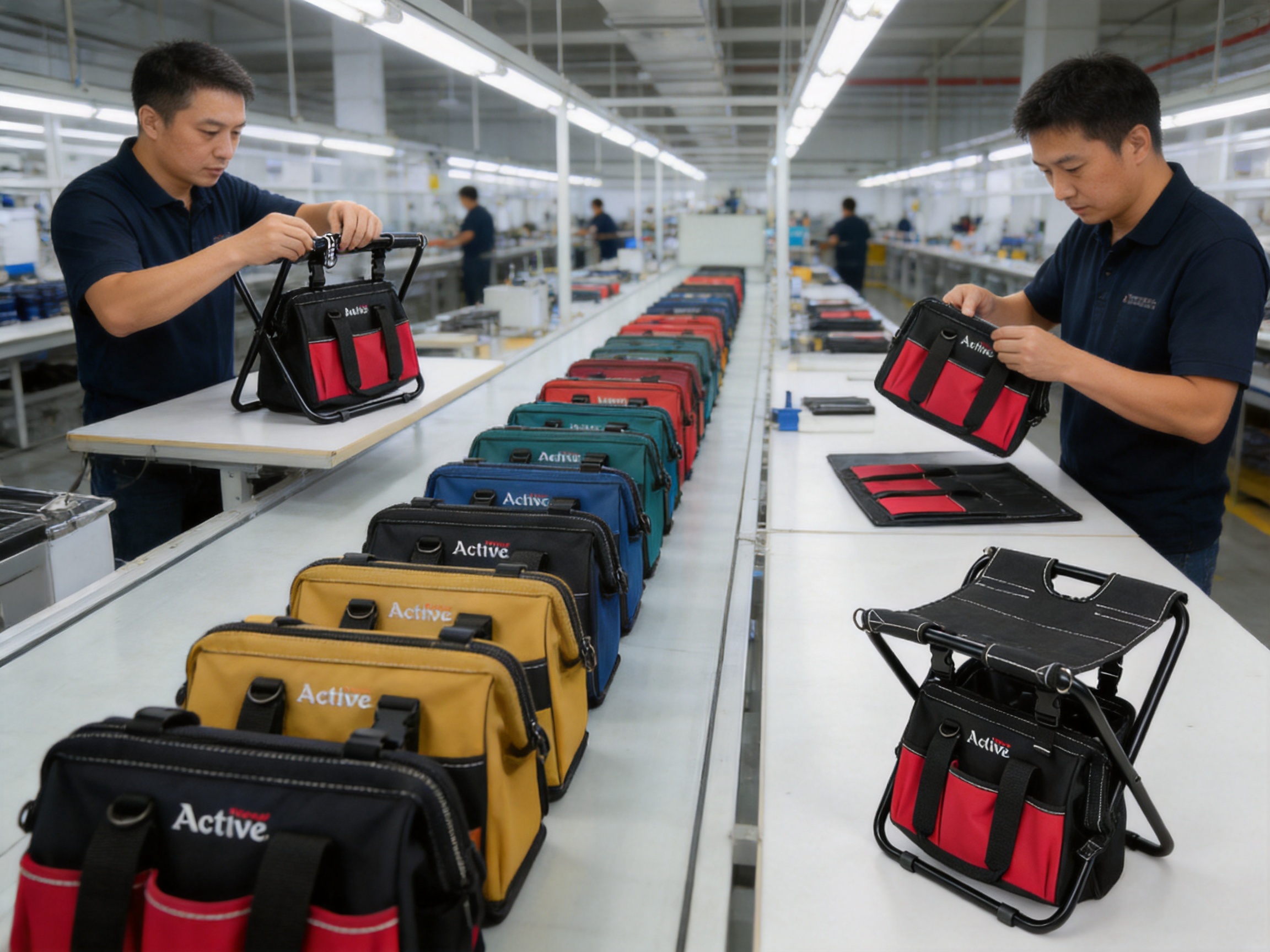
Zhangjiagang Seaark Tools Industrial Co., Ltd. was founded in 2004 and specializes in professional tool bags and customization solutions. Its experience covers a wide range of products, including trolley tool bags, tool backpacks, zippered tool bags, tool bags with tubular handles, waist tool bags, tool pouches, tool vests, tool bucket bags, garden bags, folding-seat tool bags, and other multifunctional storage products.
The company’s long-term focus on tool bag manufacturing supports a product development process based on practical usage rather than appearance alone. Tool bags must balance storage capacity, portability, durability, sewing quality, hardware performance, closure function, and user comfort. Experience across several product categories can help manufacturers understand how these elements interact.
In 2012, the company established Zhangjiagang Haiyi Tool Bags Co., Ltd. as a core manufacturing base in China. It also operates a production facility in Cambodia. A multi-location production structure can provide greater flexibility for global supply planning and may help customers manage sourcing requirements and the impact of additional tariffs in certain markets.
The company operates multiple production bases, employs more than 200 people, and manages approximately 11,000 square meters of floor space. These resources support the cutting, sewing, assembly, inspection, packing, and development activities required for professional tool bag production.
Research and Development
An independent research and development team supports the creation of more than 10 new designs each year. This ongoing design activity is important in a market where users increasingly expect products to provide better organization, improved portability, and more specialized functions.
Product development for a foldable tool bag with seat involves more than creating a fabric container. Designers must consider the relationship between the steel frame and textile bag, the zipper attachment, pocket positioning, folding action, load distribution, appearance, and intended working environment. A dedicated development team can evaluate these areas as part of a structured process.
The company’s registered Active Storage brand and multiple design patents indicate an emphasis on product design and intellectual property. For private-label customers, the same development capabilities can support the creation of customized products that reflect a buyer’s requirements while maintaining manufacturability.
Quality and Social Compliance
Professional buyers increasingly evaluate suppliers according to both product quality and production responsibility. The company’s facilities undergo annual third-party audits, including BSCI, SEDEX, FCCA, and SCS audits. Such audits are used to review aspects of factory operations, social responsibility, and standardized production practices.
Audit systems do not replace product inspection, but they provide buyers with additional information about supplier management and operational standards. For international customers, third-party assessments can support vendor qualification and procurement review processes.
Quality control for this product should include checks of fabric construction, stitching, pocket attachment, zipper operation, frame alignment, folding action, connection strength, dimensions, load-related performance, appearance, and packaging. A clear inspection standard helps ensure that customized production remains consistent across batches.
Production Process for a Professional Tool Bag with Folding Seat
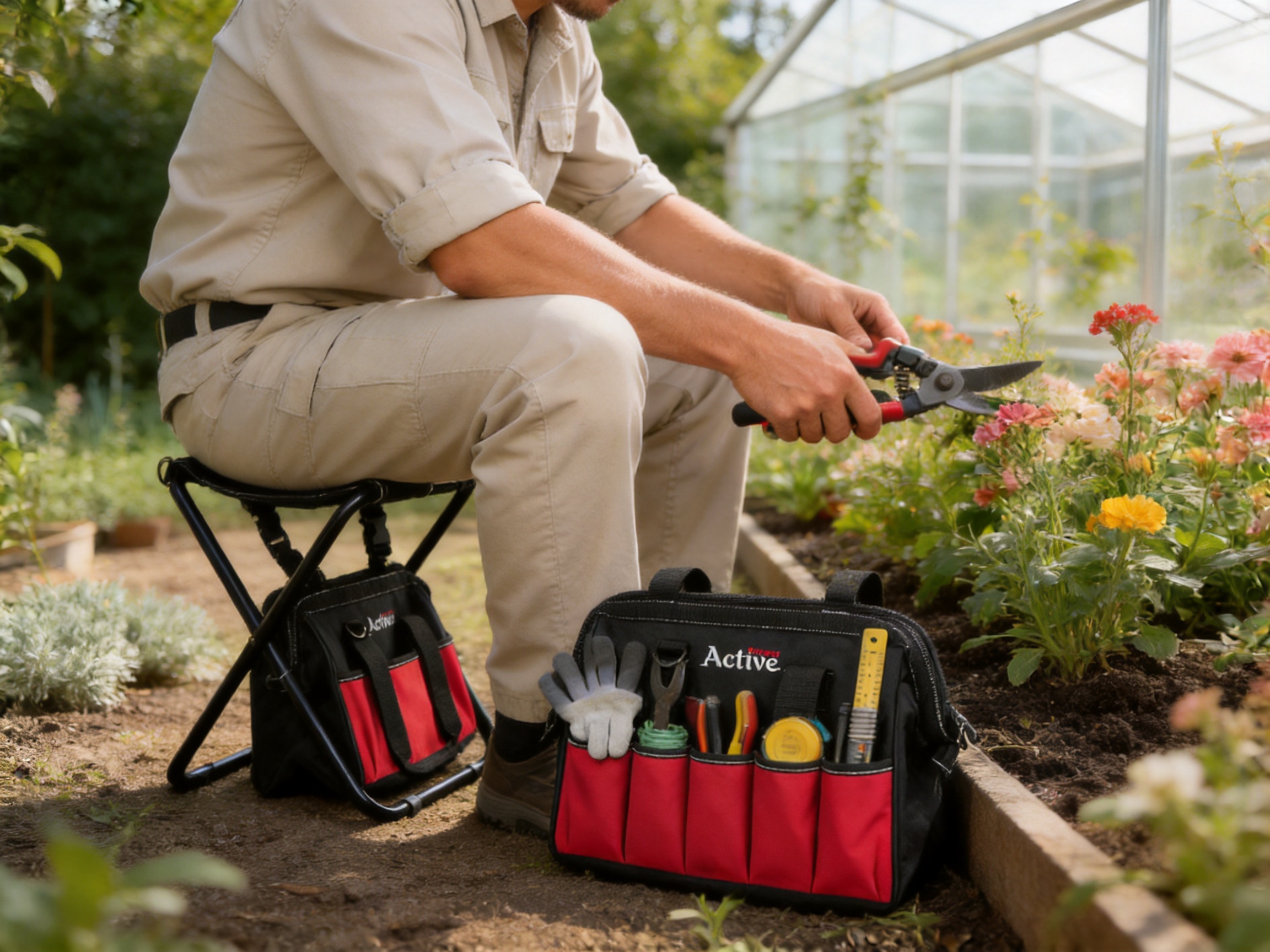
The manufacturing process begins with product specifications and material planning. The manufacturer must confirm the bag dimensions, pocket layout, frame configuration, fabric type, zipper requirements, color standards, logo details, packaging instructions, and target load capacity. These details become the basis for sampling and production preparation.
Material Selection and Inspection
Polyester fabric is selected according to the required density, appearance, color, and intended application. Incoming materials should be checked for color consistency, weaving or coating defects, surface damage, and compliance with the approved sample. Zippers, thread, labels, webbing, hardware, and frame materials should also be inspected before cutting and assembly.
Material inspection is important because a tool bag contains multiple components that must work together. A strong fabric can still produce an unsatisfactory product if the thread, zipper, pocket binding, or frame connection is not suitable. A systematic inspection process reduces the chance that inconsistent materials will enter the production line.
Pattern Making and Cutting
Patterns define the shape and dimensions of the bag body, pocket sections, reinforcement panels, zipper areas, and attachment points. Accurate patterns help maintain consistency between samples and mass-production units. Cutting equipment and procedures should be managed to ensure that panels are aligned and that fabric grain, color direction, and printed or branded areas are properly considered.
For a seven-pocket design, cutting accuracy is particularly important because multiple panels must be positioned correctly on the exterior of the bag. Uneven pocket placement can affect appearance and may also influence tool accessibility and load distribution.
Sewing and Reinforcement
After cutting, panels are assembled through industrial sewing operations. High-stress areas, including handles, pocket openings, frame attachment points, and zipper ends, require appropriate reinforcement. Stitch density, seam allowance, thread selection, and edge finishing all influence the bag’s ability to withstand regular handling.
The sewing process must also maintain the intended shape of the bag. If panels are sewn with inconsistent tension, the bag may twist, pockets may not open correctly, or the zipper may become difficult to operate. Skilled sewing operators and process inspection help control these risks.
The seven pockets should be attached according to the approved layout. Their openings must remain accessible, and their dimensions should be verified against the product specification. Reinforcement may be added where users are expected to place heavier or sharper tools.
Frame Fabrication and Assembly
The reinforced steel frame is prepared separately from the textile bag. Frame production may include cutting, bending, joining, surface treatment, and inspection. The frame must be checked for alignment, smooth movement, stable contact points, and compatibility with the detachable bag.
Assembly connects the textile component to the steel structure through the zipper system and other designed attachment points. The connection should be secure during normal use while remaining practical for removal. The assembly team must verify that the zipper opens and closes smoothly and that the bag sits correctly on the frame when installed.
Functional Testing and Final Inspection
Finished units should undergo functional checks before packing. These checks can include opening and closing the zipper, removing and reinstalling the bag, folding and unfolding the frame, checking the stability of the assembled product, confirming pocket attachment, and reviewing visible workmanship.
Load-related tests should be carried out according to the manufacturer’s internal procedures and the product’s stated rating. Testing should consider how weight is distributed within the bag and how the frame responds when the product is used as a seat or support. Any safety guidance provided to customers should be clear and consistent with the approved design.
Final inspection also includes measurements, color comparison, label placement, packaging quality, and order quantity verification. For customized orders, a retained reference sample or approved production sample can help the factory and buyer compare results across production batches.
Practical Use and Maintenance Guidance
Users should distribute tools evenly rather than placing all heavy items on one side of the bag. Balanced loading helps the frame remain stable and makes the product easier to carry. Sharp tools should be positioned carefully so that blades and points do not damage the fabric or create a handling hazard.
The frame should be completely unfolded and placed on a stable, reasonably level surface before it is used as a seat. Users should respect the stated load capacity and avoid using the product for loads or activities outside its intended purpose. The product is designed as a mobile tool storage and support solution, not as a ladder, climbing aid, or vehicle seat.
After outdoor use, leaves, soil, moisture, and other debris should be removed from the bag. The detachable construction makes this maintenance easier. The polyester bag should be cleaned according to the care instructions supplied by the manufacturer and allowed to dry thoroughly before long-term storage.
The zipper should be kept free from dirt and excessive strain. Forcing a zipper around an overloaded compartment can reduce its service life. Users should close the frame before storing the product and keep it in a dry location away from sharp objects, excessive heat, and prolonged exposure to damaging conditions.
Commercial Value for Distributors and Retailers
For distributors, the product can occupy several related market categories at once. It can be presented as a gardening accessory, a professional tool organizer, a mobile maintenance station, a portable seat, or a multifunctional storage bag. This broad positioning can support different sales channels, including hardware stores, garden centers, online retailers, agricultural suppliers, and professional equipment distributors.
The product also offers a clear explanation for retail customers. Its value can be communicated through three simple functions: carry tools, organize tools, and provide a folding seat. Products with an easy-to-understand benefit are often easier for sales teams and online listings to present.
Its compact folding format can support efficient merchandising. Retailers can display the product in a folded or assembled position, while packaging can explain the detachable bag, pocket system, load capacity, and intended applications. Customized colors and branding can strengthen recognition within a product range.
For professional buyers, the product can complement larger tool storage systems. A workshop may use tool chests for heavy equipment and the foldable tool bag for mobile tasks. A landscaping company may equip each worker with one unit for daily hand tools. A home improvement retailer may offer the product as an accessory for customers who need a portable organization solution.
How It Supports Different Workflows
A product’s usefulness depends on how well it fits the user’s workflow. The foldable tool bag with seat supports a preparation, transport, work, and storage cycle.
During preparation, the user places tools into the seven pockets and main storage area. Frequently used items can be positioned where they are easiest to reach, while spare equipment can remain in the central compartment. The user can then confirm that essential tools are present before leaving the workshop.
During transport, the frame provides structure and the zipper helps secure the bag. The product can be carried to a garden, greenhouse, farm area, customer site, or workshop location. Its folding construction is useful when the product must be loaded into a vehicle or stored between jobs.
During work, the user can keep tools close at hand and use the frame for seating or support. The organized layout helps reduce movement and interruptions. Instead of placing tools on the ground, the user can return them to dedicated pockets after each task.
After work, the bag can be checked for missing tools, detached for cleaning if needed, and folded for storage. This workflow makes the product suitable for both individual users and organizations responsible for managing several workers and tool sets.
Q&A: Foldable Tool Bag with Seat
What is the main purpose of this product?
The product is designed to combine portable tool storage with a folding seat or support function. It is intended for gardening, farming, outdoor maintenance, woodworking, household repair, and similar tasks where users need organized tools and occasional seating in the same work area.
How many pockets does the tool bag have?
The product has seven pockets. These pockets help users separate tools according to size, function, and frequency of use. The layout can also serve as a basis for customized pocket arrangements in private-label or specialized product programs.
What is the product made from?
The storage bag is made from polyester, while the supporting structure uses a reinforced steel frame. Polyester provides flexible storage and customization potential, and the steel frame provides structural support for the folding workstation design.
Can the bag be removed from the frame?
Yes. The bag uses a zipper system that allows it to be detached from the frame. This supports easier cleaning, transport, replacement, and separate use of the storage component.
What is the load capacity?
The stated load capacity is 33.07 pounds. Users should distribute tools evenly and follow the manufacturer’s instructions regarding loading, seating, folding, and general safe use.
What are the product dimensions?
The listed dimensions are 42 × 29 × 31 centimeters. The product’s folding structure allows it to occupy less space when it is being transported or stored.
Is this product only for gardening?
No. Gardening is one of its primary applications, but the product can also be used for farming maintenance, household repair, fine woodworking, property maintenance, and other mobile tasks requiring organized hand tools.
How is this different from a regular tool tote?
A regular tool tote generally provides storage and carrying functions. This product adds a reinforced folding seat frame, detachable construction, and a mobile workstation format. These features can provide greater versatility for users who work outdoors or need occasional seating.
How is this different from a folding stool?
A folding stool provides seating but normally does not offer organized tool storage. This product combines both functions, allowing users to carry and access tools while using the frame as a seat or support.
Can the color be customized?
Yes. The product information lists color as customizable. Buyers should confirm color standards, minimum order requirements, logo placement, packaging, and sampling procedures with the manufacturer before production.
Can the pocket layout be customized?
Customization may be considered according to project requirements. Buyers should provide details about the intended tools, preferred pocket sizes, placement, material, branding, and target load so that the manufacturer can evaluate the design.
Who manufactures this product?
The product is manufactured by Zhangjiagang Seaark Tools Industrial Co., Ltd., a Chinese supplier specializing in professional tool bags and customization solutions. The company has manufacturing operations in China and Cambodia and supports a range of tool storage categories.
Does the manufacturer support private-label projects?
The company provides standard products and tailor-made solutions for global brands and partners. Private-label buyers should discuss artwork, materials, colors, dimensions, packaging, inspection standards, and order quantities during the quotation and sampling process.
What quality information is available about the manufacturer?
The company has more than 20 years of tool bag manufacturing experience, operates multiple production bases, and maintains an independent research and development team. Its facilities undergo annual third-party audits, including BSCI, SEDEX, FCCA, and SCS audits.
How should the product be stored?
The product should be cleaned and dried after use, folded according to its operating instructions, and stored in a dry area away from excessive heat, sharp objects, and prolonged damaging exposure. The zipper and frame should be checked periodically for dirt, damage, or abnormal operation.
Why Choose an Experienced Tool Bag Manufacturer?
The performance of a multifunctional tool bag depends on coordinated decisions across fabric, sewing, hardware, frame construction, assembly, and testing. An experienced manufacturer can evaluate these details as part of an integrated production system rather than treating each component separately.
For example, increasing the bag’s capacity may affect the frame balance, zipper length, pocket placement, and load distribution. Changing fabric thickness may influence sewing methods and product weight. Adding a logo may require changes to panel selection or production sequencing. A supplier with experience across multiple tool bag categories is better positioned to identify these interactions during development.
Seaark’s product range includes trolley tool bags, tool backpacks, zippered tool bags, tool bags with tubular handles, waist tool bags, tool pouches, tool vests, tool bucket bags, folding-seat tool bags, garden bags, and multifunctional bags. This broad category experience provides a foundation for understanding the needs of professional users and global distribution partners.
The company’s production history, R&D activity, multiple manufacturing bases, and audit programs also support a more structured sourcing relationship. Buyers can work with the manufacturer on standard products, customized versions, or new product concepts based on a defined specification.
Conclusion
The Foldable Tool Bag with Seat Detachable Storage Tote Bag is a practical response to the needs of mobile outdoor work. Its reinforced steel frame provides folding support, its polyester bag offers flexible storage, its zipper system enables detachment, and its seven pockets help users organize tools according to their working habits.
The product’s greatest advantage is its two-in-one function. It combines a portable tool organizer with a folding seat, reducing the need to carry separate equipment. This can improve convenience for gardeners, farmers, landscapers, maintenance workers, woodworkers, and household repair users who move between work areas and need tools close at hand.
Its 42 × 29 × 31 centimeter dimensions, 33.07-pound load capacity, customizable color options, and detachable storage design make it suitable for both general retail and customized professional programs. Compared with a basic tool tote or standalone stool, it offers a broader range of functions in one coordinated product.
The manufacturing capabilities behind the product are equally important. Zhangjiagang Seaark Tools Industrial Co., Ltd. brings more than two decades of tool bag experience, multiple production bases, an independent R&D team, a broad product portfolio, and annual third-party facility audits. These strengths support product development, private-label customization, and international supply requirements.
For buyers seeking a rugged tool bag, mobile tool luggage solution, garden organizer, or professional electrician and maintenance bag concept, this product provides a strong platform for customization. Its blend of storage, seating, portability, and manufacturing flexibility makes it a competitive option for modern outdoor and mobile work.
References
1. Product specification sheet for Foldable Tool Bag with Seat Detachable Storage Tote Bag, including dimensions, material, pocket quantity, closure type, and load capacity.
2. Manufacturer-provided company information for Zhangjiagang Seaark Tools Industrial Co., Ltd., including company history, production bases, workforce, facility size, and product categories.
3. Manufacturer-provided information regarding research and development activities, design patents, registered brand ownership, and new product development.
4. Manufacturer-provided information regarding annual third-party audits, including BSCI, SEDEX, FCCA, and SCS assessment programs.
5. General principles of textile tool bag manufacturing, including material inspection, pattern cutting, industrial sewing, reinforcement, frame assembly, functional testing, and final inspection.
Product: Foldable Tool Bag with Seat Detachable Storage Tote Bag




We are a professional enterprise engaged in exporting various types of toolkits.
We firmly believe that 'quality is everything, service enhances value'.
-
+86-15298800699

-
+86-512-58670375

-
karen@kun-bag.com

-
Building 11, No. 93 Chengang Road, Zhangjiagang City, Jiangsu Province, China

Copyright © Zhangjiagang Seaark Tools Industrial Co., Ltd. All Rights Reserved.
Custom Electrician Tool Backpack Manufacturers